
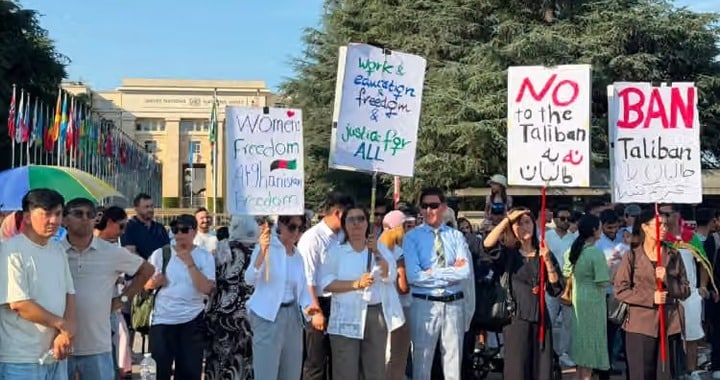
Afghans in 28 cities across Europe, North America and Asia held demonstrations and other public events marking five years since the Taliban returned to power, with many protesters urging the international community not to normalize relations with the group and calling for the recognition of gender apartheid in Afghanistan.
Rallies and other events were reported in Bonn, Geneva, Amsterdam, Munich, Stuttgart, Hamburg, Islamabad, Berlin, Kiel, Frankfurt, Helsinki, Zurich, Oslo, Cologne, Vienna, The Hague, Stockholm, Madrid, Barcelona, Bilbao, Toronto, New Westminster, Reston, Düsseldorf, Tehran, Paris, London and Washington.
In several cities, protesters marched through the streets and chanted slogans opposing Taliban rule. Elsewhere, organizers held prayer gatherings, protest camps, cultural programmes and hunger strikes.
The rights and freedoms of Afghan women and girls were at the center of many of the events. Protesters also urged governments to reject efforts to legitimize the Taliban and called for greater international attention to human rights violations in Afghanistan.
Bonn
In Bonn, Germany, the Campaign Against Gender Apartheid in Afghanistan organized a rally outside the United Nations office. At the conclusion of the demonstration, participants issued a resolution calling on the UN and the international community to recognize and criminalize gender apartheid in Afghanistan.
The resolution also urged governments to halt efforts that could legitimize the Taliban and ensure that women, victims of abuses, protesters, civil society representatives and democratic forces in Afghanistan have a meaningful voice in international decision-making.
Geneva
A gathering in Geneva was held outside the United Nations office in support of Afghan women and girls.
Organizers said the event was intended to keep the voices of Afghan women at the center of international attention, highlight the human rights situation in Afghanistan, and reaffirm the principles of freedom, equality, dignity and fundamental rights.
Berlin
In Berlin, demonstrations and related activities continued for several days. Organizers established a protest tent and held a voluntary hunger strike before concluding the programme with a rally near the Brandenburg Gate on August 15.
The organizers said their campaign sought to defend human dignity, freedom, equality and human rights in Afghanistan.
Munich
Afghan activists, academics, human rights advocates, political figures, artists and members of the community gathered at Bellevue de Monaco in Munich.
Women joining remotely from Afghanistan and Pakistan spoke about restrictions on their lives, their concerns and their experiences under Taliban rule.
The discussions covered human rights, the situation of women and girls, education, the economy, migration, refugees, and Germany and the European Union’s policies toward Afghanistan.
A final statement from the gathering stressed that education, employment, liberty and human dignity are fundamental rights. It also called for any political engagement with the Taliban to take account of the human rights situation and not contribute to the normalization of abuses.
Kiel
In Kiel, Germany, protesters held a demonstration under the title “The Voice of the Unseen,” followed by a cultural programme.
The Schleswig-Holstein Refugee Council also called for an end to the deportation of Afghan refugees to Afghanistan and urged greater support for Afghans facing risks.
Amsterdam
Several Afghan groups organized a demonstration in Amsterdam. Protesters called on the Netherlands and the European Union to reject the normalization and legitimization of Taliban rule and to place the rights of Afghan women at the center of their policies.
The gathering took place at Dam Square, where participants protested the restrictions imposed on women and girls.
Madrid, Barcelona and Bilbao
In Spain, events were held in Madrid, Barcelona and Bilbao as part of a coordinated international campaign.
In Madrid, Afghan women, refugees and feminist groups gathered in the Puerta del Sol area and called for stronger international action to protect the rights of Afghan women.
The demonstrations carried messages opposing gender apartheid and the legitimization of Taliban rule.
Toronto
In Toronto, protesters gathered at Queen’s Park and highlighted women’s right to education and employment. Participants also called on Canada not to recognize the Taliban.
A resolution adopted by Afghan community members called for an end to gender apartheid, opposition to normalizing relations with the Taliban, protection of women’s and girls’ rights, freedom of expression and the media, protection for refugees, and an independent investigation into alleged human rights violations.
Islamabad
In Islamabad, Afghan women’s protest movements, human rights organizations and other groups held a joint event.
Participants chanted slogans against Taliban policies and emphasized women’s rights to education, work and freedom. They said their civic campaign for freedom, justice and equality would continue.
Hamburg
Afghan community members and civil society activists demonstrated in Hamburg, condemning Taliban rule and what they described as widespread restrictions on the rights and freedoms of Afghans.
Participants also criticized German policies toward the Taliban and the deportation of Afghan refugees, while calling for stronger support for women’s rights, civil liberties and vulnerable Afghans.
A separate conference at Hamburg City Hall examined Afghanistan’s political, social and humanitarian situation five years after the Taliban takeover, as well as Germany’s policy toward Afghanistan, refugee deportations and the question of how governments should engage with the Taliban.
Frankfurt
In Frankfurt, Afghan citizens and activists marked August 15 as a dark day in Afghanistan’s history.
Demonstrators chanted slogans including opposition to the Taliban and calls for education, work and freedom. Speakers urged the international community to defend the fundamental rights of Afghans, particularly the rights of women and girls to education and employment, as well as civil liberties and human rights.
Participants also called on governments and international institutions to reject recognition of the Taliban unless the rights of the Afghan people are respected.
Oslo
Several events were held in Oslo. In one demonstration, protesters marched from the Afghan embassy toward the Norwegian parliament, expressing support for Afghan women’s struggle for rights and freedom.
Another event, titled “From Seeking Justice to Accountability,” focused on justice, accountability, cooperation among human rights defenders and the future of justice in Afghanistan.
New Westminster
In New Westminster, Canada, an event titled “Fresh Wound: From Remembrance to Action” brought together speakers and participants for expert presentations, panel discussions, protest music and theatre.
The programme examined human rights, gender apartheid, cultural destruction and the future of civic activism in Afghanistan.
Cologne
A gathering titled “Five Years of Taliban Rule” was held at Heumarkt Square in Cologne, Germany.
The organizers expressed solidarity with Afghan women and girls and protested the human rights situation in Afghanistan after five years of Taliban rule.
Reston
In Reston, Virginia, a programme titled “Afghanistan, Five Years After the Fall” was held on August 15 at the North County Government Center.
The event focused on remembering victims, amplifying the voices of Afghan women and refugees, addressing separated families and discussing Afghanistan’s future.
Additional programmes marking the fifth anniversary were also held in Stuttgart, Helsinki, Zurich, Vienna, The Hague, Stockholm and Düsseldorf.
August 15: “Victory Day” or a “Black Day”?
The Taliban returned to Kabul on August 15, 2021, as US and NATO forces completed their withdrawal from Afghanistan and the Afghan republican government collapsed. Then-President Ashraf Ghani left the country that day, while Taliban forces entered the capital and took control.
The Taliban have since marked August 15 as a day of victory, describing it as the end of what they call the foreign occupation of Afghanistan. The group commemorates the date annually through official ceremonies and public statements.
For many Taliban opponents, civil society activists, human rights defenders and Afghan citizens, however, August 15 represents a “black day”—the beginning of a period marked by severe restrictions on political and civil freedoms.
Five years after the takeover, the Taliban’s government remains internationally isolated, while the group has imposed sweeping restrictions on the lives of Afghans, particularly women and girls. Among the most significant restrictions are those affecting access to education, employment and participation in public and social life.
The worldwide demonstrations on the fifth anniversary reflected a continuing divide over Afghanistan’s future: while the Taliban presents its return to power as a historic victory, its opponents are demanding that the international community prioritize human rights and refuse to normalize the group’s rule without meaningful change.



