
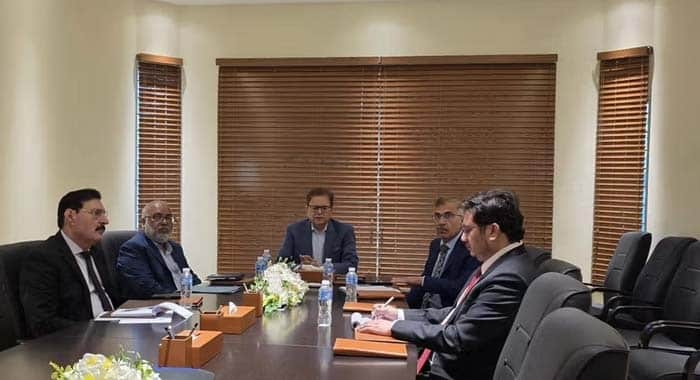
Pakistan’s Special Envoy for Afghanistan, Mohammad Sadiq Khan, has stated that he chaired a meeting of the Afghanistan–Central Asia Intergovernmental Coordination Cell (ACICC), bringing together regional stakeholders to discuss trade, transit, and connectivity across Central and South Asia. However, no representative from the Taliban administration was present at the session, according to official remarks.
The ACICC is a regional cooperation framework designed to enhance collaboration between Afghanistan and Central Asian states, with a focus on strengthening trade linkages, improving transit systems, advancing infrastructure development, and reducing barriers to regional economic integration.
In a statement posted on social media platform X on Tuesday, May 5, Khan said that participants discussed shared regional priorities, coordination mechanisms, and future steps aimed at improving connectivity and economic cooperation among participating countries.
According to the envoy, one of the key points of discussion was the potential expansion of the Quadrilateral Traffic in Transit Agreement (QTTA), which currently includes Pakistan, China, Kazakhstan, and Kyrgyzstan. The proposed inclusion of Tajikistan and Uzbekistan was also reviewed as part of broader efforts to enhance regional trade corridors.
The meeting further addressed improving air connectivity between Pakistan and Tajikistan, alongside proposals to simplify visa procedures for Tajik business communities to facilitate increased trade and commercial engagement.
However, the official statement did not include any reference to Afghanistan’s direct participation or representation in the discussions, despite the framework being titled around Afghanistan–Central Asia coordination.
The meeting takes place against a backdrop of increasingly strained relations between Pakistan and the Taliban authorities in Afghanistan in recent months. Reports of border tensions and occasional cross-border clashes have further complicated diplomatic engagement between the two sides.
Analysts suggest that the absence of a Taliban representative at a forum explicitly referencing Afghanistan may reflect ongoing political and diplomatic friction between Kabul and Islamabad, as well as shifting regional engagement patterns.
Observers note that regional connectivity initiatives continue to evolve independently of direct Afghan participation in some forums, raising questions about the future role of Afghanistan in multilateral economic frameworks.



