
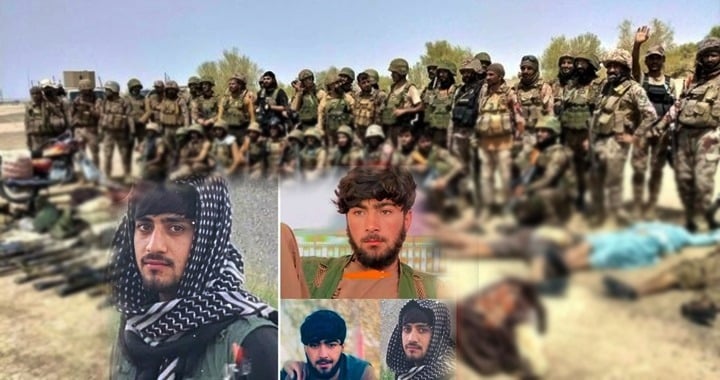
For years, the Afghan Taliban have repeatedly assured Pakistan and the international community that Afghan territory will not be allowed to become a launching pad for attacks against other countries. Yet the latest figures emerging from Pakistan’s counterterrorism operations present a problem that Kabul cannot simply dismiss with another assurance.
According to security sources, 48 Afghan nationals were identified among 200 terrorists eliminated during 800 intelligence-based operations conducted in Khyber Pakhtunkhwa and Balochistan over the past month.
The significance of the figure lies not merely in the number. It lies in what that number represents.
These were not Afghan nationals encountered in some unrelated criminal investigation. They were identified among terrorists targeted during security operations in two Pakistani provinces that have repeatedly borne the brunt of terrorism linked to networks operating from the Afghanistan-Pakistan theatre.
In North and South Waziristan alone, 62 TTP terrorists were eliminated during 223 operations, with 16 identified as Afghan nationals. In Bajaur and Mohmand, 55 terrorists were eliminated in 180 operations, including 13 Afghan nationals. Another 46 terrorists were eliminated during 160 operations in Khyber and Orakzai, with 11 identified as Afghan nationals.
The pattern continued across the border in Balochistan. In Quetta and Pishin, 37 terrorists were eliminated, eight of whom were identified as Afghan nationals.
Taken together, the figures create a question considerably more difficult than the routine diplomatic exchange between Islamabad and Kabul.
The Geography of the Problem
The Taliban’s standard response to Pakistan’s complaints has focused heavily on denial. Kabul has repeatedly said that Afghan soil is not being used against Pakistan and that the Taliban do not permit such activity.
But there is an important distinction between denying that Afghan territory is being used and explaining why Afghan nationals continue to appear among terrorists involved in attacks inside Pakistan.
The distinction matters because the Taliban regime exercises authority across Afghanistan and has repeatedly portrayed itself as having restored security and eliminated rival armed networks.
If Afghan nationals are crossing into Pakistan to participate in terrorism, several possibilities emerge.
They may be operating independently. They may have joined Pakistani terrorist networks while retaining Afghan nationality. They may be receiving logistical or operational assistance from networks based in Afghanistan. Or they may be moving across a border that Kabul claims it has the capacity to control.
Each possibility raises a different question for the Taliban.
The Question of Control
This is ultimately a question of state authority.
A government cannot claim effective control over its territory only when discussing sovereignty, international recognition or diplomatic legitimacy. Control also carries responsibility.
If Afghan citizens are repeatedly participating in terrorist attacks inside Pakistan, Kabul must explain how these individuals are recruited, trained, equipped, transported and facilitated.
And if the answer is that these activities occur without the knowledge or permission of the Taliban administration, another question follows: how much control does Kabul actually exercise over the networks operating from its territory?
That is where the issue moves beyond terrorism and enters the realm of credibility.
Pakistan does not merely need another assurance that Afghan soil will not be used against it. It needs demonstrable action capable of matching that assurance.
From Denial to Accountability
The latest figures therefore deepen an existing credibility gap.
The Taliban can continue to insist that they have no policy of allowing attacks against Pakistan. But policy statements alone cannot settle an issue that is repeatedly producing operational evidence on the ground.
For Pakistan, the central concern is not the nationality of terrorists as an isolated statistic. It is the continuing connection between Afghanistan, cross-border terrorism and terrorist networks targeting Pakistani security forces and civilians.
If Kabul has genuinely prevented its territory from being used against Pakistan, it should be able to demonstrate that through verifiable action.
Otherwise, the question will become increasingly difficult to avoid: are the Taliban unable to control the networks operating from Afghanistan, unwilling to act against them, or simply unwilling to acknowledge the scale of the problem?
The 48 Afghan nationals identified among the 200 terrorists eliminated during the latest operations do not, by themselves, answer that question.
But they make the question harder for Kabul to ignore.



