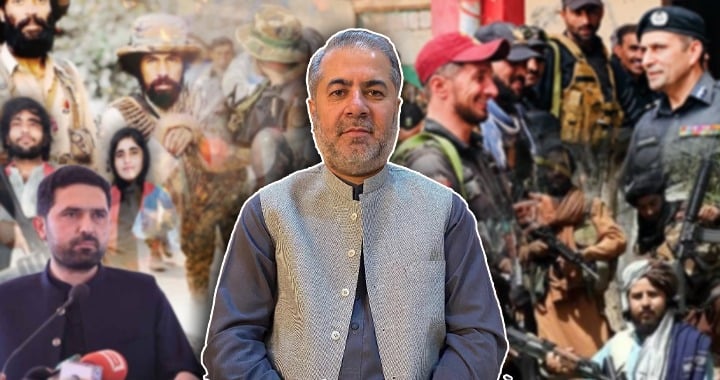
Khyber Pakhtunkhwa is the province that has lived under the shadow of terrorism for more than two decades. Entire generations have grown up watching bomb blasts, targeted killings, suicide attacks, military operations and intelligence-based operations become part of everyday vocabulary. Thousands of civilians, police personnel, soldiers, tribal elders, politicians, journalists and religious scholars have paid the ultimate price. Yet despite such enormous sacrifices, the province today once again finds itself confronting a deteriorating security situation.
The question repeatedly being asked across the province is no longer whether terrorism has returned. It has. The more important question is whether the provincial leadership truly understands the scale of the challenge and is prepared to treat it as its foremost priority.
Conversations with elected representatives, officials and people living in the affected districts reveal growing uncertainty about who is actually driving policy. At a time when coordinated action is required, many appear uncertain about the direction of governance itself. That uncertainty inevitably affects the confidence of those expected to fight on the front lines.
The greatest concern today is not that security forces have stopped fighting. They continue to conduct operations every day across southern districts and other vulnerable regions. Police officers continue to patrol dangerous roads, establish checkpoints, participate in intelligence-based operations and respond to terrorist attacks with remarkable courage. The concern is that those making sacrifices often appear to be fighting without the visible political ownership that such a prolonged conflict requires.
Counterterrorism cannot succeed if it is viewed merely as the responsibility of uniformed institutions. Every successful campaign against terrorism anywhere in the world has combined military capability with political ownership, administrative support, financial commitment and public confidence. Once any of these pillars weakens, terrorist organizations attempt to exploit the resulting gaps.
The Police Cannot Fight Alone
Over the past several years, Khyber Pakhtunkhwa Police have transformed into one of Pakistan’s most experienced counterterrorism forces. Their operational record speaks for itself. Officers have repeatedly confronted heavily armed terrorists under extremely difficult conditions, often becoming the first line of defence before other security formations arrive.
The professionalism displayed by the force deserves recognition. Many officers voluntarily lead operations in some of Pakistan’s most dangerous districts. Their courage is beyond question.
However, courage alone cannot substitute for modern equipment, planning and sustained logistical support.
One recurring concern raised within policing circles is that resources announced on paper do not always translate into capabilities on the ground with the required speed. Budget allocations create headlines, but success in counterterrorism depends upon what eventually reaches the officer deployed at an isolated checkpoint, the investigation unit pursuing terrorist facilitators, or the bomb disposal team attempting to prevent another tragedy.
A police officer confronting heavily armed terrorists requires more than determination. He requires modern weapons, protected mobility, surveillance capability, reliable communications, drones, night-vision equipment, intelligence support and continuous specialized training. Terrorist organizations adapt constantly. State institutions must adapt even faster.
Recent incidents have illustrated these realities. Officers deployed against terrorists armed with sophisticated weapons often find themselves operating under conditions that expose serious capability gaps. The bravery of individual officers frequently compensates for those shortcomings, but bravery should never become a substitute for preparedness.
Ownership Matters More Than Statements
The most dangerous development is not merely the resurgence of terrorism. It is the perception that no one fully owns the war.
When political leadership hesitates to publicly stand with those risking their lives, confusion spreads through the entire administrative structure. Counterterrorism demands unity of purpose. Mixed political messaging, contradictory public statements and attempts to distance political leadership from security operations only encourage those seeking to exploit divisions within the state.
Terrorist organizations carefully observe these divisions. They understand that weakening public confidence is almost as valuable as carrying out a successful attack.
This is why political ownership carries enormous importance. It is not simply about attending briefings or issuing condemnations after attacks. It means consistently supporting the institutions conducting operations, ensuring timely provision of resources, taking responsibility for difficult decisions and sending an unmistakable message that the state speaks with one voice against terrorism.
The challenge has become even greater following the merger of the former tribal districts into Khyber Pakhtunkhwa. Integrating these areas was never going to be achieved merely by changing administrative boundaries. Institutions required investment, infrastructure, training and sustained financial support.
Many former Levies and Khasadar personnel entered the policing system under extremely challenging circumstances. They inherited responsibilities across some of the world’s most complex security environments. Expecting them to confront battle-hardened terrorist organizations without continuous modernization would be unrealistic.
The Cost of Confusion in a Long War
The war against terrorism has now entered its third decade. That reality alone creates challenges which cannot be ignored. Entire communities have lived through repeated cycles of violence, military operations, displacement, rehabilitation and reconstruction. Public fatigue is real. Families have sacrificed loved ones, businesses have suffered, investment has slowed and thousands of young people have grown up knowing little except uncertainty.
Such a prolonged conflict requires something more than operational success. It requires a clear national and provincial narrative that explains where the province stands today, what objectives remain to be achieved, and how success will ultimately be measured.
Unfortunately, confusion has increasingly replaced clarity.
Instead of presenting a unified position, political debates frequently overshadow security priorities. Counterterrorism becomes entangled in partisan disputes, while contradictory statements leave the public uncertain about the seriousness with which the challenge is being treated.
This ambiguity benefits only those seeking to destabilize the province.
Terrorist organizations thrive where political divisions weaken institutional resolve. They carefully exploit disagreements, amplify misinformation through social media and attempt to create the impression that the state’s institutions are operating without political backing. Such perceptions can become as dangerous as physical attacks themselves.
A province confronting terrorism cannot afford uncertainty regarding its priorities.
Frontline Districts Need the Best Leadership
One lesson from previous phases of the conflict deserves renewed attention.
The districts bordering Afghanistan have always demanded exceptional administrative and policing leadership. These are not ordinary postings. They require experienced officers capable of understanding local dynamics, maintaining public confidence, coordinating with multiple security institutions and responding quickly to evolving threats.
Counterterrorism cannot rely solely on numerical strength. Experience, leadership and local knowledge often determine whether intelligence is converted into successful operations.
Equally important is investment in technology.
Today’s terrorist organizations are no longer operating with outdated tactics alone. They adapt rapidly, use encrypted communications, exploit social media, employ increasingly sophisticated explosive devices and benefit from experience accumulated over years of conflict. State institutions must therefore remain technologically ahead rather than merely reacting to emerging threats.
Modern surveillance systems, high-quality drones, secure communications, electronic intelligence capabilities and specialized training are no longer optional. They have become operational necessities.
Every rupee allocated for counterterrorism should ultimately strengthen the capabilities of those deployed in the field. Announcements alone cannot defeat terrorism. Capability does.
The Police Remain the First Line of Defence
Despite all challenges, one fact deserves recognition.
Khyber Pakhtunkhwa Police continue to remain the principal obstacle preventing terrorist organizations from expanding deeper into the country.
This explains why police personnel remain frequent targets.
Unlike military formations operating from secured installations, police officers serve within the communities they protect. Terrorists often know where they live, where their families reside, the routes they travel and the police stations from which they operate. Their exposure makes their responsibilities uniquely dangerous.
Yet they continue performing those duties.
The repeated targeting of police personnel itself demonstrates how seriously terrorist organizations view them as an operational barrier. Their sacrifices deserve not only public appreciation but continuous institutional strengthening.
If those standing on the front lines repeatedly ask for better protective equipment, improved mobility, advanced weapons and stronger logistical support, those requests should never be viewed as complaints. They should be understood as operational requirements identified by professionals confronting the threat firsthand.
The Challenge Extends Beyond Khyber Pakhtunkhwa
No serious assessment of today’s security environment can ignore its regional dimension.
Cross-border movement continues to complicate Pakistan’s counterterrorism efforts. Militants exploit difficult terrain, longstanding smuggling routes and ungoverned spaces to facilitate movement, logistics and operational planning.
Pakistan has consistently maintained that terrorist organizations, particularly Fitna al-Khwarij, continue to benefit from sanctuaries across the border. Islamabad has repeatedly emphasized that lasting regional stability depends upon ensuring that no country’s territory is used to facilitate attacks against another.
Recent developments also point toward increasing operational cooperation between Fitna al-Khwarij and Baloch terrorist organizations.
While their ideological narratives differ, their operational interests increasingly intersect. One possesses long experience in insurgent warfare and cross-border survival. The other has invested considerable effort in propaganda, international messaging and recruitment. Together, these complementary capabilities present a more complex security challenge than either organization poses individually.
The recent increase in terrorist violence in Balochistan cannot be examined in isolation from these broader developments.
Counterterrorism strategies must therefore evolve accordingly.
Politics Cannot Replace Responsibility
Perhaps the greatest mistake would be allowing political calculations to dictate security policy.
Terrorism does not distinguish between political parties, governments or institutions. Its victims include civilians, police officers, soldiers, teachers, traders, religious leaders and children. Every successful attack weakens public confidence and strengthens the perception that the state is struggling to maintain order.
For that reason, counterterrorism must remain above partisan politics.
Political disagreements are inevitable in any democracy, but they should never prevent unified support for those defending the country against violent extremism.
The people of Khyber Pakhtunkhwa deserve clarity, consistency and leadership. They deserve a government visibly committed to standing alongside the institutions confronting terrorism every day. They deserve policies driven by security requirements rather than political considerations.
The province has already sacrificed too much to repeat mistakes that experience has clearly exposed.
Khyber Pakhtunkhwa has repeatedly demonstrated remarkable resilience. Its police officers continue to display extraordinary courage. Security forces continue conducting successful operations. Intelligence-based actions continue disrupting terrorist networks. Local communities continue rejecting extremist violence despite enormous pressure.
These strengths provide reason for confidence.
But confidence alone will not determine the outcome.
Victory against terrorism requires political ownership, sustained investment in frontline institutions, modern capabilities, effective governance and unwavering national unity. Without these elements operating together, operational successes risk becoming temporary gains rather than lasting achievements.
The men standing at checkpoints in Bannu, Waziristan, Lakki Marwat, Dera Ismail Khan, Swat and the merged districts have already demonstrated that they possess the courage required for this fight. The question that remains is whether the political leadership will demonstrate an equal level of commitment.
History suggests that terrorism is defeated not only by those carrying weapons, but by governments willing to provide direction, ownership and unwavering support to those fighting on behalf of the state. For Khyber Pakhtunkhwa, that lesson has never been more relevant than it is today.