
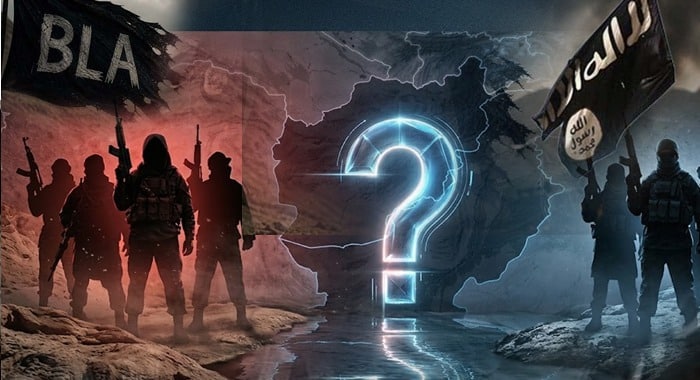
The recent assassination of judges in Balochistan has once again exposed the increasingly complex and dangerous terrorist landscape confronting Pakistan. The attack was not merely an act of violence against individuals; it was a calculated assault on one of the most important foundations of the state the justice system. By targeting members of the judiciary, terrorists attempted to send a message far beyond the immediate tragedy: that those who defend the rule of law can also be threatened, intimidated, and eliminated.
Shortly after the attack, the Islamic State Khorasan Province (ISKP) claimed responsibility. The speed and timing of the claim immediately raised difficult questions. Was ISKP directly involved? Was it attempting to exploit the attack for propaganda purposes? Or does the claim point toward a broader pattern in which different militant actors, despite ideological differences, benefit from each other’s violence?
These questions deserve serious attention because the relationship between ISKP and the Baloch Liberation Army (BLA) represents one of the most challenging dimensions of Pakistan’s current security environment. The two organisations are not identical. They emerged from different ideological backgrounds and pursue different stated objectives. The BLA presents itself as a separatist militant organisation focused on Balochistan, while ISKP follows a transnational extremist ideology. Yet, despite these differences, their actions reveal a disturbing common ground: both rely on terror, intimidation, and attacks against civilians and state institutions to achieve their objectives.
The question, therefore, is not whether BLA and ISKP are formal allies. The more important question is whether they have become partners in bloodshed by contributing to the same destructive outcome, the weakening of state authority, spreading of fear, and undermining of public confidence.
Terrorist organisations do not always require official alliances to serve each other’s interests. In modern conflicts, cooperation can take many forms. Sometimes it involves direct operational coordination; at other times, it appears through propaganda, mutual exploitation of violence, or attempts to confuse security responses. When one organisation carries out an attack and another quickly claims responsibility, the result can create uncertainty, complicate investigations, and manipulate public perception.
This is precisely why ISKP’s rapid claim after the assassination of judges is significant. Responsibility claims are not merely announcements; they are strategic tools. Terrorist groups understand that controlling the narrative after an attack is almost as important as carrying out the attack itself. By claiming responsibility, a militant organisation seeks visibility, fear, and psychological impact.
If ISKP attempted to attach itself to an attack carried out by another actor, it would not be the first time terrorist organisations have used propaganda to expand their influence. Such tactics allow groups to project strength, attract attention, and create the impression of operational reach. Whether the claim represented direct involvement, indirect facilitation, or simply propaganda opportunism, the broader objective remains the same: creating instability and weakening confidence in state institutions.
The attack’s target makes this even more alarming. Judges are not merely government officials; they represent the authority of law. They symbolise a system where disputes are resolved through courts rather than through violence. By targeting judicial officers, terrorists attempt to attack the very idea that justice can exist without fear.
The message behind such attacks is clear: if those responsible for upholding the law can be murdered, then ordinary citizens may begin to believe that violence is more powerful than justice. This is the psychological warfare at the heart of terrorism. The objective is not only physical destruction but also the erosion of public trust.
The BLA’s activities in Balochistan demonstrate a similar pattern of using violence to create fear among communities. The attack on a civilian passenger bus in Mastung, which resulted in the deaths of innocent passengers and injuries to others, reflects the devastating consequences of militant violence against ordinary people. Such attacks reveal a fundamental contradiction in the narratives promoted by terrorist groups: organisations that claim to represent communities cannot justify murdering the very civilians whose interests they claim to defend.
The targeting of civilians is not a political strategy; it is a crime against society itself. When passengers travelling on public roads become victims of militant attacks, the consequences extend beyond the immediate loss of life. Fear spreads through communities, economic activity suffers, and ordinary people begin paying the price for conflicts they did not create.
This is where the actions of BLA and ISKP converge. Although their ideological narratives differ, their methods produce the same result: insecurity, instability, and suffering. Both challenge the authority of the state through violence. Both attempt to replace political processes with fear. Both seek influence by demonstrating their ability to disrupt normal life.
The danger is amplified because Balochistan already faces multiple security and development challenges. The province holds enormous strategic importance due to its geography, natural resources, and economic potential. Yet terrorism threatens to overshadow these opportunities by creating an environment where investment, development, and social progress become more difficult.
Militant organisations benefit from instability because chaos creates the conditions in which extremist narratives survive. Every attack that damages public confidence helps terrorists achieve one of their primary objectives: convincing people that the state is unable to protect them.
However, the response must recognise that terrorism cannot be defeated through security measures alone. Effective intelligence operations, law-enforcement actions, and protection of vulnerable institutions remain essential. But lasting peace requires stronger governance, economic opportunities, political inclusion, and public trust in state institutions.
At the same time, Pakistan must maintain a clear distinction between addressing grievances and tolerating terrorism. Political disagreements, social issues, or regional challenges can only be resolved through democratic and constitutional means. The murder of civilians, attacks on judges, and destruction of public institutions cannot be justified under any political or ideological banner.
The people of Balochistan deserve security, development, and justice not a future defined by violence carried out in their name. Groups like BLA and ISKP may present different narratives, but their actions reveal a shared disregard for human life and democratic values.
The possibility of coordination between such groups requires careful investigation and intelligence assessment. However, even without a formal partnership, their violence creates a similar outcome. They contribute to an environment where fear replaces confidence, where weapons replace dialogue, and where terrorism attempts to challenge the authority of law.
The assassination of judges should therefore be viewed not only as a security incident but as a warning about the evolving nature of terrorism in Pakistan. The challenge is no longer limited to individual organisations; it is the broader ecosystem of violence, propaganda, and intimidation that allows extremist groups to survive.
Whether acting independently or benefiting from overlapping interests, BLA and ISKP represent parallel threats to peace and stability. Their greatest achievement would be convincing society that violence is unavoidable and that institutions cannot protect citizens.
Pakistan’s answer must be the opposite: stronger institutions, united communities, and an unwavering rejection of terrorism in every form. The future of Balochistan cannot be shaped by those who spread fear. It must be shaped by those who believe in justice, stability, and the rule of law.
The question of whether BLA and ISKP are partners may remain subject to investigation. But one reality is undeniable: both organisations have left a trail of bloodshed, and both represent a direct challenge to peace in Pakistan.



