
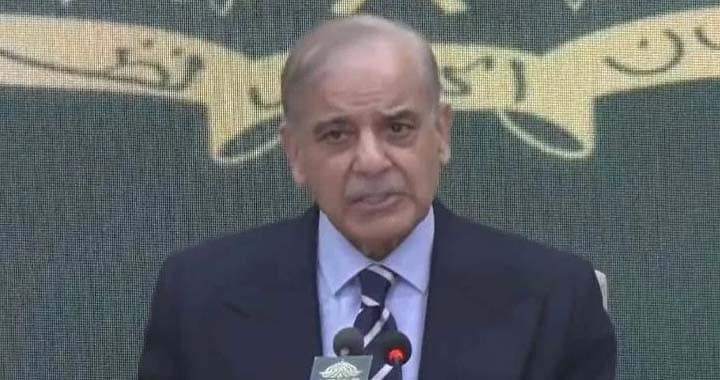
Prime Minister Shehbaz Sharif has called for transforming Pakistan’s diplomatic and military achievements into tangible economic dividends, declaring that the country must now move beyond economic stabilisation towards sustainable growth, increased exports, industrial development and national self-reliance.
Addressing the National Security Workshop, the Prime Minister said the government had taken difficult but necessary decisions to pull the economy back from the brink of instability and introduce long-overdue structural reforms. He stressed that Pakistan could no longer afford complacency and must capitalise on its strategic achievements through economic strength, institutional efficiency and national unity.
Highlighting the growing pressure of population expansion on national resources, Prime Minister Shehbaz Sharif described Pakistan’s rapidly increasing population as a “ticking time bomb,” warning that failure to address the issue could undermine the country’s economic future and food security.
He announced that an Apex Committee meeting would soon be convened to deliberate on decisive measures to control population growth, emphasising that the issue required urgent national attention.
The Prime Minister disclosed that a dedicated task force had been established under the supervision of Dr. Shabana, with the Health Minister also included in the initiative. He said he himself was chairing the task force, describing it as an apex-level body tasked with addressing the population challenge.
He emphasised that, just as the government had taken difficult decisions to stabilise the economy, similarly firm measures would be required to manage population growth before it placed an unbearable burden on national resources.
Highlighting Pakistan’s diplomatic achievements, the Prime Minister described bringing Iran and the United States to the negotiating table in Islamabad after 47 years as an extraordinary diplomatic success.
He reiterated that Pakistan remained sincerely committed to promoting regional peace, reducing tensions and facilitating meaningful dialogue between countries.
The Prime Minister particularly acknowledged the efforts of Field Marshal Syed Asim Munir and Deputy Prime Minister and Foreign Minister Ishaq Dar, praising their sustained diplomatic engagement and tireless efforts towards regional stability.
He said the diplomatic process had resulted in the signing of an Islamabad Memorandum of Understanding, reflecting Pakistan’s commitment to constructive engagement and peaceful conflict resolution.
The Prime Minister highlighted the government’s efforts to overhaul the Federal Board of Revenue (FBR), particularly addressing widespread tax evasion and corruption in indirect taxation, including sales tax.
He stated that long-pending structural reforms had been advanced over the past two and a half years, with their implementation during the 2025–26 fiscal year resulting in the recovery of a record Rs900 billion through measures aimed at curbing tax evasion and corruption.
He described the removal of highly corrupt elements from the FBR as a major institutional achievement, stressing that eliminating financial leakages and strengthening revenue collection were essential for economic independence.
According to the Prime Minister, Pakistan’s GDP growth is projected at 3.5 percent during the current year. However, he stressed that the country must accelerate economic activity and raise growth to at least six percent to create sustainable employment and achieve meaningful development.
He also noted that Pakistan’s foreign exchange reserves had reached potentially historic levels, while emphasising that national dignity and economic sovereignty could only be secured through continuous hard work, honesty, integrity and responsible governance.
The Prime Minister revealed that Pakistan’s exports had increased by eight percent during the first quarter of the current fiscal year, but stressed that substantially greater efforts were needed to strengthen the country’s export base.
He highlighted the remarkable expansion of Pakistan’s information technology sector, stating that IT exports had reached $4.6 billion compared with approximately $1.5 billion three years earlier.
He called for further investment in technology, innovation, manufacturing and value-added industries, emphasising that Pakistan must shift towards a productive and export-oriented economy rather than relying on traditional economic models.
Addressing the country’s mineral potential, the Prime Minister announced that illegal gold mining in Khyber Pakhtunkhwa had been completely stopped.
He said the government’s objective was to transform Pakistan’s vast mineral resources into high-value finished products through mining, manufacturing, processing and exports.
He emphasised that mining companies would be required to establish smelters within the stipulated contractual timelines, ensuring that mineral resources were processed domestically rather than exported in raw form.
The Prime Minister said a comprehensive plan for mineral value addition had been prepared and that its implementation would remain a government priority.
He also referred to the financial support extended during recent economic difficulties, stating that the federal government had provided Rs28 billion in subsidies during the initial weeks of the crisis, while Rs50 billion had been spent on fuel subsidies.
He stressed that teamwork, effective federal-provincial coordination and national consensus were indispensable for achieving long-term economic objectives.
The Prime Minister identified Pakistan’s young population as both a major national challenge and an extraordinary opportunity, noting that approximately 60 percent of the country’s population comprised young people.
He stressed that without equipping the younger generation with modern education, technological expertise and productive employment opportunities, Pakistan could not achieve sustainable economic independence.
He called for large-scale investment in information technology, artificial intelligence, vocational education and skills development, emphasising that young Pakistanis must be equipped to compete in the modern global economy.
He said the federal government was working with provincial administrations to expand educational and professional training opportunities, while underscoring the need to generate employment on a much larger scale in the coming years.
The Prime Minister further described agriculture as the backbone of Pakistan’s economy, regretting that the sector had not received the attention it deserved over the past eight decades.
He called for modernising agricultural practices, improving productivity and unlocking the enormous potential of livestock, water resources, fertile land and other natural assets.
Concluding his address, Prime Minister Shehbaz Sharif emphasised that Pakistan possessed enormous human, agricultural, technological and mineral resources, but translating this potential into prosperity required discipline, innovation, integrity and collective national determination.
He called for stronger national dialogue, improved federal-provincial cooperation and a shared commitment to economic transformation.
Quoting Allama Muhammad Iqbal, the Prime Minister reiterated the importance of fresh thinking, ambition and hard work in building a prosperous and self-reliant nation.
The Prime Minister’s message was clear: Pakistan must now convert its diplomatic achievements, security gains and economic stabilisation into measurable prosperity. From controlling population growth and eliminating corruption to expanding exports, unlocking mineral wealth and empowering its youth, the government has placed economic transformation and national self-reliance at the centre of its future agenda.



