
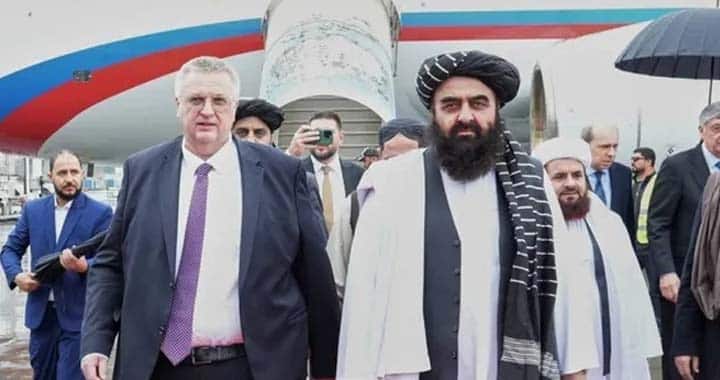
Russia’s increasingly ambitious engagement with Afghanistan’s Taliban government is facing a fundamental strategic contradiction: while the Kremlin publicly presents the Islamic Emirate as a potential security partner and regional stabilizing force, its own legal, diplomatic and security record reveals a far more complicated reality—an unratified military cooperation agreement, limited capacity to deliver promised defense assistance, emerging third-country procurement channels, and mounting concerns over terrorist networks operating from Afghan territory.
An extensive investigative review of Russian legal records, United Nations Security Council monitoring reports, Afghan defense procurement information, and diplomatic developments across Moscow, Kabul, Minsk and the wider region reveals the growing gap between Russia’s political ambitions in Afghanistan and its ability to manage the security consequences.
The centerpiece of Moscow’s latest Afghan strategy was the May 27, 2026 signing of a Military-Technical Cooperation Agreement between Russian Defense Council Secretary Sergei Shoigu and Taliban Defense Minister Mullah Mohammad Yaqoob Mujahid, on the sidelines of the 14th International Security Meeting in Moscow.
The ceremony was presented by official outlets as a significant step toward institutionalizing military relations between Russia and the Islamic Emirate. However, the legal status of the agreement raises serious questions about the substance of that commitment.
According to the Russian GARANT legal registry, under record number 414401469, the agreement had still not entered into force as of November 12, 2026. Its activation depends on the exchange of written diplomatic notifications confirming that both parties have completed their respective domestic legal procedures.
This distinction is critical. Despite the highly publicized signing ceremony, Moscow has yet to convert the political announcement into an operationally effective treaty framework.
The agreement’s uncertain status comes as the Taliban government seeks to rebuild Afghanistan’s deteriorating Soviet-era military infrastructure, particularly its aviation, armored vehicle and air-defense capabilities.
Afghanistan’s reported procurement requirements include thousands of small arms, heavy machine guns, artillery systems, multiple-launch rocket systems, armored vehicles, military transport trucks and extensive helicopter and aircraft maintenance support.
The most pressing demands involve the rehabilitation of Mi-8 and Mi-17 transport helicopters, Mi-24 attack helicopters and several Soviet-era combat aircraft that remain grounded or stored at former Afghan military installations.
The Taliban also seeks maintenance expertise, spare parts and technical assistance for its legacy aviation fleet, alongside equipment intended to strengthen its air-defense capabilities.
Yet Russia faces considerable constraints. Its defense-industrial sector remains under pressure from the continuing war in Ukraine, Western sanctions and competing demands for military production and maintenance capacity.
The experience of previous Russian-linked aviation repair initiatives in Afghanistan further illustrates the difficulties. The collapse and dissolution of Vertical-T, a Russian aviation company previously associated with discussions about helicopter maintenance in Afghanistan, eliminated one potential commercial channel for such cooperation.
Consequently, Moscow’s public political commitments have not translated into a demonstrated large-scale program to restore Afghanistan’s military aviation infrastructure.
Perhaps the most consequential development is the emerging Belarusian dimension of Russia’s Afghan policy.
Investigative reporting published in October 2026 by Afghanistan International, Reform.news and other regional outlets described negotiations between Taliban officials and Belarusian defense-linked entities over potential military equipment, drone technology and maintenance cooperation.
The reported involvement of Belarusian defense exporters, including Belspetsvneshtekhnika and Beltechexport, alongside the 558th Aircraft Repair Plant and drone developer KB INDELA, suggests that Minsk could become an important intermediary in Afghanistan’s efforts to acquire military technology.
The arrangement carries significant geopolitical implications.
Belarus offers Moscow an additional diplomatic and industrial channel through which engagement with Kabul could expand without requiring every transaction to be publicly presented as a direct Russian military transfer.
Reports also point to the possible involvement of Indian mediation, recalling earlier arrangements under which Belarusian military aviation equipment was supplied to Afghanistan through alternative financing and procurement mechanisms.
However, these reported negotiations should not be confused with confirmed deliveries of military equipment. Their strategic significance lies in the emerging procurement architecture and the possibility of expanded defense cooperation.
The most serious challenge to Moscow’s Afghanistan policy comes from the security situation documented by United Nations monitoring bodies.
The 37th report of the UN Security Council Sanctions Monitoring Team, Document S/2026/44, raised concerns that advanced weapons, night-vision equipment, thermal-imaging devices, sniper systems and drone capabilities were reaching Tehrik-e-Taliban Pakistan (TTP) through individuals and networks associated with Afghanistan’s de facto authorities.
Subsequent monitoring in Document S/2026/651, published in August 2026, added further concerns about militant drone capabilities and the operational development of extremist networks inside Afghanistan.
These findings expose a fundamental problem for Russia: Moscow wants to rely on Taliban security institutions to contain threats emanating from Afghanistan, yet international monitoring reports continue to raise questions about weapons diversion, militant mobility and the presence of transnational extremist organizations.
The issue is particularly sensitive because Article 4 of the Russian-Afghan military cooperation agreement establishes restrictions on transferring military equipment and related materials to third parties without prior written consent.
Effective implementation of such restrictions would require credible end-user monitoring and institutional control over weapons distribution—precisely the areas in which international reporting has identified serious concerns.
The contradiction extends beyond Afghanistan’s immediate western and northern borders.
The August 2026 UN monitoring report, Document S/2026/651, addressed the November 2025 terrorist attack on New Delhi’s Red Fort and raised concerns about the continued presence of AQIS leadership in Kabul.
For India, these developments create a difficult strategic environment. New Delhi has reasons to pursue pragmatic engagement with Afghanistan’s de facto authorities and maintain regional influence, but it must also consider the implications of the presence of extremist networks on Afghan territory.
At the same time, reports of Belarusian military and drone-related negotiations involving Kabul, potentially facilitated through Indian mediation, highlight the complicated intersection of security interests, defense procurement and regional diplomacy.
The resulting paradox is unmistakable: countries seeking practical cooperation with Kabul must simultaneously confront serious questions about the security environment under Taliban rule.
Moscow’s dependence on Taliban security institutions became particularly visible in October 2026.
Following diplomatic tensions surrounding the October 5 Moscow Format summit, Russian Foreign Intelligence Service Director Sergei Naryshkin reportedly traveled to Kabul on October 14 for closed-door discussions with Taliban intelligence chief Abdul Haq Wasiq.
The absence of detailed public disclosures about the meeting has intensified interest in the nature of Russian-Taliban intelligence cooperation.
The visit nevertheless illustrates the importance Moscow attaches to maintaining direct access to Afghanistan’s intelligence and security leadership.
Just two days later, Russian Foreign Minister Sergey Lavrov delivered a warning at a Moscow security conference involving the CSTO, CIS and SCO, expressing concern about militants attempting to enter Central Asian countries from Afghanistan.
Lavrov’s remarks highlighted the growing threat posed by transnational extremist networks and militant movements operating near the Panj River.
His warning was particularly significant because it came immediately after the reported intelligence-level engagement with Kabul.
The contrast captures the central dilemma of Russian policy: Moscow considers the Taliban an indispensable interlocutor for counterterrorism cooperation while remaining deeply concerned about the militant networks that continue to operate in and around Afghanistan.
The consequences are already visible along Tajikistan’s border with Afghanistan.
A series of violent incidents in late 2025, including attacks involving drones and armed militants, killed Chinese workers and Tajik border personnel, raising concerns about the vulnerability of infrastructure and mining projects in the region.
The incidents also underscored the growing exposure of Chinese economic interests to instability along the Afghan frontier.
Russia has responded by strengthening its security engagement with Tajikistan, accelerating military assistance and supporting border modernization efforts.
Meanwhile, CSTO forces conducted counter-incursion exercises in Tajikistan in October 2026, while China moved forward with a major grant-funded border infrastructure program in the Pamir region.
These developments demonstrate that the Afghan question is no longer simply a bilateral issue between Moscow and Kabul. It is increasingly intertwined with the security calculations of China, India, Pakistan, Iran and the Central Asian republics.
For Russia, the challenge is particularly delicate: it seeks to cultivate the Taliban as a diplomatic and intelligence partner while simultaneously reinforcing the military defenses of neighboring states against threats emerging from Afghan territory.
The evidence points to a significant gap between Russia’s political ambitions and its practical capacity to shape Afghanistan’s security environment.
The May 2026 military cooperation agreement remains legally unactivated according to the cited Russian registry. Afghanistan’s military modernization requirements far exceed what Moscow has publicly demonstrated it can provide. Belarus has emerged as a potential alternative procurement channel, while UN monitoring reports continue to raise serious questions about weapons diversion, extremist networks and cross-border threats.
At the same time, Russia’s intelligence leadership is maintaining direct contact with Taliban security officials even as its foreign minister warns of militant infiltration from Afghanistan.
This is not the profile of a fully consolidated strategic defense alliance. It is the profile of a cautious and increasingly complicated relationship in which political recognition, intelligence cooperation, military ambitions and regional security concerns are pulling Moscow in different directions.
Russia may have gained diplomatic access to Kabul, but access does not necessarily translate into influence, and influence does not guarantee control.
For the Taliban, Moscow offers international legitimacy, potential military expertise and access to alternative diplomatic and industrial networks. For Russia, Afghanistan offers an opportunity to expand regional influence and strengthen its counterterrorism posture.
Yet both sides face a fundamental question: can they build a sustainable security relationship when the institutional safeguards, military resources and regional stability required to support it remain uncertain?
The emerging picture is of a Kremlin attempting to secure strategic advantages in Afghanistan without assuming the full economic, military and diplomatic costs of a direct defense commitment.
The unratified treaty, reported Belarusian procurement negotiations, concerns over militant access to advanced weapons, Naryshkin’s intelligence mission and Russia’s simultaneous reinforcement of Tajikistan collectively reveal the limits of Moscow’s Afghan strategy.
The central contradiction is no longer whether Russia is willing to engage the Taliban. That engagement is already well established.
The real question is whether Moscow can prevent its pursuit of influence in Kabul from undermining the security interests it has spent decades building across Central Asia.
As Afghanistan remains at the intersection of competing regional powers, extremist networks and fragile economic corridors, Russia’s attempt to turn diplomatic recognition into a strategic defense partnership may prove far more difficult than the Moscow signing ceremony suggested.
The Kremlin has opened the door to Kabul. Whether it can control what comes through that door is the defining security question of its Afghan policy.



