
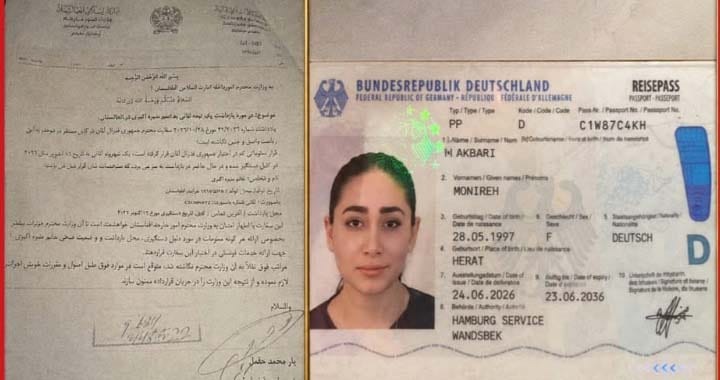
The kidnapping of German national Monira Akbari in Herat on October 16, 2026, has exposed yet another disturbing dimension of the Taliban’s system of intimidation, financial exploitation, and organised extortion. Documents obtained by Rasa establish the circumstances surrounding her abduction and raise grave questions about the involvement of Taliban-affiliated networks in kidnapping foreign nationals for financial gain.
Despite the seriousness of this incident, the Taliban have officially denied that Monira Akbari was abducted. Their denial, however, does not erase the available documentation or answer the fundamental questions surrounding her disappearance and the circumstances of her captivity.
The Green Trend of Afghanistan’s intelligence unit became aware of the kidnapping within the first few hours of the incident. However, prioritising the victim’s safety and avoiding any action that could jeopardise efforts to secure her freedom, the organisation deliberately withheld the information from public disclosure.
Now that the Taliban have officially denied the incident, Rasa is making these documents public to expose the truth, challenge the Taliban’s denial, and bring international attention to the fate of a German citizen whose freedom has become the subject of a deeply troubling situation.
Information obtained by Rasa from contacts within Taliban offices reveals that demands concerning Monira Akbari’s release have been directed towards a third country rather than formally communicated to the German government.
The Taliban have demanded a ransom from that third country, accusing Monira Akbari of conducting intelligence activities on its behalf. These demands have remained outside formal diplomatic communication with Germany, creating further uncertainty over the negotiations, the victim’s safety, and the actual intentions of those holding her captive.
This is not simply a kidnapping case. It is a disturbing example of how human freedom can be turned into an instrument of financial coercion, political manipulation, and secret bargaining.
A German citizen has disappeared in Afghanistan, ransom demands are being directed through undisclosed channels, and the authorities exercising power in the country are denying that the kidnapping ever took place. Such contradictions demand immediate international scrutiny and a clear explanation.
Kidnapping, ransom collection, intimidation, and extortion have become defining features of the criminal networks operating under the Taliban’s shadow. Rather than establishing an environment of security and accountability, the Taliban’s system of governance continues to face serious questions over the conduct of individuals and networks connected to its power structures.
The case of Monira Akbari exposes the dangerous consequences of allowing criminal networks to operate through political connections, institutional influence, and an absence of independent accountability.
The Taliban cannot claim to exercise authority while denying responsibility for the security of individuals living within the territory under their control. Nor can they expect the international community to accept official statements in place of verifiable facts.
The situation becomes even more disturbing when viewed against the billions of dollars in foreign assistance that have entered Afghanistan through various channels, alongside the domestic revenues collected under Taliban administration.
Despite access to substantial financial resources, the appetite for illicit money, ransom collection, and extortion appears far from satisfied.
There is an old and undeniable reality: a deeply ingrained habit does not disappear simply because circumstances change. The Taliban may have exchanged the battlefield for the machinery of administration, but the methods of coercion, intimidation, and financial exploitation continue to cast a dark shadow over their rule.
The plundering of public resources and the pursuit of money through extortion cannot be reconciled with claims of responsible governance. Afghanistan’s resources belong to its people, not to individuals or networks seeking to enrich themselves through fear, coercion, and criminal enterprise.



