
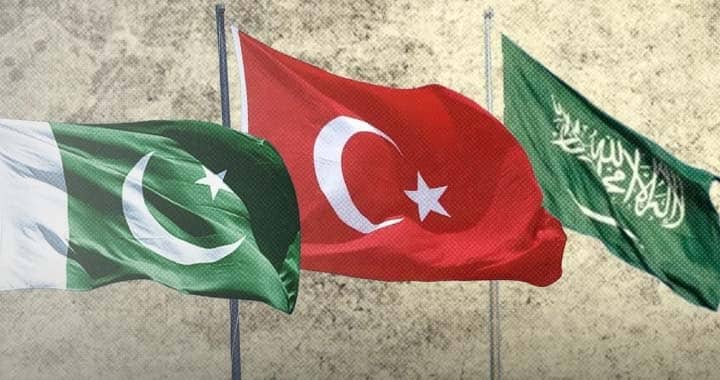
Pakistan is set to host the Strategic Political and Defence Committee (SPDC) of the Makkah Joint Defence Agreement (MJDA) for the first time during the last week of November, marking a significant milestone in trilateral defence cooperation among Pakistan, Saudi Arabia and Türkiye. The high-level meeting, tentatively scheduled for November 27–28 in Islamabad, comes at a critical juncture amid escalating regional tensions and mounting security challenges across the Middle East.
The proposed meeting assumes particular significance against the backdrop of reported Houthi attacks targeting Saudi Arabia, growing disruptions to maritime shipping in the Red Sea, and heightened uncertainty surrounding the evolving US-Iran-Israel situation. Against this increasingly complex regional security environment, the three countries are expected to deliberate on emerging threats, strengthen strategic coordination and explore a collective framework for addressing challenges to regional peace, stability and security.
Senior civilian and military leadership from all three member states are expected to participate in the deliberations. Pakistan is expected to be represented by Deputy Prime Minister and Foreign Minister Senator Ishaq Dar, Defence Minister Khawaja Asif and Chief of Defence Forces Field Marshal Syed Asim Munir. Türkiye is expected to send Foreign Minister Hakan Fidan, Defence Minister Yaşar Güler and senior military leadership, while Saudi Arabia is expected to be represented by Foreign Minister Prince Faisal bin Farhan, the Saudi Defence Minister and senior military officials.
The Islamabad meeting will be the third gathering of the SPDC, following its previous sessions in Istanbul on August 31 and Riyadh on October 5. Pakistan currently holds the alliance’s secretariat, headed by retired Lieutenant General Nauman Mahmood, reflecting Islamabad’s central institutional role in facilitating the emerging trilateral defence framework.
Discussions are expected to focus on the evolving regional security landscape, escalating tensions in the Middle East, the US-Iran situation, maritime security in the Red Sea and responses to threats against Saudi Arabia’s critical civilian and strategic infrastructure. The participants are also expected to examine mechanisms for enhanced intelligence coordination, defence cooperation and strategic consultation within the framework of the agreement.
The Makkah Joint Defence Agreement, signed on August 7, 2026, establishes a collective defence framework under which an armed attack against one member state is treated as an attack against all three. Pakistan has authenticated the agreement, while the Turkish Parliament endorsed it following parliamentary deliberations. The agreement reflects the three countries’ commitment to institutionalising defence cooperation and strengthening their ability to respond collectively to shared security challenges.
A key item on the Islamabad agenda will also be the finalisation of the agreement’s official name and abbreviation. Three proposed names and their corresponding abbreviations are expected to be presented for consideration, an important step towards establishing the institutional identity of the trilateral arrangement.
Pakistan has consistently emphasised diplomacy, regional stability and the protection of Saudi Arabia’s sovereignty and territorial integrity amid the prevailing security challenges. Islamabad has also called for an end to attacks on Saudi civilian infrastructure and urged the Houthis to return to negotiations, underlining the importance of dialogue in preventing further regional escalation.
Pakistan and Saudi Arabia share decades of defence cooperation, strategic partnership and mutual support, complemented by longstanding military ties and bilateral defence arrangements. Türkiye’s participation adds another significant dimension to the emerging trilateral security partnership, bringing together three influential regional states with shared interests in regional stability and collective security.
The three member countries have maintained that the defence arrangement is defensive in nature, is not directed against any particular state and remains open to the participation of other countries.
The forthcoming Islamabad meeting is therefore expected to provide an important platform for strengthening institutional coordination, advancing collective defence consultations and defining a common approach to an increasingly volatile regional security environment.
With Islamabad preparing to host the landmark deliberations, Pakistan, Saudi Arabia and Türkiye are set to advance their trilateral defence partnership through closer coordination, collective security commitments and a shared emphasis on protecting sovereignty and regional stability.



