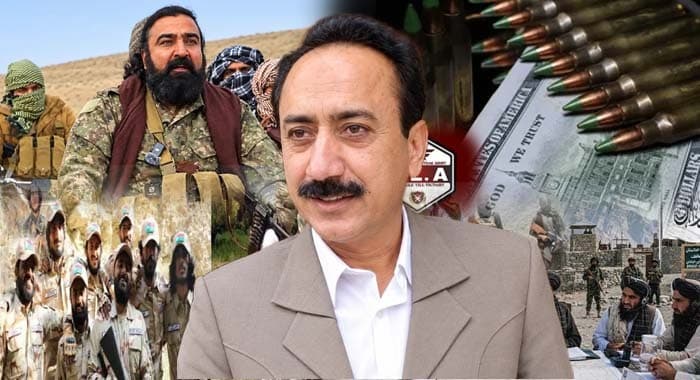
The future of armed groups operating from Afghanistan and targeting Pakistan cannot be understood merely by examining individual commanders, funding disputes or reports of internal differences. Their organizational structures, external connections, recruitment networks and ability to adapt to changing regional circumstances are far more consequential. Developments surrounding Baloch separatist commander Bashir Zeb, in particular, offer an opportunity to examine the complicated environment in which these groups operate.
There have been conflicting reports about Bashir Zeb’s health and whereabouts, including suggestions that he was poisoned, that he might be taken to India for treatment, and that he was receiving medical care in Kandahar. These accounts have not been independently established, but the circulation of such reports indicates that something may be happening within the networks associated with these organizations. Rivalries, internal disagreements and efforts to remove influential figures are not unusual among armed groups. The reported developments should therefore be viewed in the wider context of their organizational dynamics rather than as evidence of an imminent collapse.
Regional politics will also influence the future of these networks. If relations between Pakistan and India improve, or if political and strategic circumstances in India change, the environment in which Baloch separatist organizations operate could be affected. Their external support networks may face different pressures, potentially weakening some of the resources available to them. The political difficulties confronting the Modi government in India could also influence its regional calculations. However, it would be premature to conclude that changes in India’s domestic politics will automatically translate into the decline of armed organizations operating against Pakistan.
The organizational structure of the Balochistan Liberation Army (BLA) is particularly important in this regard. Reports of its presence, recruitment and training infrastructure in Afghanistan, including areas around Kandahar and Helmand, raise questions about the extent to which these networks can sustain themselves. Yet, the group’s resilience cannot be measured solely through the circumstances of one commander or the availability of funding at a particular moment.
One of the most consequential aspects of the BLA, in my assessment, is its communication infrastructure. I believe external assistance, including support allegedly routed through India and attributed to Israel, has contributed to the group’s ability to maintain secure communications. Claims about the specific technology supplied to the organization and its resistance to interception require independent verification. Nevertheless, the broader challenge is real: terrorist organizations increasingly rely on encrypted communication, digital networks and technological methods that complicate intelligence collection and operational disruption.
The example of Daesh illustrates how the disruption of communication networks can undermine an organization’s ability to coordinate and operate. The methods used by terrorist organizations evolve, however, and the technologies available to one group cannot simply be assumed to be identical to those used by another. The BLA’s reported communication capabilities, its alleged connections within administrative and security structures, and its ability to coordinate activities require sustained attention from Pakistani security and intelligence agencies.
This is why the BLA should not be expected to weaken quickly merely because of reported difficulties involving an individual commander or funding channel. Its organizational networks may survive leadership changes and adapt their methods. The use of drones and other emerging technologies is one indication of how armed groups can alter their tactics when conventional methods become more difficult. The challenge is therefore structural, not simply personal.
Reports have also circulated about meetings in Kandahar involving representatives of the BLA, Haji Gul Bahadur’s network and other armed organizations, including al-Qaeda. The reported discussions allegedly concerned recruitment difficulties and the possibility of sharing resources or financial support. These accounts have been disputed, and the details of any such meeting should not be treated as established fact. What deserves attention, however, is the broader question of coordination among armed groups operating from Afghan territory.
For approximately two and a half years, different organizations have explored forms of coordination. Some joint efforts and operational contacts have reportedly taken place, but differences between their objectives, organizational cultures and areas of influence have also created friction. Cooperation between armed groups does not necessarily mean that they have become a unified organization. Their alliances can be temporary, transactional and vulnerable to internal competition.
The BLA and the Tehreek-e-Taliban Pakistan (TTP), for example, have fundamentally different ideological and political objectives. The BLA’s stated separatist agenda is rooted in Baloch nationalism, while the TTP presents itself as a religious movement seeking its own interpretation of Islamic governance. Haji Gul Bahadur’s network and the Afghan Taliban also operate within different organizational and political settings. Their shared opposition to Pakistan or their presence in the same regional environment does not erase these distinctions.
Religious ideology, however, gives groups such as the TTP a different kind of transnational reach. Their religious framing allows them to establish connections beyond ethnic and geographical boundaries, including with individuals and networks across the Muslim world. This can provide access to ideological support, personal contacts and resources. The BLA, by contrast, remains tied to a separatist agenda and a specific ethnic-national context. Any assistance it receives from religiously oriented armed groups would not necessarily transform its fundamental character or objectives.
The TTP, meanwhile, has increasingly developed characteristics that make it difficult to describe through conventional definitions of a traditional insurgent movement. Rather than functioning only as a single, centralized organization, its networks can operate through affiliated groups, local commanders, personal loyalties and shifting arrangements. In that sense, it increasingly resembles a franchise structure in which the broader ideological identity can be reproduced through different local networks. Understanding this evolution requires a closer examination of its recruitment, financing, planning and operational relationships.
The situation in Afghanistan itself presents another major question. The Taliban authorities have restored their rule, but maintaining control and governing a modern state are fundamentally different challenges. Afghanistan’s recent history demonstrates the difficulties successive political systems have faced in establishing durable institutions and providing effective governance. Monarchical rule, socialist and communist experiments, the Western-backed republican system and the Taliban’s religious authoritarian model have all encountered serious limitations or ultimately failed to establish lasting political stability.
The Taliban’s return to power has not resolved the country’s institutional and economic problems. Their government continues to face challenges involving international engagement, economic sustainability, public services, political inclusion and the management of a diverse society. The ability to fight a war or negotiate the withdrawal of foreign forces does not automatically provide the administrative capacity required to govern a country.
Afghanistan’s ethnic, linguistic and religious diversity also demands an inclusive political framework. A system that fails to accommodate different communities and minorities risks deepening internal divisions. Political stability cannot be built solely through coercive authority or the dominance of one ideological or social group. It requires institutions that can accommodate differences, distribute opportunities and establish confidence among the population.
The Taliban authorities have also demonstrated an interest in engaging external powers, including through invitations for American involvement in discussions or initiatives. Such outreach is not entirely unprecedented in Afghanistan’s history. Successive governments have sought foreign investment, diplomatic support and strategic partnerships. But the international environment has changed considerably, and the old model of relying on a powerful external patron to sustain a political system is increasingly difficult to reproduce.
The emerging international order is more closely shaped by economic interests, bilateral arrangements and the capacity of individual states to sustain themselves. China’s approach to international relations, as frequently described by its leadership, emphasizes economic engagement and mutually beneficial transactions rather than direct political domination. Whether or not every major power follows that approach, Afghanistan’s future cannot depend indefinitely on the intervention or financial backing of external actors.
Countries increasingly need functioning institutions, productive economies, technical expertise and the capacity to meet their own domestic requirements. Afghanistan’s dependence on imported goods, equipment and technical services highlights the scale of its economic and industrial challenges. Without investment in education, skills, infrastructure and productive capacity, diplomatic engagement alone will not provide a sustainable path forward.
The same realities will shape the future of armed organizations operating from Afghan territory. Their ability to survive will depend not only on external funding or individual commanders but also on the political environment, the networks available to them and their capacity to adapt. Pakistan must therefore continue to monitor these relationships, strengthen intelligence capabilities and address the technological methods used by terrorist organizations.
Ultimately, the future of the region will be determined by more than shifting alliances among armed groups or changes in the leadership of neighboring countries. It will depend on whether states can build effective institutions, develop economic strength and establish relationships based on mutual interests and respect for sovereignty. For Pakistan, confronting cross-border terrorism requires recognizing the complexity of these networks while remaining clear about the threat they pose to national security.