
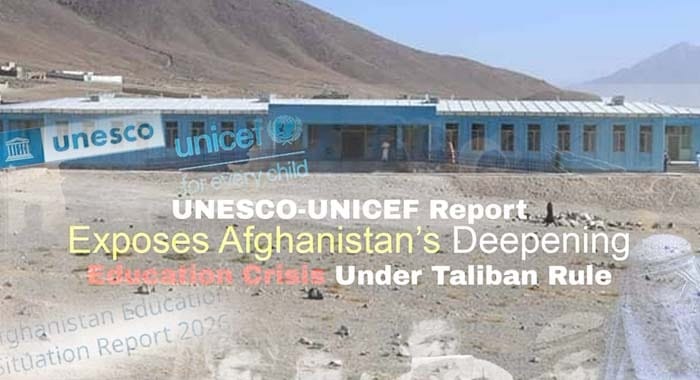
Afghanistan’s education crisis has reached alarming proportions, with 53 percent of primary school-age children remaining outside formal education and more than 2.6 million adolescent girls denied access to secondary schooling since 2021. The findings expose the widening consequences of the Taliban authorities’ restrictions on education, particularly their continued exclusion of girls and women from classrooms and universities.
A new joint report by UNESCO and UNICEF, titled Afghanistan Education Situation Report 2026, documents how the country’s education system is struggling to meet growing demand while restrictions on female education, recurring emergencies, inadequate investment and large-scale returns place further pressure on already overstretched services.
The crisis carries a particularly stark contradiction. The Taliban authorities present themselves as defenders of Islam and Sharia, yet their restrictions have deprived millions of girls of access to education, despite the central importance Islam places on acquiring knowledge. The denial of education to an entire generation of girls raises serious questions about the religious justification offered for these restrictions.
More than 2.6 million adolescent girls have been denied secondary education since 2021. Community-based classes, literacy and skills programmes, distance learning and private tutoring remain among the few available alternatives. By October 2026, approximately 5,300 community-driven classes were operating, serving around 162,000 learners, 64 percent of them girls. However, these limited initiatives cannot replace access to formal, in-person schooling.
The report also highlights the growing pressure on Afghanistan’s education infrastructure. The school-age population increased from approximately 10.4 million in 2019 to 11.5 million in 2024, while enrolment has failed to keep pace with demographic growth. Although around 6.6 million children were enrolled in public primary schools in 2025, an increase of approximately 560,000 compared with 2022, millions remain excluded from formal education.
The quality of learning is another major concern. A national assessment involving more than 55,000 pupils across all 34 provinces found that fewer than half of Grade 4 students achieved minimum proficiency in language for Grade 3, while only one in four met the corresponding benchmark in mathematics. The findings point to serious shortcomings in classroom instruction, teacher support and the availability of adequate learning materials.
Early childhood education is even more neglected. Fewer than one in 100 children aged three to four participate in early learning programmes, depriving them of opportunities to develop foundational skills before entering primary school.
The pressure is also intensifying in areas receiving returning Afghans. By September 2026, approximately 1.23 million Afghans had returned during the year, including more than 245,000 children requiring educational support. The growing number of children needing access to schools is placing further demands on a system already struggling to accommodate its existing population.
Afghanistan’s higher education sector has also suffered a substantial contraction. With women still barred from universities, total enrolment stood at around 208,000 students in 2026, compared with 189,000 in 2024 and approximately 430,000 in 2020. The slight recovery since 2024 does little to conceal the scale of the decline or the exclusion of women from university education.
The contradiction between the Taliban authorities’ religious rhetoric and their education policies is particularly difficult to overlook. Islam places great importance on the pursuit of knowledge, while education is essential for both individual development and the progress of society. Yet, the authorities continue to impose restrictions that prevent girls and women from pursuing education beyond permitted levels. Invoking religion to justify such exclusion does not resolve the contradiction; it makes the question of religious interpretation and the consequences of these policies even more pressing.
The consequences extend far beyond the millions of girls currently denied classrooms. Restricting women’s access to education narrows the country’s future pool of teachers, doctors, professionals and skilled workers. Weak learning outcomes among children, limited early education and declining university enrolment further threaten Afghanistan’s ability to rebuild its institutions and develop its economy.
UNESCO and UNICEF have called for the full restoration of educational rights for Afghan girls and women, alongside greater investment in teachers, learning materials and the overall quality of education. Their findings make clear that community-based initiatives, however valuable, cannot compensate for the absence of a functioning and inclusive formal education system.
The Taliban authorities repeatedly invoke Islam as the foundation of their governance. But a policy that denies millions of girls the opportunity to learn raises a fundamental question: how can a government claim to uphold religious principles while restricting a pursuit that Islam places among its essential duties? Afghanistan is not merely facing an education shortfall. It risks leaving an entire generation behind, with consequences that will outlast the policies responsible for creating the crisis.



