
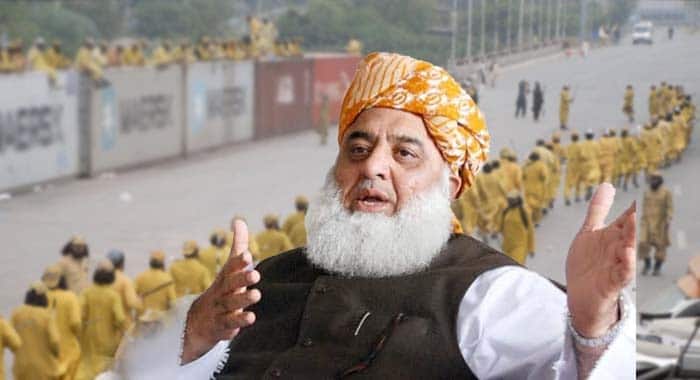
Pakistan’s current political and security environment demands prudence, political maturity and a responsible approach from all political forces. Yet, developments surrounding Jamiat Ulema-e-Islam-Fazl (JUI-F) chief Maulana Fazlur Rehman have raised concerns about a possible return to the kind of confrontational politics that kept the country politically unsettled for years.
Observers believe Maulana and his party have been left out of the federal government and the newly formed advisory arrangements in Khyber Pakhtunkhwa following the imposition of Governor’s Rule. Some view this political exclusion as the source of his growing frustration, while others interpret his current posture as a calculated effort to secure a greater share in the next political setup.
Whatever the underlying political calculations, the increasingly confrontational tone adopted by Maulana, some party leaders and, particularly, sections of the party’s social media machinery deserves serious attention. The concern is not simply about a disagreement between JUI-F and the government. It is about whether the party is moving towards a pattern of political agitation that Pakistan has already experienced at considerable cost.
A seasoned politician with decades of parliamentary and political experience is expected to distinguish between personal or party grievances and the broader interests of the country. Political exclusion, disagreement over power-sharing or differences with the government cannot justify rhetoric or actions that risk deepening instability, particularly when Pakistan faces serious security challenges, economic pressures and regional uncertainties.
The controversy surrounding an anti-encroachment notice issued to Maulana in Islamabad has brought this tension into sharper focus. Speaking to a private television channel, a government representative clarified that the anti-encroachment campaign had been underway in the capital for approximately 18 months and that action had also been taken against properties in affluent neighborhoods, including those around Maulana’s residence.
He maintained that the notice had no connection with Maulana’s political activities and accused him of politicizing an administrative matter. He also rejected the suggestion that the government was pushing the JUI-F chief towards street agitation, arguing that Maulana himself was moving towards confrontation.
The government has maintained that the campaign was not selective. According to the explanation offered, authorities initially targeted encroachments in affluent localities, removing unauthorized structures from several properties in the vicinity of Maulana’s residence. The government representative further argued that defending encroachments and turning an administrative matter into a political controversy was unjustified, adding that the presence of a group of young supporters did not give anyone the right to challenge the state.
He also clarified that a separate government figure’s remarks concerning Maulana represented a personal opinion and should not automatically be interpreted as the prime minister’s position. He questioned the suggestion that the government wanted confrontation when its own representatives were publicly discussing the matter.
The distinction between administrative enforcement and political victimization is important. If an individual, regardless of political stature or influence, has violated applicable regulations, the appropriate course is to address the matter through established legal procedures. Political leadership cannot reasonably demand exemptions from rules that apply to ordinary citizens. Equally, the government must ensure that enforcement remains transparent, consistent and free from political discrimination.
But the controversy also raises a wider question about the direction of JUI-F’s politics. Pakistan has already spent years dealing with political agitation, institutional confrontation and deeply divisive narratives, particularly during PTI’s prolonged confrontational politics. Repeated protests, political deadlock and the escalation of disputes into broader institutional crises took a heavy toll on the country’s political environment. The concern now is whether JUI-F is beginning to follow a similar trajectory.
The comparison is not about treating the two parties as identical or suggesting that their political circumstances are the same. It is about recognizing a familiar pattern: political grievances increasingly framed as confrontations with the state, administrative disputes elevated into major political battles, and supporters mobilized through increasingly hostile narratives. Pakistan has little reason to welcome a repetition of that cycle under a different party’s banner.
The role of party social media machinery makes the situation more consequential. Political party accounts and supporters can contribute to democratic debate, question government decisions and demand accountability. But when administrative disagreements are repeatedly portrayed as attacks on political rights, or when confrontational messaging becomes a tool for mobilizing hostility against state institutions, political debate risks turning into another source of polarization. JUI-F’s leadership has a responsibility to ensure that its political communication does not encourage such an environment.
Maulana’s political experience makes the expectations from him considerably higher. He has participated in parliamentary politics, led political alliances and remained an influential figure in national affairs for decades. Such experience should translate into restraint, political wisdom and an appreciation of the difference between negotiating for political influence and escalating tensions to exert pressure on the state.
His party, too, must demonstrate that political participation is not conditional upon receiving government positions, advisory appointments or a preferred share in the distribution of power. Exclusion from a government arrangement may be a legitimate political grievance, but it does not remove the responsibility to operate within democratic and constitutional norms.
Whether Maulana’s current posture reflects genuine political grievances or an effort to improve his bargaining position ahead of the next political arrangement, the national interest must remain paramount. Political negotiations are legitimate, criticism of government policies is necessary, and opposition is an essential component of parliamentary democracy. None, however, requires confrontation for its own sake.
The government, for its part, must uphold the law consistently, avoid unnecessary escalation and keep channels of political dialogue open. Administrative enforcement must remain impartial, and political disagreements should not become excuses for selective treatment. But political accommodation cannot mean allowing any party to turn an administrative matter into a test of state authority.
Pakistan has already witnessed the consequences of prolonged political polarization. It does not need another cycle of agitation, institutional friction and divisive rhetoric, particularly at a time when national cohesion is essential. The question facing Maulana and JUI-F is whether decades of political experience will be reflected in a more responsible approach, or whether the country will see familiar confrontational politics returning under a different party’s banner.
The real measure of political maturity is not how effectively a party can mobilize supporters against the government, but how responsibly its leadership can pursue political interests without compromising the country’s stability.



