
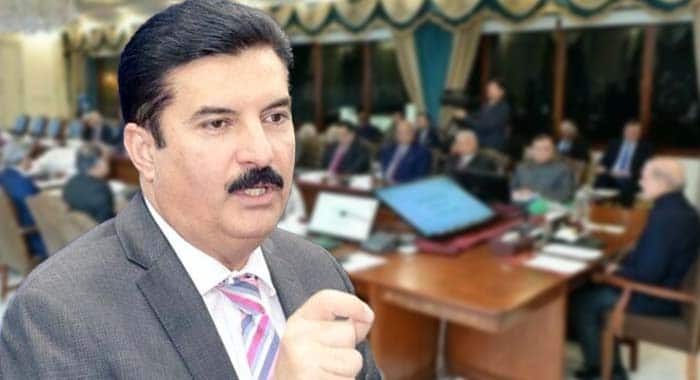
Governor Khyber Pakhtunkhwa Faisal Karim Kundi has categorically stated that the fight against terrorism in the province requires unwavering federal support, stressing that Khyber Pakhtunkhwa cannot effectively confront the growing security challenges without the backing and cooperation of the federal government.
Addressing a ceremony organized by the Council of Pakistan Newspaper Editors (CPNE) in Peshawar, the Governor emphasized that the province has endured enormous sacrifices in the war against terrorism over the past two decades. He maintained that the restoration of sustainable peace, stability and development requires a unified national response, effective institutional coordination and an uncompromising commitment to counterterrorism.
“Without Islamabad’s support, Khyber Pakhtunkhwa cannot fight this war alone,” the Governor asserted, underscoring that combating terrorism is not the responsibility of any single institution but a collective national obligation involving the federal and provincial governments, security forces, police, political leadership, media and society.
Taking a pointed view of the province’s security management, Governor Kundi questioned the previous provincial government’s commitment to institutional coordination and operational preparedness. He stated that despite the persistent threat of terrorism, the previous government convened only one meeting of the Apex Committee during its tenure, reflecting serious shortcomings in security coordination.
He explained that Apex Committee meetings bring together the Chief Minister, Corps Commander, Inspector General Frontier Corps, Inspector General Police, Inspector General Federal Constabulary, Chief Secretary and other senior officials to assess security challenges and formulate coordinated responses.
The Governor also questioned the allocation and utilization of provincial resources, stating that the police had identified a requirement of Rs40 billion, whereas only Rs1 billion had been provided. He stressed that a police force cannot be expected to confront heavily armed and technologically equipped terrorist networks without adequate financial resources, modern equipment, manpower and institutional support.
Referring to the approximately Rs800 billion received by the province under the NFC Award, he questioned why adequate resources had not been allocated to strengthen police and security infrastructure.
He further highlighted the absence of adequate police deployment at divisional headquarters, the lack of new police stations over approximately nine years, and the prolonged failure to implement reforms concerning the Levies and Khasadar personnel.
Recalling the difficult security environment between 2008 and 2013, Governor Kundi highlighted the sacrifices made during the previous counterterrorism campaign, particularly the historic military operation in Swat.
He noted that the operation was undertaken after taking the public into confidence, followed by the displacement of residents, the clearance of terrorist elements and the eventual rehabilitation and return of displaced families.
He maintained that significant improvements in the security situation had been achieved by 2013, but subsequently the province continued to experience a resurgence of terrorism.
The Governor stressed that terrorism cannot be defeated through political rhetoric, selective condemnation or contradictory positions. He called for collective ownership of the security challenge and greater responsibility from all political stakeholders.
Addressing the growing threat of terrorist quadcopter attacks, Governor Kundi questioned the inconsistency in political responses to security incidents.
He recalled that drone strikes in earlier years had generated strong protests and resolutions in the provincial assembly because of civilian casualties. However, he questioned why similar political concern had not been demonstrated over terrorist quadcopter attacks targeting security personnel, police and civilians.
He emphasized that civilian casualties must never be overlooked, while also stressing that attacks by terrorist elements using modern drone technology demand an equally clear and unequivocal response.
The Governor further stated that Pakistan has repeatedly raised concerns at international forums regarding the use of Afghan territory by hostile elements against Pakistan, including concerns involving India and Israel. He questioned the lack of an effective response from the provincial government despite security threats originating from across the border and provocative statements from Afghan officials.
Highlighting the deteriorating security environment, Governor Kundi identified the southern districts of Khyber Pakhtunkhwa, particularly Dera Ismail Khan and Bannu divisions, as areas of serious concern. He also referred to continuing challenges in Kurram.
He observed that the security situation in several areas had deteriorated to the extent that movement after sunset had become increasingly difficult and unsafe.
Rejecting the notion that terrorism could be overcome without effective security measures, he questioned how terrorist networks could be eliminated and areas cleared without meaningful action against those carrying arms and challenging the writ of the state.
He stressed that restoring peace requires practical measures, effective counterterrorism operations, strengthened policing and coordinated action by all relevant institutions.
The Governor reiterated that the federal government’s support is indispensable for addressing the province’s security challenges. He stated that any decision concerning emergency measures must be considered in the context of the prevailing security situation and the need to protect citizens.
He also referred to Bilawal Bhutto Zardari’s efforts to bring political parties together through dialogue and consensus, emphasizing that negotiations can only succeed when all parties honour their commitments and respect agreements reached through political consultation.
He maintained that no political disagreement can justify taking up arms against the Constitution and laws of Pakistan.
Speaking about the media’s responsibilities, Governor Kundi called for a free, independent and financially sustainable press, emphasizing the importance of professional journalism, journalists’ welfare, institutional protection and freedom of expression.
He welcomed recommendations from newspaper editors concerning outstanding payments to newspapers and assured them that he would raise the matter with the relevant authorities to facilitate the settlement of legitimate dues.
He also emphasized that disagreement should be recognized as a democratic strength, criticism as a means of correction and dialogue as the foundation for resolving national challenges.
Concluding his remarks, Governor Faisal Karim Kundi reiterated that the people of Khyber Pakhtunkhwa have already paid an enormous price in the fight against terrorism. The province cannot be left to confront this challenge without adequate federal backing, institutional coordination and political responsibility. The fight against terrorism demands national unity, not political point-scoring; concrete action, not hollow promises; and an unwavering commitment to restoring peace and protecting the lives of citizens.



