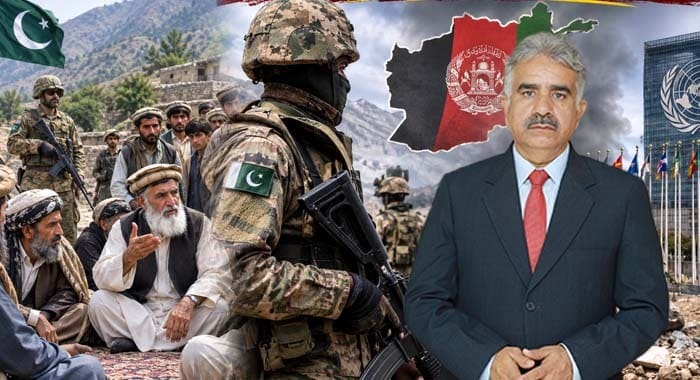
The discussion surrounding Sarah Adams’ assertions about an alleged Al-Qaeda plan against Pakistan raises questions that require careful examination. Adams has suggested that Al-Qaeda’s strategy targets Pakistan and that Jamiat Ulema-e-Islam-Fazl (JUI-F) chief Maulana Fazlur Rahman is connected to the alleged plan. The first question is whether the claims are supported by credible evidence and whether the political implications being drawn from them withstand scrutiny.
Former intelligence operatives may retain contacts and knowledge of the organizations they once monitored. They may also continue to follow the activities and plans of such groups after leaving service. Yet this does not mean every assertion they make should automatically be accepted as established fact. Serious allegations involving a political leader must be assessed on the basis of verifiable evidence, not merely association, speculation or the political weight of the person being named.
One point that deserves consideration is the difference between a political leader’s influence in a region and an operational relationship with a terrorist organization. Maulana Fazlur Rahman and JUI-F have had a longstanding political and religious presence in parts of southern Khyber Pakhtunkhwa, including areas around South and North Waziristan, Tank, Dera Ismail Khan, Bannu and Lakki Marwat. The party’s support draws on religious, social and political relationships that have developed over decades. That influence is a matter of political history, but it does not, by itself, establish participation in an Al-Qaeda plan.
Some figures associated with the banned Tehreek-e-Taliban Pakistan (TTP) have expressed respect for Maulana Fazlur Rahman. Such expressions may be relevant when examining the relationship between religious politics and militant discourse, but they are not proof of an operational alliance. A claim that a political leader is part of a terrorist conspiracy requires evidence of conduct, coordination or material support, rather than an inference based on his constituency, ideology or public standing.
There is also a broader regional dimension. Adams has made assertions concerning the movement of Islamic State Khorasan Province (ISKP) personnel from Iraq and Syria towards the Afghanistan-Pakistan border region. These claims need to be examined alongside credible security assessments and independently verifiable information. The presence and activities of terrorist organizations in Afghanistan remain a serious concern for Pakistan, but the details of any alleged transfer, its scale and the actors involved must be established rather than assumed.
United Nations assessments have repeatedly raised concerns about terrorist organizations operating from Afghan territory, including Al-Qaeda, the TTP and ISKP. Their objectives and relationships are not necessarily identical. Any discussion of cooperation among these organizations, or of arrangements involving the Balochistan Liberation Army (BLA), must distinguish documented links from allegations that remain unverified.
The possibility of tactical cooperation between groups with different immediate objectives is not inconceivable. Organizations may exchange personnel, resources, expertise or logistical assistance when they perceive a common advantage. But the existence of a broad terrorist threat does not establish every alleged connection among the groups, just as the naming of a political party in a report does not establish that party’s involvement in a militant network.
The international dimension makes the issue more complicated. Statements by American officials about preventing Afghanistan from becoming a source of instability for Pakistan can be interpreted as signals of concern about cross-border terrorism. They may also serve diplomatic or strategic purposes. Without further evidence, however, it would be premature to conclude that Washington is preparing a particular intervention or that the allegations surrounding Pakistan’s political leadership are part of a coordinated international plan.
The appropriate response is to examine the evidence, distinguish established facts from conjecture and assess the security implications without allowing speculation to become a substitute for investigation. Pakistan has a direct interest in preventing Afghan territory from being used to organize attacks against its people, while also ensuring that serious accusations against political actors are supported by credible proof.
The Targeting of Tribal Elders and the Destruction of Local Authority
The second issue is the systematic targeting of tribal elders and leaders in Pakistan’s former Federally Administered Tribal Areas (FATA). To understand the significance of these killings, it is necessary to understand the local system that existed before the region’s security crisis intensified.
Under the former Frontier Crimes Regulation (FCR), tribal administration relied heavily on maliks, ‘mashrans’, clan structures and local committees. These arrangements connected village-level affairs with the political administration and placed substantial responsibility on tribal elders for maintaining order. The system had serious limitations, including collective-responsibility provisions that could punish entire communities for the actions of individuals. Nevertheless, local elders occupied an important position in dispute resolution, community representation and the maintenance of social order.
The scale of violence against these figures was therefore consequential. According to the figures cited in this discussion, approximately 188 tribal elders were killed, 62 were injured and two went missing. The violence was particularly severe in North and South Waziristan, which became major centers of militant activity.
These attacks did more than eliminate individual leaders. They weakened the local structures through which communities mediated disputes, communicated with the state and resisted armed groups. When a malik or ‘mashran’ was killed, the consequences extended beyond his family. A community could lose a trusted representative, a dispute-resolution mechanism and a source of resistance to coercion. Repeated attacks could leave residents with fewer safe and effective ways to challenge armed groups.
The emergence and expansion of the TTP deepened this crisis. Armed commanders sought authority not only through weapons but also through religious rhetoric and the assertion of alternative systems of justice and governance. In areas where traditional leaders had been eliminated or intimidated, these commanders could exploit the resulting vacuum. Communities faced the prospect of challenging armed men without the protection of the institutions that had previously helped organize local resistance.
The history of the conflict must be examined carefully. The regional spread of militancy has involved changing organizations, competing agendas, foreign interventions and shifting alliances. The labels applied to armed groups have also changed over time, but the central issue remains the use of violence to impose authority and undermine Pakistan’s constitutional order. Claims about the sponsorship of particular organizations require evidence; what cannot be ignored is the damage inflicted on tribal communities and their traditional leadership.
Security and Development Must Advance Together
The security challenge cannot be separated from the economic and administrative future of the former tribal districts. These areas possess mineral resources and significant development potential, but natural wealth cannot deliver prosperity where insecurity prevents investment, infrastructure construction and normal economic activity.
The argument that political parties should cooperate on security and development is therefore central. JUI-F, Pakistan Peoples Party, Pakistan Muslim League-Nawaz, Pakistan Tehreek-e-Insaf, Awami National Party and regional political groups may differ sharply on national politics. Yet their competition should not prevent them from agreeing on the basic requirements of public safety, functioning institutions, education, employment and infrastructure.
No party can credibly promise lasting development while treating the security crisis as merely an opponent’s political problem. Nor can the state expect communities to reject militancy if the alternative offered to them consists only of enforcement measures without reliable public services, economic opportunities and effective representation.
The discussion around the proposed Apex-level Regional Development Council (ARDC) points towards a model in which security, local participation and development are addressed together. Tribal elders and local representatives could help communicate community concerns, discourage support for armed groups and strengthen cooperation with the state. Such participation, however, must not become a revival of coercive collective punishment. Responsibility should be based on individual conduct and lawful, clearly defined community roles, with due process and protection for residents who oppose terrorism.
The state must also meet its side of the bargain. If communities are expected to reject armed groups, they must see tangible improvements: roads and bridges, reliable communications, schools, colleges, universities, healthcare and employment opportunities for young people. These are not optional benefits to be offered after security has been achieved. They are part of building the conditions in which militant recruitment loses its appeal and communities gain a practical stake in peace.
The experience of the former tribal areas also raises questions about the state’s own record. For decades, these territories remained under a centrally administered system. Their integration into Khyber Pakhtunkhwa required more than a constitutional and administrative change. It required careful planning for policing, law and order, governance, funding and the transition from the previous administrative structure. Where planning and coordination fall short, residents bear the consequences.
Provincial and federal authorities must therefore establish clear responsibilities and long-term commitments rather than repeatedly shifting blame. Short political cycles and changing government priorities cannot provide the continuity required to transform areas that have experienced years of conflict. Development plans must be sustained, adequately funded and assessed against measurable outcomes.
Local Responsibility, National Cooperation
One proposal worth considering is to give local and regional leadership a more direct role in administration and development, potentially through smaller administrative units where appropriate. The objective should not be to fragment the country or transfer security responsibilities to communities without adequate resources. It should be to make governance more accessible, define accountability clearly and ensure that decisions reflect local needs.
The responsibilities of elected representatives and local institutions should be established transparently. Community leaders can support peacebuilding, identify local priorities and help authorities understand emerging threats, but they cannot replace professional policing, intelligence work or the state’s constitutional obligations. Any system based on local responsibility must include safeguards against intimidation, political exploitation and the punishment of innocent residents.
The same principle applies to public-sector appointments. Doctors, engineers, teachers, administrators and other professionals with roots in remote districts can contribute to development when they are willing and qualified to serve there. Local knowledge can help public institutions understand community needs and improve service delivery. However, appointments must also preserve merit, professional standards and equal opportunity. A district’s progress requires both local commitment and capable institutions.
Pakistan’s political leadership must move beyond the idea that security in the former tribal districts belongs to one party, one province or one institution. Terrorism, development and governance are connected challenges that demand sustained coordination among federal and provincial governments, security institutions, elected representatives and local communities.
The central lesson is that defeating terrorism requires more than eliminating armed operatives. It also means restoring the institutions terrorists seek to destroy, protecting community leaders, rebuilding public confidence and ensuring that peaceful civic life offers people greater security and opportunity than life under the threat of armed coercion.
Political parties may continue to compete for power, but that competition must not come at the expense of the country’s stability. The people of the former tribal districts have already paid a heavy price in lives, displacement and lost opportunities. Their future cannot be secured through security operations alone, nor through development promises unsupported by effective governance. It requires both, sustained over time and backed by a genuine national commitment.