
Afghanistan is facing renewed concerns over its security and political stability as prolonged tensions with Pakistan, stalled Chinese-led mediation efforts, and reported clashes between Taliban forces and armed opposition groups raise fears of a possible resurgence of widespread violence.
Recent confrontations involving the Afghanistan Freedom Front (AFF), an anti-Taliban armed group, and Taliban forces in Afghanistan’s northeastern Nuristan province have drawn attention to the evolving security situation. Analysts and officials cited in a report by Nikkei Asia warn that continued hostilities between Islamabad and Kabul, combined with limited progress towards a diplomatic settlement, could create opportunities for anti-Taliban groups to intensify their activities.
The developments have renewed questions about the durability of Afghanistan’s post-2021 security environment and the potential consequences of a prolonged regional confrontation.
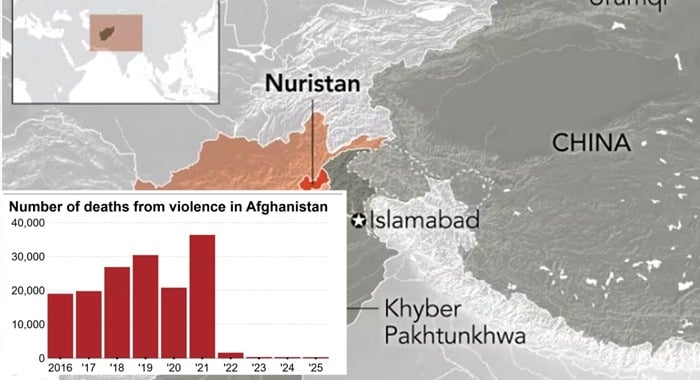
Fighting was reported in late September in Kamdesh district of Nuristan province, which borders Pakistan’s Khyber Pakhtunkhwa province. The confrontations involved Taliban forces and fighters affiliated with the Afghanistan Freedom Front, an armed opposition organisation established in March 2022 following the Taliban’s return to power.
According to a statement published by the AFF on social media platform X, Taliban forces launched an assault on opposition positions in Kamdesh using ground troops and drones. The group claimed that Taliban forces suffered heavy casualties and were subsequently compelled to withdraw.
The Taliban-led Afghan Ministry of Defence offered a different account, alleging in a statement dated 29 September that insurgents had crossed from Pakistan into Afghan territory with the support of the Pakistani military but in fact it was fake and a propaganda by Taliban.
Pakistan rejected Kabul’s allegations. A Pakistani government official, speaking anonymously to Nikkei Asia, said the clashes occurred when Taliban forces attempted to clear mountainous areas where opposition fighters were present.
The competing accounts underline the contested nature of the incident. Independent verification of the casualty figures and the circumstances surrounding the clashes remains essential to establishing a complete picture of the confrontation.
The Afghanistan Freedom Front emerged in March 2022 as an armed movement opposing Taliban rule. According to the Washington-based Institute for the Study of War, the group includes former Afghan security personnel and is led by General Yasin Zia, who served as Afghanistan’s army chief from 2020 to 2021.
The group’s reported confrontation with Taliban forces in Nuristan has drawn attention to the continued presence of armed opposition networks operating against the authorities in Kabul.
Observers cited in the reporting suggest that prolonged tensions between Pakistan and the Taliban administration could provide additional motivation for anti-Taliban groups to expand their operations. Such groups may perceive the deteriorating relationship between Islamabad and Kabul as an opportunity to challenge Taliban authority.
However, the extent of any increase in their military strength, territorial influence, or operational capacity remains difficult to establish conclusively. Isolated clashes do not, by themselves, demonstrate that Afghanistan is returning to nationwide civil war, but they highlight vulnerabilities that could become more consequential if political and security tensions continue to escalate
The latest developments come amid difficulties in Chinese-led diplomatic efforts to reduce tensions between Pakistan and Afghanistan. Beijing has sought to facilitate dialogue through several rounds of engagement, including a meeting in Beijing in May 2025, further discussions in Kabul in August 2025, and seven-day talks in Urumqi in April 2026.
During the Urumqi discussions, China reportedly urged both sides to avoid further escalation and pursue a comprehensive settlement addressing their security concerns. Despite these efforts, tensions have persisted, with both countries experiencing periodic exchanges of fire since October 2025. Continued militant attacks inside Pakistan and subsequent Pakistani military action inside Afghanistan have further complicated the diplomatic environment.
Analysts cited by Nikkei Asia argue that mediation in a conflict involving entrenched security concerns, competing political interests, and cross-border militancy is unlikely to produce immediate or lasting results without sustained cooperation from both sides. The continuing absence of a durable understanding has raised concerns that the confrontation could become increasingly difficult to contain.
A central source of friction between Islamabad and Kabul remains the activities of Tehrik-e-Taliban Pakistan (TTP).
Pakistan has repeatedly accused the Taliban-led Afghan authorities of allowing TTP militants to operate from Afghan territory and of failing to take effective action against the group. Kabul has disputed aspects of Pakistan’s allegations and has raised concerns over Pakistani military operations inside Afghanistan.
The continuing cycle of militant attacks, accusations, and cross-border strikes has placed additional pressure on bilateral relations.
According to the report, Pakistan carried out several waves of airstrikes inside Afghanistan during the two weeks preceding publication, targeting locations it alleged were associated with TTP militants. Afghan authorities claimed that civilians were killed in the strikes but it was also proved as fake as they don’t have evidence of that, adding another dimension to the dispute.
The competing security narratives and the human cost of military operations underscore the urgency of credible communication channels, verifiable information, and diplomatic engagement to prevent further escalation.
Some analysts believe that prolonged tensions with Pakistan could weaken the Taliban administration by placing additional pressure on its security apparatus and creating opportunities for armed opposition groups.
Israr Madani, president of the Islamabad-based International Research Council for Religious Affairs, told Nikkei Asia that anti-Taliban elements within the Afghan diaspora had supported Pakistani strikes against TTP militants inside Afghanistan.
Pakistani officials cited in the report also suggested that anti-Taliban groups could become more motivated to launch attacks if the conflict between Islamabad and Kabul continued without a diplomatic breakthrough. Nevertheless, the political and military implications remain uncertain. The Taliban authorities continue to exercise control over Afghanistan, and the available information does not establish that armed opposition groups possess the capacity to mount a nationwide challenge to their rule. The more immediate concern is whether persistent external tensions and localised armed confrontations could gradually erode security gains and create conditions for a broader cycle of instability.
Historical data illustrate the scale of the potential consequences. According to figures attributed to Sweden’s Uppsala University, deaths from violence in Afghanistan exceeded 36,000 in 2021. The reported number fell sharply to 1,653 in 2022 and declined to fewer than 400 annually over the following three years.
These figures indicate a substantial reduction in recorded violence after the Taliban’s return to power in August 2021, despite the circumstances surrounding their takeover. However, a renewed expansion of armed opposition activity, combined with continuing tensions with Pakistan, could put those gains under pressure. A reversal would carry serious implications for civilians, public services, economic recovery, humanitarian conditions, and Afghanistan’s broader regional relationships.
The distinction between reduced nationwide violence and the persistence of targeted attacks is important. Lower overall casualty figures do not necessarily mean that all regions are secure or that the underlying political and security tensions have been resolved.
Despite the difficulties facing its mediation efforts, China is expected by some analysts to remain engaged in attempts to ease tensions between Pakistan and Afghanistan. Ghulam Ali, an assistant research fellow at National Chung Hsing University in Taiwan, told Nikkei Asia that the limited progress of Beijing’s efforts was not unexpected, given the complexity of the dispute. He suggested that mediation would remain dependent on the willingness of both parties to compromise.
The prospects for direct Chinese engagement with armed anti-Taliban groups appear more limited. Fakhar Kakakhel, a research fellow at Hong Kong Chu Hai College, said China had not established contact with the Afghanistan Freedom Front and was not considering such a step. He suggested that Beijing would be more likely to favour a regional dialogue involving Pakistan, Afghanistan, and Tajikistan.
A broader regional framework could provide an avenue for addressing cross-border security concerns, reducing misunderstandings, and encouraging practical commitments against militant activity. However, any meaningful diplomatic progress would require sustained engagement, verifiable security measures, and a willingness by the parties to address one another’s principal concerns.
Afghanistan’s evolving security situation presents a complex challenge involving the Taliban administration, Pakistan, armed opposition groups, and regional powers seeking to prevent further instability.
The clashes in Nuristan, continuing allegations over cross-border militancy, and the limited progress of Chinese-led mediation have intensified concerns that the current confrontation could create conditions conducive to renewed armed resistance.
Although a return to nationwide civil war is not inevitable, the combination of persistent regional hostilities and internal opposition activity warrants close attention. The consequences of a broader escalation would extend beyond Afghanistan, potentially affecting border security, regional trade, humanitarian conditions, and the stability of neighbouring countries.
Preventing such an outcome will require effective diplomacy, credible action against militant networks, reliable verification of security claims, and sustained efforts to protect civilians.
The central challenge for the region is whether Islamabad and Kabul can move beyond recurring confrontation towards a workable security arrangement before continued hostilities create further opportunities for armed opposition and undermine Afghanistan’s fragile stability.



