
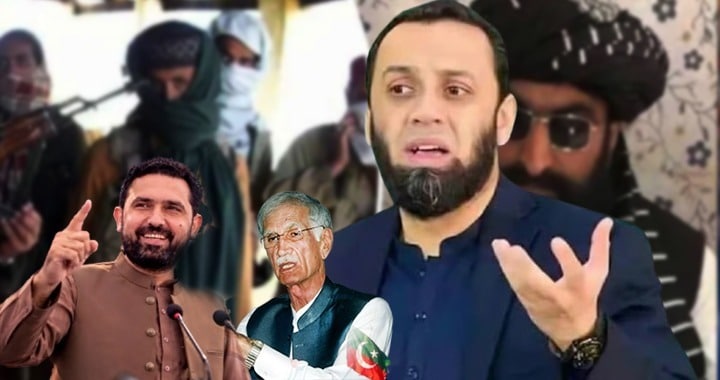
Federal Information Minister Ataullah Tarar has accused the Pakistan Tehreek-e-Insaf (PTI) of facilitating the banned Tehreek-e-Taliban Pakistan (TTP), describing the party as the group’s “B-team” and alleging that the Khyber Pakhtunkhwa government has failed to take effective measures against terrorism despite receiving approximately Rs700 billion through the National Finance Commission (NFC) for counterterrorism efforts.
Speaking at a press conference in Islamabad alongside Prime Minister’s Adviser Ikhtiar Wali Khan and PML-N leader Jalal Khan, Tarar alleged that security operations had cleared areas of terrorists and restored peace, but the subsequent opportunity for terrorists to resettle had undermined those gains.
He questioned why the provincial government had not given adequate attention to essential counterterrorism infrastructure, including the Counter Terrorism Department (CTD), forensic laboratories and Safe City surveillance cameras, despite the substantial funds allocated for security-related requirements.
Tarar said the provincial government’s priorities had shifted away from public service and security towards protests and political confrontation, even as residents continued to face terrorism, violence and instability.
He also referred to police constable Faheemullah, who was martyred in Kohat, and said the families of police personnel and civilians who lose their lives in terrorist incidents deserved answers about the government’s response to the threat.
The minister argued that the people of Khyber Pakhtunkhwa had a right to question whether their government was doing enough to protect them and prevent terrorists from re-establishing their presence in areas previously cleared through security operations.
Tarar Questions KP Government’s Priorities
Tarar said successive PTI governments had pushed Khyber Pakhtunkhwa backwards over the past 13 and a half years, arguing that a province once known for tourism and peace had suffered a significant decline.
He criticized Chief Minister Sohail Afridi for allegedly focusing on protests and political agitation rather than governance, development and the security needs of the province.
The minister questioned how much time the chief minister had devoted to governance and what major development projects his administration had delivered to the public.
He contrasted the situation in Khyber Pakhtunkhwa with other provinces, where he said chief ministers were working on development projects, while the provincial government in KP had failed to give sufficient attention to healthcare, education, roads, universities and information technology.
Tarar argued that effective governance required sustained attention to public needs rather than political mobilization. He maintained that terrorism and insecurity had compounded the difficulties faced by residents, making the restoration of peace and the strengthening of law enforcement institutions particularly urgent.
He also questioned whether the provincial government had invested adequately in the systems required to investigate terrorist incidents, gather forensic evidence, improve surveillance and strengthen specialized counterterrorism capabilities.
Taliban Ideology and Women’s Participation
Tarar also criticized the ideological outlook of the Afghan Taliban, saying their approach restricted women’s freedom and participation in sports and other fields.
He questioned whether such an ideology should be allowed to be imposed across Khyber Pakhtunkhwa, presenting the issue as a broader concern about the province’s social direction and the rights of its residents.
His remarks came as he accused the PTI-led provincial government of failing to deliver on its responsibilities in governance and counterterrorism.
The minister said the province needed a government focused on protecting citizens, improving public services and addressing the security challenges confronting its population rather than prioritizing political interests.
Ikhtiar Wali Alleges Public Funds Were Diverted to Political Activities
Prime Minister’s Adviser Ikhtiar Wali Khan also criticized the PTI government in Khyber Pakhtunkhwa, alleging that public funds had been spent on social media activities and political promotion instead of development and public welfare.
Wali said the party had promised revolutionary changes, a fair system of justice and improvements in education and healthcare, but had failed to deliver on those commitments.
He alleged that the provincial government had not built a single new university despite its development promises, adding that 18 of the province’s 34 universities were approaching financial insolvency.
He also claimed that university projects announced by PTI representatives existed only on paper, with land remaining vacant and no buildings constructed despite claims that students were already studying there.
Wali challenged the party’s representatives to substantiate their claims about new universities, saying he had been carrying the relevant documents for months and was prepared to debate the issue publicly.
He further alleged that the government had neglected educational institutions, hospitals and other essential infrastructure while directing resources towards political activities and social media campaigns.
Tribal Districts and Security Infrastructure
Wali also criticized the handling of funds allocated to the former tribal districts following their merger with Khyber Pakhtunkhwa.
He said the federal government had assured that separate funds would be provided for the development of the tribal districts and alleged that the money had not been spent in accordance with the intended purpose.
According to Wali, infrastructure developed in the tribal districts under previous PML-N governments had not received adequate follow-up investment in subsequent years. He accused the PTI government of failing to build sufficient schools, colleges and police stations after the merger.
He also alleged that approximately 30,000 to 35,000 social media influencers had received monthly payments of Rs50,000 each, questioning the government’s spending priorities amid persistent public-service and security challenges.
Wali said residents across Khyber Pakhtunkhwa continued to face shortages of basic facilities, including access to clean drinking water. He claimed that in some areas, people and animals were forced to drink from the same sources.
He urged young people to question their elected representatives about the province’s worsening conditions, the use of public funds and the absence of improvements in essential services.
Calls for Accountability
Wali argued that the people of Khyber Pakhtunkhwa should not accept deprivation as their fate and called for accountability over the province’s governance and financial management.
He also alleged that certain political figures had experienced a rapid improvement in their personal financial circumstances while public services remained inadequate, citing individuals he claimed had acquired extensive private-school and hospital businesses.
He acknowledged that shortcomings existed across provinces but argued that the development visible in parts of Punjab and Sindh highlighted the need for better governance in Khyber Pakhtunkhwa.
Both Tarar and Wali called for greater attention to public welfare, development and accountability, with Tarar placing particular emphasis on the provincial government’s counterterrorism performance and the security infrastructure he said remained inadequate despite substantial funding.
Tarar maintained that the families of those martyred in terrorist attacks deserved answers, while the people of Khyber Pakhtunkhwa needed a government that prioritized security and public service over political confrontation.



