
From the central leadership of Pakistan Tehreek-e-Insaf, or PTI in short, to its provincial and district leaders, and from the party’s ordinary supporters to its most ardent devotees, the same question keeps coming back. I use the word devotees deliberately, because PTI is not really a political party but a fan club. And even if, by the wildest stretch of the imagination, it is accepted as a political party, it is perhaps the only one in the country, if not the world, without a single worker. After all, a worker is supposed to possess at least some political awareness and a basic understanding of the issues. PTI’s rank and file, or rather the admirers of its founder, fail even this elementary test. Political acumen is one thing, but these people appear deprived of even ordinary common sense. The saying “common sense is not common” may apply elsewhere, but it fits PTI’s self-proclaimed followers to perfection.
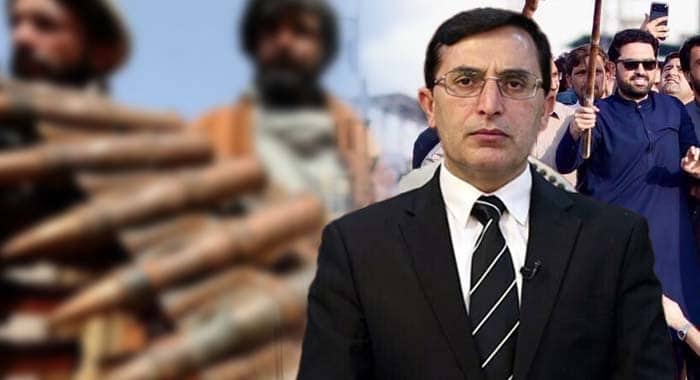
Whether this assessment is right or wrong can easily be judged from a statement by PTI’s powerless chairman, Barrister Gohar Ali Khan, whose authority appears to be as hollow as his title. Speaking to the media in Charsadda, he was, beyond doubt, trying to reassure the intellectually challenged participants of his party’s long march, which would be more appropriately described as a farce march, given the apparent absence of reason among those taking part in it and their blindness to everything except their devotion to PTI’s founder.
Barrister Gohar declared that PTI stood with the state in the war against terrorism. Yet, in the very next breath, he demanded that the state change its policy against terrorism. One wonders how the two positions can possibly be reconciled.
But the PTI chairman did not stop there. He went a step further and scattered such pearls of wisdom that the world could scarcely contain its amazement. He argued that the policy against terrorism must be changed from time to time.
What a revelation! Apparently, the state had never considered the need to review its counterterrorism strategy in response to changing circumstances until Barrister Gohar arrived to enlighten it.
After that, the self-styled chairman of PTI appeared less like the leader of a political party and more like the lawyer and spokesperson of Khyber Pakhtunkhwa Chief Minister Sohail Afridi. He declared that Afridi had never made a statement in support of terrorists. He also claimed that what was happening to Afridi today should serve as a lesson for other provinces.
Like his party’s founder, Barrister Gohar also brazenly accused the coalition parties in the government of running a false narrative against PTI. The accusation itself was baseless, yet he appeared to feel not the slightest embarrassment while making it.
The same powerless chairman who comes up with gems such as “democracy has been brought to a traffic jam” should be asked a few straightforward questions.
If PTI truly stands with the state in the war against terrorism, how can it simultaneously demand that the state change its counterterrorism policy? And how does the word change find its way so readily onto the tongues of people who claim to stand with the state while questioning the very policy through which it confronts terrorism?
There is, moreover, a government in this state. What exactly prevents PTI from standing with that government if it genuinely stands with the state? Is the distinction between the state and the government invoked only when it suits the party’s political convenience?
Barrister Gohar should also answer another set of questions. Whether it is Sohail Afridi, the other so-called political heavyweights of the founder’s fan club, most of whom are political turncoats and opportunists, or Barrister Gohar himself, the question is not merely whether they have ever issued statements in support of terrorists. The more pertinent question is whether they have ever spoken out against them with the same determination and publicity they reserve for their political grievances.
Has Barrister Gohar ever bothered to condemn even a single terrorist attack? Has Sohail Afridi? Have the other prominent faces of PTI consistently and unequivocally condemned terrorist violence?
Have the leading figures associated with the party’s fan club not repeatedly argued, openly and without apparent hesitation, that condemning terrorists would get them killed? Have they not invoked the example of the Awami National Party (ANP), suggesting that the party paid a terrible price for speaking against terrorists? Have such arguments not been repeated time and again?
If the answer to these questions is yes, then Barrister Gohar’s claim that PTI stands with the state against terrorism deserves far more scrutiny than his carefully worded declaration suggests.
And what explanation does he have for his founder’s own admission? In an interview, PTI’s founder acknowledged that his government had brought back and resettled 40,000 to 45,000 terrorists from Afghanistan, including 5,000 to 7,000 fighters. Indeed, he has repeatedly taken credit for this decision with considerable pride.
What does Barrister Gohar have to say about that? Does he defend the decision, dispute the admission, or believe that the consequences of bringing thousands of terrorists back into the country have nothing to do with the security challenges Pakistan faces today?
Did PTI’s founder not repeatedly advocate opening an office for the Taliban in Peshawar? Was this not part of the political approach he promoted towards the group?
And finally, but no less importantly, did PTI’s founder not earn the nickname Taliban Khan? More to the point, did he not earn it for good reason?
Barrister Gohar would do well to explain why that name became associated with his party’s founder in the first place. Until he does, his declaration that PTI stands with the state against terrorism, immediately followed by a demand to change the state’s counterterrorism policy, will remain an exercise in political contradiction.
A party cannot claim solidarity with the state while evading the most uncomfortable questions about its own record, its political choices, and its response to terrorism. Nor can a declaration of support substitute for an unequivocal condemnation of terrorist violence.
The question, therefore, is not simply whether PTI says it stands with the state. The real question is what that claim amounts to when its leadership is asked to account for the words and actions of its own founder.



