
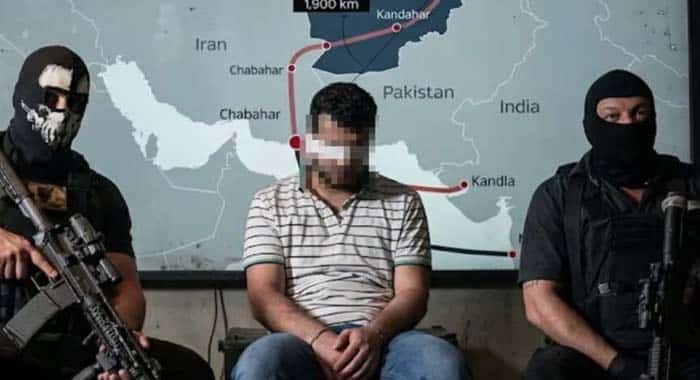
The reported arrest in Italy of Mirwais Safi, an Afghan-based operative allegedly linked to Islamic State Khorasan Province (ISKP), has brought renewed attention to the increasingly transnational character of militant networks operating in and around the Afghanistan-Pakistan region.
The development represents more than another European counter-terrorism operation. It highlights a security reality that regional analysts and international security agencies have repeatedly warned about: extremist networks operating from South and Central Asia can develop connections, logistical channels and ideological influence that extend far beyond the region, eventually reaching European cities and other Western jurisdictions.
The reported apprehension of Safi therefore raises broader questions about the ability of militant networks associated with the Afghanistan theatre to maintain operational or ideological links with individuals and networks outside the region.
European counter-terrorism operations frequently focus on identifying and disrupting locally based cells, radicalization networks and individuals suspected of facilitating extremist activity. However, cases involving individuals allegedly connected to the Afghanistan-Pakistan militant theatre demonstrate the increasingly international dimensions of the threat. Modern extremist networks are not necessarily dependent on a single physical base or conventional organizational structure. They can operate through dispersed individuals, online communities, encrypted communications, informal financial channels and cross-border personal connections.
This makes the security situation in Afghanistan relevant not only to its immediate neighbours but also to European and Western security institutions. The reported arrest in Italy consequently raises an important question for policymakers: Can extremist networks operating from Afghanistan truly be contained within Afghanistan’s borders? The available experience suggests that the answer requires serious examination.
The development also places renewed focus on the security environment inside Afghanistan under the Taliban’s de facto administration. The Taliban have repeatedly stated that Afghan territory will not be permitted to be used against other countries and have portrayed their counter-terrorism campaign against ISKP as evidence of their determination to prevent Afghanistan from becoming a base for international terrorism. At the same time, international governments and regional stakeholders continue to express concerns regarding the presence and activities of various militant and extremist organizations in Afghanistan.
The reported case in Italy adds another dimension to that debate. If individuals with operational or ideological links to Afghanistan-based extremist networks are able to establish connections in Europe, it demonstrates the importance of examining not only attacks themselves but also the networks, recruitment mechanisms, communications infrastructure and cross-border relationships that facilitate them.
ISKP has repeatedly demonstrated its ambition to operate beyond a purely local Afghan battlefield. The group has promoted a transnational extremist ideology and has sought to exploit instability, sectarian tensions and weak security environments. Its threat is therefore fundamentally different from that posed by an armed group whose objectives remain confined to a particular territory.
For European security agencies, the concern is not simply whether ISKP can physically dispatch operatives abroad. The more complex challenge involves the possibility that individuals already present in Europe could be radicalized, recruited, directed or otherwise connected to networks operating in the Afghanistan region. Digital technology has made that challenge substantially more difficult to contain.
Contemporary extremist organizations can exploit encrypted messaging platforms, online propaganda, social-media ecosystems and decentralized recruitment mechanisms to establish relationships across continents. Individuals do not necessarily need to travel directly from an established militant stronghold to a European city to become part of a wider extremist network. Online radicalization can precede physical contact.
Informal facilitators can connect individuals across borders. Irregular migration routes can create additional vulnerabilities. And fragmented networks can make traditional intelligence methods more difficult to apply. The reported arrest of Safi therefore warrants attention not only as an individual law-enforcement case but also as an opportunity to examine how extremist networks associated with the Afghanistan theatre potentially connect with European environments.
For years, neighbouring countries and regional security analysts have argued that instability in Afghanistan cannot be treated exclusively as an internal Afghan matter. The country’s geography, history of militant activity and connections to transnational extremist organizations mean that developments inside Afghanistan can have consequences well beyond its borders. A security vacuum in one region can become an intelligence challenge in another. A recruitment network in one country can produce a security investigation thousands of kilometres away.
And an extremist ideology propagated online from one conflict theatre can ultimately manifest itself in a European city. This interconnectedness makes the security situation in Afghanistan an issue of regional and international security, rather than solely a domestic Afghan concern.
The reported Italian arrest also presents a challenge for international policymakers engaging with Afghanistan’s de facto authorities. Engagement with Kabul inevitably involves questions of security cooperation, counter-terrorism assurances and verification. The critical issue is not simply whether assurances are issued.
It is whether those assurances can be independently verified through sustained, measurable and transparent counter-terrorism action. International stakeholders therefore face a difficult balance: maintaining channels necessary for humanitarian, diplomatic and security communication while ensuring that counter-terrorism commitments are not accepted solely on the basis of political declarations.
Any credible assessment must examine whether extremist infrastructure is actually being dismantled, whether transnational networks are being disrupted, and whether Afghan territory is effectively prevented from being used to facilitate violence beyond Afghanistan’s borders.
The case also reinforces the importance of accountability. Where credible evidence establishes links between individuals operating in Europe and extremist networks connected to Afghanistan, European law-enforcement and judicial authorities must be able to pursue those networks through evidence-based investigations and appropriate legal mechanisms.
At the same time, regional authorities must recognize that counter-terrorism cooperation cannot be reduced to selective action against one organization while other transnational networks remain insufficiently addressed. Terrorism does not respect political boundaries. Neither does extremist propaganda. Neither do digital recruitment networks. And neither do the consequences of security failures.
The reported arrest of Mirwais Safi should therefore be viewed within the broader evolution of the international terrorism threat. It illustrates how the Afghanistan-Pakistan security environment can intersect directly with European counter-terrorism concerns. For European policymakers, the development underscores the importance of sustained intelligence cooperation, monitoring of transnational extremist networks, disruption of online radicalization and close scrutiny of links between individuals in Europe and militant networks operating in conflict-affected regions.
For regional stakeholders, it reinforces an equally important lesson: Afghanistan’s security cannot be separated from the security of its neighbours or from the security of countries thousands of kilometres away. The international community cannot afford to view extremist networks through a purely geographic lens.
The reported Italian operation ultimately points to a broader reality: the consequences of instability and extremist infrastructure are not necessarily confined to the territory where those networks originate or operate. The distance between Afghanistan and Europe may be thousands of kilometres, but modern militant networks can bridge that distance through technology, ideology, personal connections and clandestine facilitation. That makes effective counter-terrorism a shared international responsibility.
For Kabul, the episode underscores the continuing importance of demonstrating through verifiable action rather than assurances alone that Afghan territory will not serve as an enabling environment for transnational extremist activity. For Europe, it is a reminder that developments in Afghanistan can have direct implications for domestic security. And for the wider international community, it reinforces a fundamental principle:
The reported arrest in Italy should therefore prompt renewed scrutiny of the transnational pathways connecting extremist actors in the Afghanistan theatre with networks and individuals abroad—and reinforce the need for sustained, evidence-based international cooperation to prevent Afghanistan’s security challenges from becoming tomorrow’s European security crises.



