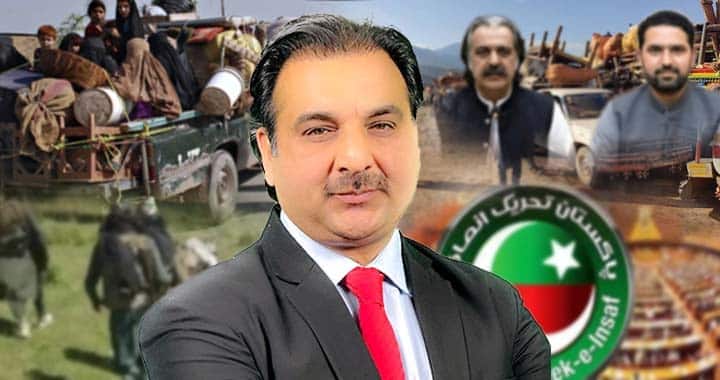
The question of how the PTI leadership has approached the Taliban and terrorism is not new. Since 2009, there have been repeated statements about negotiations, ceasefires, amnesties, rehabilitation and resettlement. The party’s founder has himself made around 16 such statements, including remarks to international media.
At one point, he said that if they came into power in Khyber Pakhtunkhwa, they would give the banned Tehreek-e-Taliban Pakistan (TTP) an office in Peshawar, open the doors of the Chief Minister’s House for them and settle them here. That may be the personal wish of an individual, but the state cannot formulate its internal or external policies, including Afghan policy and international affairs, according to one person’s wishes.
If you negotiate with a militant organization, regardless of the terms and conditions, you also have to consider how the international community will view that decision. How will the United States, the UK, Russia, China and the Gulf countries respond? Will they continue cooperating with you on your other policies, particularly when you are also seeking support from institutions such as the IMF? I do not think a state can negotiate with a militant organization and then expect the state itself to operate according to that organization’s terms.
There is one fundamental reason we have repeatedly discussed: they are afraid of them.
This is not something that started today. In meetings of their parliamentary party dating back to 2011, 2012 and 2013, they had decided that if they spoke against terrorist organizations, took action against them or formulated policies against them, they could meet the same fate as the Awami National Party and JUI.
That is why, even when they know the reality, they deliberately divert the discussion.
There are two important dimensions to what is happening. One is external funding aimed at destabilizing Pakistan. Different methods are used for this purpose.
The first is conventional warfare through terrorism, targeting your defence line, Army, security forces, law-enforcement agencies and police. The objective is to destabilize the system through terrorism.
The second method is social media. A narrative is created to turn the public against state institutions and generate mistrust.
The third is the use of a political party. When a political party goes against state policy, it can be supported for that purpose.
At present, we are seeing PTI as the political group that is most openly confronting state policy. In the province where it is in government, the Chief Minister has even spoken in a manner that ridicules the sacrifices of 80,000 martyrs.
Just recently, a police officer was martyred in Chamkani. At his funeral, Sohail Afridi could not leave the Chief Minister’s House and walk the very short distance to the police lines to attend the funeral. When terrorism is taking place in your province and police officers are being martyred, but you do not participate in their funerals, what message are you giving?
Then you accuse the Centre. Will Maryam Nawaz come from Lahore to attend the funeral? Will Shehbaz Sharif or Murad Ali Shah come from their provinces? When you cannot walk a few hundred steps to attend the funeral of a police officer in your own province, but continue accusing others, that narrative is not being spread only by anti-Pakistan social media accounts. Accounts associated with terrorist organizations and accounts based in Afghanistan are also promoting the same narrative.
These three are in a nexus. They are united and promote each other’s narratives against state institutions.
The actual responsibility of a provincial chief executive is to govern the province. Whether Sohail Afridi does not do this, does not understand it, or is inexperienced, the result is the same. When terrorism is affecting your own province and you do not take ownership of it, the consequences are obvious.
This has happened in Balochistan as well, but the Chief Minister there holds press conferences regularly and takes ownership of the situation. It happened in this province in the past too, from 2008 to 2013. There were operations and agreements, but the then provincial government owned those decisions and took responsibility for them.
When you are sitting in the seat of an elected government and enjoying its authority, you also have to take ownership of the province’s war on terror, governance and law-and-order situation. If you do not, it is obvious where these matters will go.
We have to look at the past as well. When the ANP and PPP were in government, they took ownership of the situation and made decisions at both the provincial and federal levels. The Khyber Pakhtunkhwa government also accepted that the Swat operation was necessary.
At that time, the banned TTP kept announcing that it was only 26 kilometers from Islamabad. The operation took place, and 16 or 17 years have now passed. Is there peace in Swat today? There is.
Around four million people were displaced and subsequently rehabilitated. That is an example of better governance. It is also an example of political ownership.
Here, you can call it ignorance. You can call it fear. They are terrified. They are taking new steps every day to impress the youth and the unemployed, seeking their sympathies and influence.
They are being very non-serious about serious issues.
Terrorism policy is not the policy of an individual or a provincial unit. It is not a policy that any one province can decide independently. It is a state policy. If the Centre decides to deal with terrorism in a particular way, it is the Centre that has to make that decision.
Look at the history of negotiations. Since 2003-04, there have been several agreements involving the government of Pakistan and Khyber Pakhtunkhwa with different terrorist organizations. Among the important ones were the Shakai agreement, the agreement involving Maulvi Faqir Muhammad, the Swat agreement with Sufi Muhammad and Mullah Fazlullah, and an earlier agreement involving Mangal Bagh.
Not a single one of these agreements produced lasting peace. There was never an agreement where both sides sat down, reached an understanding and the matter remained settled.
There was the Shakai agreement. The terrorists violated it and a security operation followed. There was the agreement in Swat. The terrorists did not honor it, and an operation followed. There was an agreement with Maulvi Faqir Muhammad. He did not act upon it, and an operation followed.
So all these agreements are now part of history and the record. When such agreements were made in the past, who violated them and why? Having seen this history, will the state now be forced to negotiate with them again?
Is the state so weak that eight thousand, ten thousand or twenty thousand people can pressure it into kneeling before them and accepting their conditions?
That can never happen.
The state negotiates with a state, not with a terrorist organization.
This is a war and it is still going on. In the coming days, it may become more intense. Non-state actors that are enemies of the country and want to bring the system to a standstill are working through different agendas.
They are spending millions of rupees on social media to create an atmosphere of distrust. They are trying to pressure political parties into turning against the state. They are funding terrorism and operating from Afghanistan to destabilize Pakistan.
They want to create fear. They want to weaken the defence line. They want people to lose trust in their institutions and turn against the state.
But they have not succeeded.
They have been involved in this for more than a decade and have failed. After realizing that their previous methods were not working, they turned increasingly toward social media. When that also failed to produce the desired result, they sought support through political parties.
Sometimes they operate under the name of separatism and sometimes under the name of nationalism. They keep giving their campaign different names and using different tactics.
They know that whatever options they have used and whatever efforts they have made have so far failed. They have invested billions of dollars to destabilize Pakistan, but they have not succeeded. That is why they continue to resort to different tactics.