
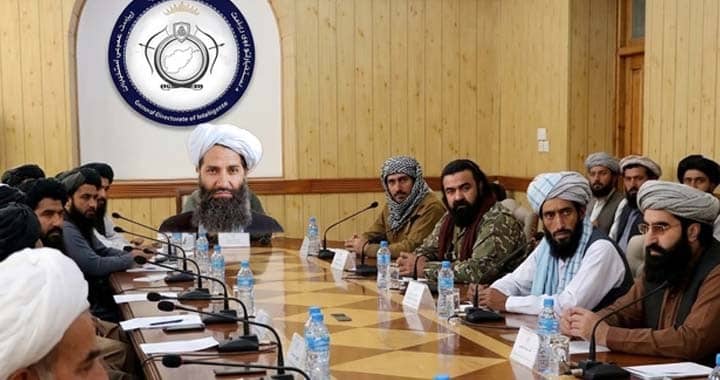
Afghanistan’s General Directorate of Intelligence (GDI) has raised concerns over direct links between India’s Research and Analysis Wing (RAW) and anti-Pakistan terror groups operating from Afghan soil, directing that such contacts should henceforth be handled through the Afghan intelligence agency, according to Taliban sources.
The revelation came after another secret meeting in Kandahar involving Balochistan Liberation Army (BLA) chief Bashir Zeb, Hafiz Gul Bahadur and a commander of Al-Qaeda in the Indian Subcontinent (AQIS), where plans for coordinated terrorist attacks against Pakistan were discussed.
According to the sources, the meeting focused on carrying out coordinated attacks in Balochistan. Hafiz Gul Bahadur and the AQIS commander reportedly agreed to provide manpower and weapons to support the planned operations.
The sources said the participants also discussed arrangements for training BLA members at camps linked to AQIS, indicating efforts to strengthen operational coordination among the anti-Pakistan terrorist groups.
The reported intervention by the Afghan GDI is the latest development in a series of meetings between AQIS and anti-Pakistan terrorist groups under the auspices of the Afghan Taliban. Rather than ending the groups’ contacts, the reported directive seeks to place such interactions under the supervision of the Afghan intelligence apparatus, according to the sources.
The latest development comes against the backdrop of an emerging intelligence picture pointing to a broader nexus among the BLA, the Hafiz Gul Bahadur faction and AQIS, with the groups allegedly seeking to rebuild their operational capacity after suffering significant losses in counterterrorism operations by Pakistan’s Security Forces.
An intelligence assessment cited by security sources has previously alleged that Afghanistan-based actors were facilitating the network, while RAW was providing financial and logistical support for activities targeting Pakistan. The allegations could not be independently verified.
The assessment said a series of Kandahar meetings had brought together senior representatives of the three groups to discuss coordinated terrorist operations in Balochistan. It further alleged that Afghanistan’s GDI assured BLA representatives of support for terrorist activities inside Pakistan during a meeting in July.
The assessment also alleged that the BLA provided 3.5 million Afghanis to Jamaat-ul-Ahrar for coordinated terrorist operations in Balochistan, while RAW allegedly provided $7.5 million to the GDI to facilitate coordinated activities involving the BLA and TTP-linked terrorists. These clandestine allegations could not be independently verified.
Another emergency meeting was reportedly held in Kandahar on August 26 after what the groups described as major losses inflicted by Pakistan’s Security Forces. BLA representatives allegedly acknowledged shortages of manpower and resources, prompting discussions on obtaining additional fighters, weapons, funding and logistical support from allied terrorist networks.
According to the assessment, the Hafiz Gul Bahadur faction and AQIS were tasked with supporting the BLA, while the participants also discussed a coordinated media campaign aimed at amplifying the impact of terrorist attacks and spreading fear across Balochistan.
The intelligence picture further points to an effort to replenish manpower through recruitment of Baloch youth, who are allegedly being sent to an AQIS-linked specialized training facility before deployment for terrorist activities.
A coordinator was reportedly designated to arrange fighters, financing, weapons and ammunition for selected targets, suggesting that recruitment, training, financing and operational deployment are being organized through interconnected channels rather than as isolated activities by individual groups.
The assessment identifies September 1 as another key date, alleging that instructions were issued from an office associated with Taliban Supreme Leader Sheikh Hibatullah Akhundzada to facilitate weapons support for the BLA. Assault rifles, rocket-propelled grenades and ammunition were reportedly ordered to be released and transported through designated channels. The claim could not be independently verified.
The reported coordination also points to an attempt by the BLA to expand its operational footprint into the Pashtun belt of Balochistan while relying on other terrorist organizations for manpower, training, financing and logistics.
Pakistan has repeatedly raised concerns over the presence of terrorist groups on Afghan soil and their use of Afghan territory to plan and facilitate attacks inside Pakistan. Islamabad has also maintained that it reserves the right to exercise self-defense against terrorist threats emanating from across the border.
The reported network presents a broader counterterrorism challenge because losses suffered by one organization can potentially be offset through shared manpower, weapons, financing, training and logistical channels involving multiple terrorist groups.
Pakistan’s Security Forces have continued intelligence-based operations against terrorist networks, with a focus on disrupting recruitment, financing, weapons movement and cross-border facilitation.



