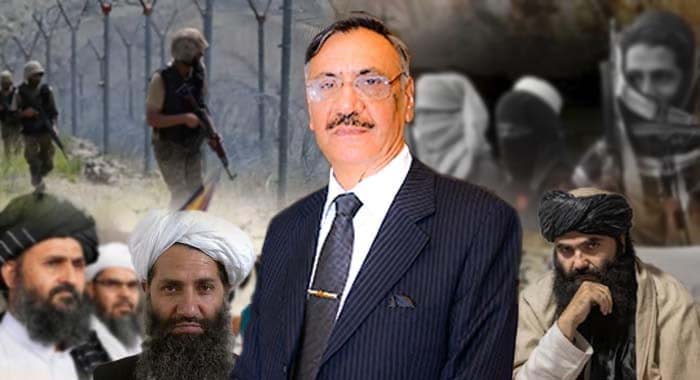
Brig (R) Mahmood Shah
The situation between Pakistan and Afghanistan is becoming increasingly serious, and the latest developments suggest that the nature of the confrontation is changing rapidly. Recent airstrikes in Pakistan’s Paktika and Kunar areas have been followed by an attempted response from the Afghan Taliban in the Kurram sector. According to the account of the latest developments, Pakistan’s security forces successfully thwarted that attack. What makes the situation particularly concerning is that the confrontation is no longer limited to conventional firing, explosions or militant attacks along the border. The reported use of drones has introduced another dimension to an already tense relationship between the two countries.
According to the information discussed, eight drones came from Afghanistan and were successfully intercepted by Pakistan’s security forces. Four of these drones were brought down in the Torkham area, while another four were intercepted in Kohat. The successful response demonstrates that Pakistan’s security forces are prepared to deal with this kind of threat, but the incident itself raises important questions about the changing character of the security challenge. The tension between Pakistan and Afghanistan is increasing, and every new incident has the potential to trigger another response from the other side.
The latest developments also need to be viewed against the backdrop of a series of incidents in Khyber Pakhtunkhwa. Before the developments in Kohat, there was an explosion in Kurram, followed by incidents in Kohat and Hangu. The repeated attacks have created growing concern about the activities of the Afghan Taliban or groups referred to by Pakistan as Fitna al-Khawarij. The important issue is not merely the identity or terminology associated with these groups, but the fact that attacks are taking place with increasing frequency and are creating a serious security challenge for Pakistan.
The situation is becoming worse, particularly because the threat is not necessarily developing in the form of a conventional war. Pakistan has extensive experience in fighting wars and possesses considerable military capability. In a conventional war, Afghanistan does not have the same power as Pakistan. The military balance between the two sides is therefore very different. Pakistan possesses sophisticated aircraft, sophisticated weapons and considerable experience in dealing with security threats. Yet the absence of conventional strength does not mean that an adversary cannot create serious problems through unconventional methods.
The Afghan environment has historically produced considerable experience in what can be described as hit-and-run operations. Foreign powers that entered Afghanistan, including Russia and America, encountered a very different kind of battlefield from a conventional state-to-state war. The methods used in such an environment rely heavily on irregular warfare, sudden attacks, movement through difficult terrain, bombs and other forms of asymmetric action. The argument is that this is the type of experience that has developed over time, rather than the ability to confront Pakistan directly in a conventional war.
That distinction is extremely important. A weaker side does not necessarily need to defeat a stronger military in a conventional battle to cause damage. It can attempt to use terrorism, bombs, sudden attacks and other unconventional methods to create insecurity. The thinking behind such operations is not to fight the stronger military directly but to find vulnerable points and attack them. This is why Pakistan cannot assess the threat solely by comparing the military strength of the two countries.
The reported use of small drones is another example of this changing form of warfare. The drones discussed in the latest incident were described as low-quality and relatively small. They were compared to the type of drones that are commonly used at weddings and other civilian occasions. The suggestion was also made that such drones could potentially have been supplied by India, manufactured locally or otherwise acquired for this purpose. Whatever their actual origin, the broader point remains that relatively simple drone technology can now be used in a security environment.
At the same time, it is important not to exaggerate the military significance of such drones. Pakistan possesses sophisticated aircraft and sophisticated weapons, while the drones described in the discussion were considered to be comparatively primitive. They cannot be regarded as a conventional military force capable of matching Pakistan’s air power. The fact that all eight reported drones were successfully intercepted also demonstrates that Pakistan has the ability to respond to such threats.
But a small weapon can still become dangerous when used for an attack. The question is not simply whether a drone can defeat Pakistan’s military. The question is whether it can be used to cause damage, create fear, conduct surveillance or assist an attack. The proliferation of relatively simple drones means that security forces must increasingly be prepared to deal with threats that do not require sophisticated military technology.
There is another reason why Pakistan must remain cautious. Pakistan may possess the capability to inflict significant damage on Afghanistan, but that does not mean that defeating Afghanistan and remaining there would serve Pakistan’s interests. Pakistan does not want to defeat Afghanistan, occupy the country and sit there indefinitely. The objective is not to conquer Afghanistan. The objective is to protect Pakistan.
This distinction is particularly important because Afghanistan has historically been an extremely difficult environment for foreign powers. Russia entered Afghanistan and eventually left. America also entered Afghanistan, remained there for approximately twenty years and spent billions of dollars. Yet even with enormous military and financial resources, the fundamental problems of Afghanistan could not simply be resolved through foreign military presence.
The lesson for Pakistan is clear: military power should not be confused with the ability to transform another country. Pakistan does not need to repeat the experience of foreign powers that entered Afghanistan and became involved in a prolonged struggle. It does not serve Pakistan’s interests to occupy Afghanistan. Pakistan’s interest is to prevent attacks against its own territory and its own people.
The economic condition of Afghanistan is another important part of this problem. The country has historically depended heavily on foreign assistance. It has struggled to generate sufficient resources to run its government and develop its economy independently. The argument presented in the discussion was that Afghanistan repeatedly looks toward foreign countries for financial support because it does not possess enough economic strength to sustain its system on its own.
Afghanistan also faces a serious problem involving its educated population. Those who become educated often leave the country and seek opportunities elsewhere. They go to America, Europe, Britain and other foreign countries, where they can find opportunities that may not be available to them inside Afghanistan. If educated people continually leave, Afghanistan loses precisely the human resources it needs to build its institutions, businesses and economy.
This creates a difficult cycle. A country without sufficient economic opportunities cannot easily retain its educated population. When educated people leave, development becomes even more difficult. When development remains weak, the dependence on foreign assistance continues. The result is a country that struggles to build the kind of stable economic and political system that could provide long-term security.
The broader problem is also connected to governance. The argument raised in the discussion was that Afghanistan has struggled to establish a functioning system capable of controlling the country effectively. When there is weak government authority and weak enforcement of law, armed groups and extremist elements can find space to operate. Such an environment can become dangerous not only for Afghanistan but also for the countries around it.
Afghanistan has therefore been described as a region capable of becoming dangerous for the wider world. The presence of foreign militants, including Osama bin Laden and others, was cited as an example of how people rejected or unwanted elsewhere could find a place in Afghanistan. When there is no effective government control and no effective system of law, individuals and organisations can establish themselves and operate from within the country.
The problem becomes even more serious when such individuals or groups use Afghanistan as a base for activities beyond its borders. Pakistan has experienced the consequences of instability and terrorism in the region. This is why what happens in Afghanistan cannot simply be treated as an Afghan issue. When instability crosses the border, it becomes a Pakistani security issue as well.
There is also a profound contradiction in the behaviour of extremist groups that invoke Islam while committing acts of violence. The discussion highlighted the fact that some groups use the name of Islam while attacking mosques and Muslims themselves. Such behaviour exposes the contradiction between their religious claims and their actions.
If a group claims to represent Islam but attacks a mosque, kills Muslims and targets innocent people, its actions cannot simply be justified by invoking religion. The use of Islamic terminology does not transform terrorism into an Islamic act. The violence committed by extremist groups has consequences for Muslims themselves, who are often among its victims.
This also demonstrates why terrorism cannot be defeated only through military means. Weapons can target individuals and organisations, but they cannot automatically eliminate the ideas and narratives that encourage people to participate in terrorism. The ideological dimension of the problem must also be confronted if the cycle is to end.
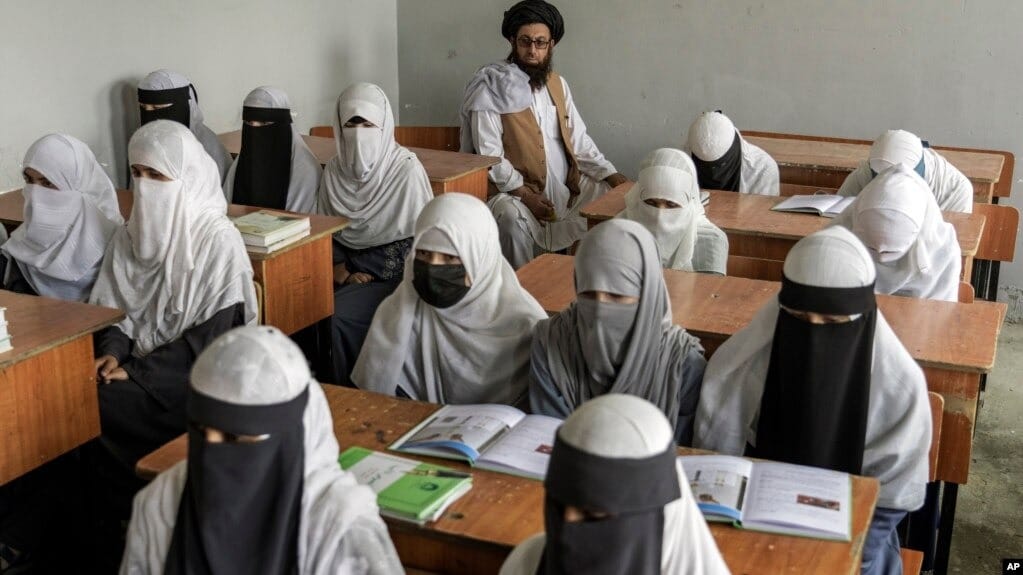
The situation inside Afghanistan is further complicated by weaknesses in healthcare and restrictions affecting women. The discussion raised serious questions about whether adequate hospitals exist to treat sick people and whether sufficient healthcare is available for women. The restrictions placed on women’s education were also highlighted as part of the broader crisis.
Education is essential for any country’s future. When women and girls are prevented from receiving education, a country loses an important part of its potential human capital. It becomes more difficult to produce educated teachers, doctors, professionals and other skilled people who are required to develop society.
The international community has the ability and resources to contribute toward addressing these problems if it chooses to do so. The argument is that the countries of the world possess enough power and money to help Afghanistan develop and improve its conditions. Yet the international community has not necessarily been willing to take responsibility for fixing Afghanistan, particularly after the experiences of previous foreign interventions.
This reluctance leaves Pakistan in a difficult position. Pakistan is directly affected by what happens across the border, while other countries may be geographically distant from the immediate consequences. The country therefore believes that the world should recognise the burden Pakistan has carried because of instability and terrorism in the region.
This was also the message referred to in Pakistan’s prime minister’s speech at the United Nations: that Pakistan has carried a burden on behalf of the wider world. The argument was that if Pakistan had not opposed extremist forces and helped keep them contained in the region, their activities could potentially have reached places such as New York and London. The broader point was that the international community should recognise the sacrifices Pakistan has made while dealing with terrorism.
The current situation in Khyber Pakhtunkhwa makes this issue even more urgent. If explosions and attacks continue in places such as Kurram, Hangu and Kohat, Pakistan will have to consider what additional measures are required to prevent the situation from deteriorating further. One possible question is whether Pakistan will conduct additional airstrikes against areas of Afghanistan where terrorists are believed to be operating or taking shelter.
But the most important requirement should come before any such response: the border must be strengthened. A stronger border does not simply mean putting more soldiers at more checkpoints. It means creating a much stronger security presence in the former tribal areas and developing the ability to understand what is happening there. These areas are important because militants can potentially use them as assembly areas before carrying out attacks.
If an attack occurs in Kurram or Hangu, the people responsible must have gathered somewhere before launching the operation. They must have moved through an area, remained somewhere, prepared their equipment and possibly rehearsed their operation. They may have travelled back and forth before the attack. The critical question is therefore why their presence was not detected before the attack took place.
This is where intelligence becomes essential. Security forces need to know where these people are gathering. They need to know where they are staying. They need to understand their movements. They need to identify the places they use for preparation. They need to know when people are entering an area and when they are leaving. Without this information, security forces may repeatedly find themselves responding only after an attack has already happened.
A stronger presence in the former tribal areas is therefore essential, but that presence must be supported by technology and intelligence. It is not enough simply to place personnel in an area and expect them to see everything that happens around them.
Modern surveillance capabilities can provide another layer of protection. The discussion included a personal account of an earlier experience involving sophisticated American surveillance technology. During that experience, surveillance drones were operating above an area where the individual concerned was staying in a house. The Americans were reportedly able to determine that the person was inside a particular house, that he remained there day and night and that he was eating and staying there.
The account also referred to a helicopter and a specialised machine that could assist in observing the area from above. The technology made it possible to look down from above and identify what was happening on the ground. It demonstrated how advanced surveillance could provide information that would be extremely difficult to obtain through ordinary ground patrols alone.
This raises an important question for Pakistan: does Pakistan possess this kind of capability? If it does not, then the country should consider acquiring it.
The ability to observe an area from above can fundamentally change the way security operations are conducted. Instead of relying entirely on people physically sitting in an area, sophisticated surveillance can provide a broader picture. It can potentially reveal where people are located, where they have come from, where they are staying and where they are going.
This capability is particularly important in difficult terrain. The alternative is to deploy people physically across large areas and maintain continuous patrols. That approach is expensive. It requires personnel, vehicles, logistics and constant movement. Surveillance technology can potentially reduce some of that burden by allowing security forces to monitor areas from above and focus their personnel where they are actually needed.
Satellites can provide another layer of surveillance. Advanced systems can help security forces understand large areas that may otherwise be difficult to monitor continuously. The purpose is not to replace people but to give them better information.
Pakistan therefore needs to develop a combination of ground presence and technological surveillance. Soldiers should remain on the ground, but they should have better information about what is happening around them. Drones can observe. Satellites can provide wider information. Intelligence can interpret what is being observed. Ground forces can then act.
The ultimate purpose of this capability is simple: to know where the threat is before it becomes an attack. If a militant group is assembling somewhere, Pakistan should know. If it is rehearsing an operation, Pakistan should know. If it is moving toward the border, Pakistan should know. If it is staying in a particular house, Pakistan should know.
If it is preparing an attack, Pakistan should know. And if a drone is launched toward Pakistani territory, Pakistan should be able to detect it and respond before it reaches its intended target.
This is the real value of surveillance. The country does not necessarily need to respond to every threat with a large military operation. If intelligence can identify a threat early enough, action can become more precise and more effective.
The cost of acquiring sophisticated surveillance systems is certainly high. But there is also a cost associated with relying entirely on physical patrols and repeatedly responding to attacks after they occur. The question is therefore not simply whether advanced surveillance is expensive. The question is whether Pakistan can afford not to develop the capability.
The situation along the western border demonstrates why this matters. Pakistan has sophisticated aircraft. It has sophisticated weapons. It has trained security forces. It has the ability to intercept small drones. But the next step is to improve its ability to identify the people and networks behind these threats.
The country needs to move from reaction to prevention. It needs to know what is happening before the explosion. It needs to know what is happening before the infiltration. It needs to know what is happening before the drone is launched. It needs to know where the attackers are preparing.
This does not mean that Pakistan should seek an open-ended war with Afghanistan. On the contrary, the argument is that Pakistan must avoid precisely such a situation.
Afghanistan wants, in this view, to draw Pakistan into a confrontation in which Pakistan attacks, enters and eventually remains in Afghanistan. But Pakistan does not want that outcome. It understands the enormous costs associated with occupying another country and the difficulties that previous foreign powers experienced in Afghanistan.
Pakistan’s objective should therefore remain limited and clear: defend its territory, protect its citizens, strengthen its border, prevent terrorism and develop the intelligence necessary to identify threats before they can cause harm.
The eight reported drones are an important reminder of how the security environment is changing. They may have been small and relatively primitive, but they demonstrate that technology is becoming part of the confrontation. The fact that four were intercepted near Torkham and four near Kohat shows that the security forces are already dealing with threats coming from above as well as threats moving across the ground.
The challenge now is to understand the bigger picture. Where did these drones come from? Who operated them? Where were they launched? What was their purpose? Who was behind them? And what other threats are being prepared? Those questions cannot be answered by air power alone.
They require intelligence. They require surveillance. They require a stronger presence along the border. They require better understanding of the former tribal areas. They require modern technology. And they require the ability to see from above.
The Pakistan-Afghanistan relationship is therefore at a critical point. The repeated attacks in Kurram, Kohat and Hangu, the recent airstrikes in Paktika and Kunar, the attempted attack on the Kurram sector and the reported eight drones intercepted near Torkham and Kohat all point toward a security environment that is becoming increasingly complicated.
Pakistan has the conventional military capability to defend itself, but the nature of the threat means that conventional strength cannot be the only answer. The country must also strengthen its intelligence capabilities. It must improve surveillance. It must increase its presence in vulnerable areas. It must understand how militants assemble and move.
It must acquire advanced capabilities if existing systems are insufficient. And it must ensure that technology, intelligence and personnel operate together. The ultimate goal should not be to fight endlessly. It should be to prevent attacks. The real measure of success will not be how many drones Pakistan shoots down or how many retaliatory strikes it conducts. The greater achievement will be identifying threats before they become attacks and stopping them before innocent people are placed in danger.
Pakistan does not need to occupy Afghanistan. It needs security from threats emerging across its western border. It does not need an endless war. It needs a stronger defence. It does not need to respond blindly. It needs better information.
And above all, it needs the ability to see what is happening before the next explosion, infiltration or drone attack takes place. The modern battlefield is increasingly becoming a contest of information. The side that knows where the threat is, where it came from, where it is going and what it intends to do has an enormous advantage. Pakistan therefore needs both eyes in the sky and knowledge on the ground. The guns will remain necessary.
The aircraft will remain necessary. The border forces will remain necessary. But the decisive capability may increasingly be the ability to observe, understand and act before violence begins.
The western frontier is changing, and Pakistan must change its security approach with it. The answer to the growing tension cannot simply be another cycle of attack and retaliation. The country needs a strategy that combines border security, intelligence, surveillance and carefully considered action while avoiding the trap of becoming permanently involved inside Afghanistan.
The objective is not to control Afghanistan. The objective is to protect Pakistan. And the path toward that objective begins with knowing what is happening on the other side of the border before the threat reaches Pakistan.