
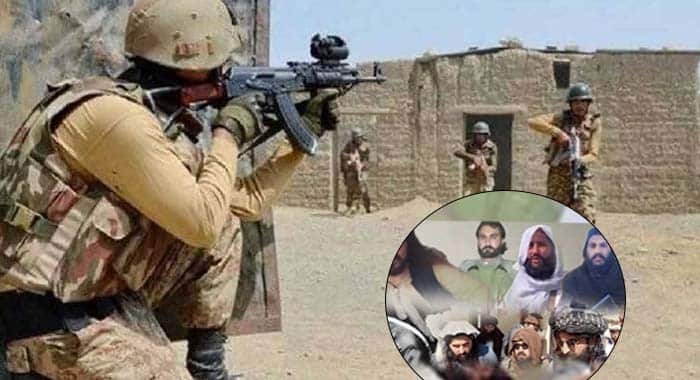
The latest security operations in Khyber Pakhtunkhwa carry a significance that goes beyond the elimination of TTP commanders, highlighting an increasingly important element of Pakistan’s counterterrorism strategy: taking the fight to the organizational infrastructure that allows terrorist networks to survive, relocate and rebuild.
The elimination of Amir Badshah,r Saifullah, or Tarab is notable, especially in Amir’s case because terrorist networks depend heavily on concealment. A commander does not necessarily need to remain inside a conventional hideout. He can move through civilian areas, use trusted contacts and rely on established support networks to avoid detection.
When intelligence-led operations begin reaching commanders at such locations, the challenge for terrorist organizations becomes considerably more complicated.
Recent developments provide a broader picture. TTP commanders have been eliminated in operations in South Waziristan and Mohmand, while a senior figure was identified among terrorists killed during an attempted infiltration from Afghanistan. Another commander was killed in an operation against a terrorist facility across the border.
These cases point to several layers of the same problem. Terrorist networks require command, movement, recruitment, logistics and access to territory. Disrupting any one layer can create friction, but simultaneously applying pressure to several layers makes rebuilding more difficult.
The cross-border dimension is particularly important. Pakistan has repeatedly faced attempts by terrorists based in Afghanistan to infiltrate through border routes and establish operational positions inside the country. The elimination of commanders among infiltration groups indicates that these movements are not necessarily composed only of low-level fighters. Experienced figures can also be involved in attempts to establish or reinforce networks.
Inside Pakistan, meanwhile, the targeting of commanders in districts such as Bannu, South Waziristan and Mohmand demonstrates the importance of local intelligence. Terrorist networks require knowledge of communities, routes and terrain to operate effectively. That makes local intelligence and sustained coordination critical to preventing them from rebuilding after operational losses.
There is, however, a distinction between disrupting a network and eliminating its capacity altogether. Terrorist organizations can decentralize command, replace leaders and modify tactics when senior figures are removed. A series of successful operations therefore has to be followed by continued intelligence collection and action against facilitators and support structures.
The strategic objective is not simply to create a long list of eliminated commanders. It is to make the process of replacing them increasingly difficult.
That is where the latest operation becomes part of a larger counterterrorism picture. When commanders are repeatedly identified and targeted across different areas, the TTP faces not only the loss of individual personnel but the growing difficulty of maintaining a stable operational architecture.
For Pakistan’s counterterrorism effort, the challenge now is to sustain that pressure. A terrorist network under pressure can retreat, fragment or change its methods. Preventing it from converting those adaptations into a new operational capability will determine whether individual successes develop into lasting disruption.



