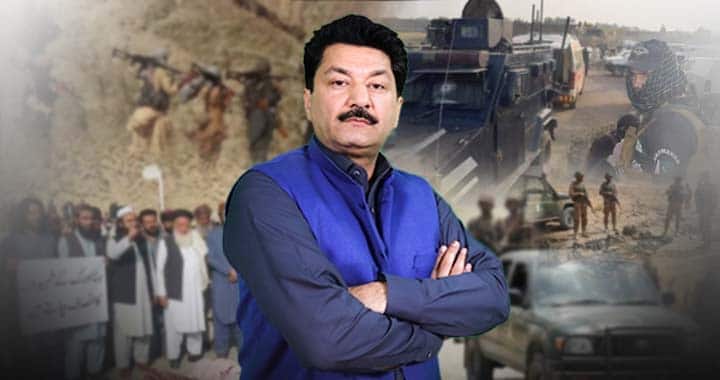
Pakistan’s security challenge can no longer be understood only through attacks taking place in remote tribal districts or along the country’s western frontier. Terrorism remains deeply rooted in some of the most affected areas of Khyber Pakhtunkhwa and Balochistan, but the recent incidents show that the threat can also reach major urban centers such as Peshawar.
That is why an attack near a police checkpoint in Peshawar carries a significance beyond the physical damage it causes. Peshawar is the provincial capital and one of the most heavily secured cities in Khyber Pakhtunkhwa. When an attack occurs there, even if casualties and material damage are limited, it raises questions about the networks capable of operating close to the provincial capital.
The wider security picture makes this particularly concerning. Various terrorist organizations have operated in and around Khyber Pakhtunkhwa, including the banned Tehreek-e-Taliban Pakistan (TTP), Islamic State Khorasan and Lashkar-e-Islam. The presence of different organizations creates the possibility of overlapping networks, facilitators and sleeper cells.
A recent counterterrorism operation in Shamshatu also demonstrated the importance of intelligence-led operations. A Daesh-e-Khorasan-linked terrorist described as a mastermind of attacks was eliminated in the operation. Such operations are important because the person carrying out an attack is rarely the entire network. Behind an attack can be planners, facilitators, financiers, recruiters, transporters and people providing safe locations.
That is why intelligence remains the most important weapon in this phase of Pakistan’s counterterrorism campaign.
The Threat Is Changing
The security situation in southern Khyber Pakhtunkhwa illustrates this changing threat. Bannu, Lakki Marwat, Dera Ismail Khan and neighboring districts have experienced terrorist attacks, targeted killings and attacks on security personnel. Terrorists increasingly understand that identifying an individual police officer, soldier or Frontier Corps personnel can be enough to carry out a targeted attack.
Technology is adding another dimension. Terrorist groups have increasingly experimented with drones and other relatively inexpensive technologies. This means that security forces have to deal with an adversary that does not need sophisticated conventional military equipment to create disruption.
At the same time, there are signs that local security structures can make a difference. In Bannu, cooperation involving police, the Counter Terrorism Department, the Elite Force and local peace committees has demonstrated the value of combining intelligence, policing and community-level information.
The transformation of local peace committees into more formal structures, including the adoption of uniforms and greater coordination with police, can help create a clearer security architecture.
The objective, however, should not be to assume that one successful operation has solved the problem. Terrorist networks adapt. When pressure increases in one area, they search for another route, another facilitator or another target.
This is why the fight against terrorism must remain continuous.
Balochistan Cannot Be Treated as a Separate Problem
Balochistan presents an even broader challenge.
The province has witnessed attacks on security personnel, political figures, civilians, travelers and businesses. Incidents in areas around Quetta, Khuzdar, Hanna-Urak, Ziarat and other parts of the province demonstrate that violence can affect both security installations and ordinary civilian life.
The consequences extend beyond the immediate victims.
When passengers are stopped, traders are abducted, banks are robbed or people from another province become reluctant to travel through Balochistan, terrorism begins to affect the province’s economic and social connectivity.
Balochistan is not an isolated piece of Pakistan. People from Balochistan work throughout the country, just as people from Punjab, Sindh and Khyber Pakhtunkhwa travel, trade and work in Balochistan.
The kidnapping of traders from Dera Ghazi Khan and their subsequent release through the intervention of a local jirga illustrates another dimension of the problem. When communities have to rely on informal mechanisms to secure the release of abducted citizens, it shows how terrorism and criminality can weaken the state’s normal security and justice mechanisms.
The people of Balochistan deserve security, economic opportunity and freedom of movement just as citizens elsewhere in Pakistan do.
The violence also requires careful analysis of how terrorist organizations recruit and sustain themselves. Youth radicalization, financing, propaganda and external support are all factors that need to be investigated through evidence rather than reduced to slogans.
Where there is evidence that terrorist organizations are being used as proxies, that evidence must be pursued through intelligence and diplomatic channels.
Afghanistan Remains Part of the Security Equation
Pakistan’s security challenge cannot be separated from developments in Afghanistan.
Islamabad has repeatedly linked attacks by the banned TTP to its presence and activity from Afghan territory, while the Afghan Taliban deny allowing their territory to be used for attacks against Pakistan. International assessments have also continued to examine the presence and activities of terrorist organizations in Afghanistan.
The appearance of new material associated with Al-Qaeda has added another concern. A recent video featuring Hamza bin Laden, the son of Al-Qaeda founder Osama bin Laden, has drawn fresh attention to the group’s continued presence and messaging.
That does not by itself establish the operational strength of Al-Qaeda inside Afghanistan or Pakistan. But it does demonstrate why claims about the disappearance of the organization should be treated carefully.
The Afghan Taliban have rejected claims that Al-Qaeda maintains an active presence in Afghanistan, describing such reports as propaganda. That position and contrary assessments should both be considered when evaluating the threat.
Pakistan therefore needs intelligence that goes beyond simply monitoring attacks after they occur. It needs to understand who is moving across the border, who receives them, who provides them accommodation, who supplies equipment and who finances their activities.
The Afghan Relationship Is Not Completely Frozen
At the same time, Pakistan-Afghanistan relations should not be described as completely silent or without channels of communication.
The two countries have faced severe tensions over cross-border terrorism and border restrictions, but diplomatic and commercial channels have not disappeared altogether. Pakistan’s Foreign Ministry continues to describe Afghanistan as an important neighboring country and a major regional relationship.
A recent interline agreement between Pakistan International Airlines and Afghanistan’s Kam Air, for example, created a streamlined route allowing Afghan travelers to connect through Islamabad to destinations in the Middle East.
Such developments do not resolve the security dispute. They do, however, demonstrate that engagement remains possible.
That distinction matters.
Pakistan needs to maintain pressure over terrorism while keeping diplomatic channels available. Security demands firmness, but diplomacy requires communication.
Pakistan Is Also Looking Beyond Its Borders
While Pakistan is dealing with terrorism internally, the regional environment is becoming more complicated.
The recent escalation involving Saudi Arabia and Iran-backed Houthi forces has created security and economic concerns extending far beyond Yemen. Reports of drone attacks near Mecca, which the Houthis have denied, have further heightened tensions.
Pakistan has its own reasons to be concerned.
The country is heavily dependent on imported energy, and disruption to major regional shipping routes can quickly affect fuel prices, transportation costs and household budgets. The Strait of Hormuz and Bab el-Mandeb are particularly important to global energy and shipping networks.
This means Pakistan’s security calculations cannot stop at its western border.
The country has also entered a new phase of defense cooperation with Saudi Arabia and Türkiye. The Makkah Joint Defence Agreement signed in August provides that an armed attack against any one of the three states will be regarded as an attack against all three, while also expanding defense cooperation.
The agreement is defensive in its stated character, and Pakistan’s Foreign Ministry has emphasized that it is intended to strengthen collective deterrence and support regional stability.
The challenge now is how Pakistan manages this new responsibility while dealing with its own security pressures.
Security at Home, Diplomacy Abroad
Pakistan is therefore operating on two interconnected fronts.
Inside the country, it has to disrupt terrorist networks, protect civilians and security personnel, strengthen intelligence and prevent terrorist organizations from rebuilding their infrastructure.
Outside the country, it has to manage relationships with Afghanistan, Saudi Arabia, Iran, Türkiye and other regional and global actors while protecting its own economic and security interests.
The recent Gulf crisis makes this balancing act even more important. Pakistan has publicly supported de-escalation, while its defense commitments to Saudi Arabia create another layer of strategic responsibility. Reuters has reported that Islamabad is facing pressure to balance its role as a Saudi defense partner with its diplomatic engagement with Tehran.
The lesson is that Pakistan’s security problem is no longer simply a matter of sending forces into an affected area and conducting an operation.
It is intelligence.
It is border management.
It is counter-radicalization.
It is economic security.
It is diplomacy.
And it is the ability to prevent terrorist organizations from turning local grievances, criminal networks and regional conflicts into a broader security threat.
Peshawar, Balochistan, Afghanistan and the Gulf may appear to be separate stories. They are not entirely separate from Pakistan’s perspective. Developments in one theater can influence the security and economic environment in another.
That is why Pakistan needs to deal with terrorism at its roots while remaining engaged with the region around it.
The objective should be simple: prevent violence from becoming normal, prevent terrorist networks from regenerating, and ensure that Pakistan’s internal security does not become hostage to instability beyond its borders.