
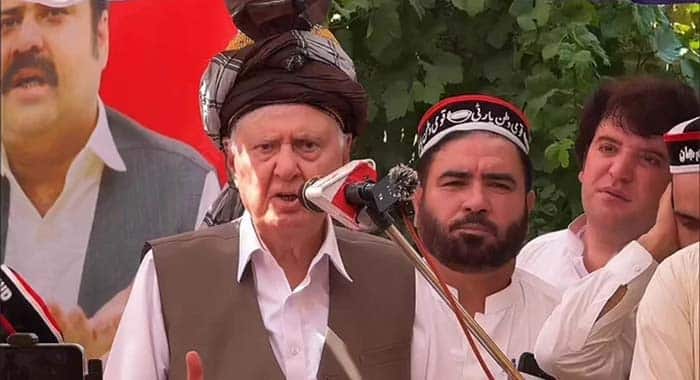
Qaumi Watan Party (QWP) Chairman and former interior minister Aftab Ahmad Khan Sherpao has sharply criticized the Pakistan Tehreek-e-Insaf (PTI) government in Khyber Pakhtunkhwa, questioning its priorities as terrorism continues to threaten the province.
Addressing a public gathering in Mohmand district, Sherpao said PTI had been in power in the province for 13 years and was now in its 14th year, but its agenda appeared to revolve around sit-ins, long marches, protests and demands for the release of the party’s founder.
Sherpao told PTI leaders and workers that their founder could not be released through street protests. He said the cases against him were before the courts and should be pursued through proper legal channels.
“If any case is found to have been registered on false grounds, we will also call it wrong,” Sherpao said, while stressing that the issue could not be resolved through the methods adopted by PTI.
He also criticized the PTI for pursuing protests while, in his view, neglecting the province’s worsening security situation.
“You cannot continue doing this while ignoring this province and its people, particularly on the issue of terrorism,” Sherpao said.
Describing the security situation in the southern districts, the QWP chief said people could no longer leave their homes or move freely after evening, while insecurity had also spread to other parts of the province.
He specifically pointed to Bajaur, saying incidents were occurring there every other day.
Sherpao called for all political parties to abandon the practice of announcing dates for long marches and instead develop a joint strategy to tackle terrorism.
Rather than announcing another protest, he said, political parties should sit together with the government and work out how terrorism could be eliminated from the province and how lasting peace could be restored.
He warned that without peace, neither Khyber Pakhtunkhwa nor the country could make meaningful progress.
“Without peace, we cannot develop at all,” Sherpao said.
Sherpao’s criticism adds to growing political and public pressure on the PTI-led provincial government over its handling of terrorism, as voices from outside the ruling party increasingly question whether political mobilization is taking precedence over the security concerns confronting residents across KP.



