
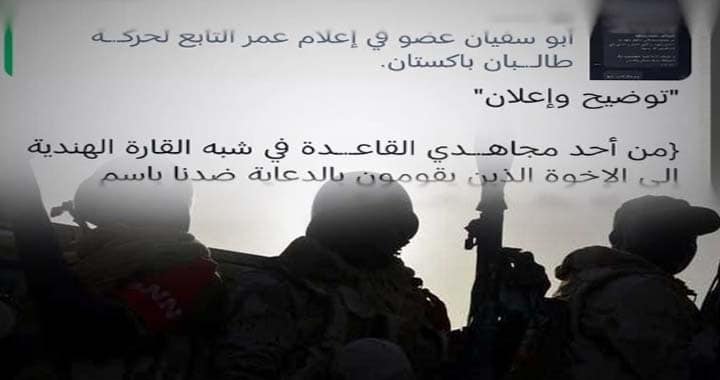
Al-Qaeda appears to be managing growing friction with Tehrik-e-Taliban Pakistan (TTP) through a carefully calibrated approach that seeks to avoid a direct confrontation while preserving its broader relationship with the group.
Available assessments indicate that the differences between Al-Qaeda and TTP are being framed primarily around ideological interpretation, operational conduct, and strategic disagreements, rather than as a fundamental rejection of TTP or a complete rupture between the two organizations.
Despite criticism of certain TTP practices and approaches, Al-Qaeda has continued to express support for TTP and other aligned militant actors. This indicates that the emerging disagreements have not translated into an outright hostile relationship.
Rather than publicly confronting TTP, Al-Qaeda appears to be pursuing a more cautious strategy: maintaining ideological solidarity while attempting to manage disagreements over methods and operational priorities. This approach allows Al-Qaeda to preserve its wider militant relationships without escalating internal tensions into an open conflict that could weaken the broader network.
The reported friction appears to involve differences over how certain objectives should be pursued, including questions surrounding ideology, operational priorities, and the conduct of attacks. Such disagreements are significant because they can affect cooperation between militant organizations, particularly when groups operate within overlapping environments and maintain relationships involving leadership, personnel, logistics, or ideological networks.
However, the existence of disagreements should not automatically be interpreted as evidence of a complete separation. Al-Qaeda’s continued expressions of support suggest that, despite criticism of certain TTP practices, the organization still regards TTP as part of a broader militant ecosystem with which it maintains important ideological and strategic connections.
One of the most notable aspects of the developing relationship is the apparent effort to prevent disagreements from escalating into direct confrontation. An open dispute between Al-Qaeda and TTP could create significant risks for both organizations by exposing internal divisions, weakening cooperation, and potentially providing security authorities with opportunities to exploit those fractures.
Consequently, Al-Qaeda appears to be adopting a measured approach in which criticism is directed at specific practices or operational decisions rather than at TTP’s existence as an organization. This distinction is important. Criticism of methods does not necessarily amount to rejection of the group itself.
The relationship between Al-Qaeda and TTP therefore appears increasingly complex, combining continued ideological affinity with emerging disagreements over strategy and operational conduct. Such relationships among militant organizations are rarely static. Groups may cooperate in certain areas while simultaneously disagreeing over priorities, tactics, leadership decisions, or the timing and nature of operations.
The current situation appears to reflect precisely such a dynamic: friction without a definitive rupture, criticism without outright hostility, and continued support despite operational disagreements.
The persistence of ties between Al-Qaeda and TTP remains significant from a regional security perspective. Continued ideological and organizational links can provide militant groups with avenues for influence, cooperation, knowledge-sharing, and resilience even when disagreements emerge. At the same time, internal friction may affect the ability of these organizations to coordinate effectively and could contribute to shifts in their operational behavior.
For security policymakers, the key issue is therefore not simply whether disagreements exist, but whether those disagreements lead to a measurable reduction in cooperation, organizational capacity, and operational connectivity.
The emerging picture suggests that Al-Qaeda is attempting to manage its differences with TTP without allowing those differences to develop into an open confrontation. While criticism of TTP’s practices reflects genuine ideological and operational friction, Al-Qaeda’s continued expressions of support indicate that the broader relationship remains intact.
The relationship can therefore best be characterized as one of managed tension rather than outright separation with Al-Qaeda seeking to preserve its wider alliances while navigating disagreements over ideology, strategy, and operational conduct. Any assessment of a potential Al-Qaeda–TTP split should therefore be based on concrete evidence of sustained organizational separation rather than isolated statements or criticism.



