
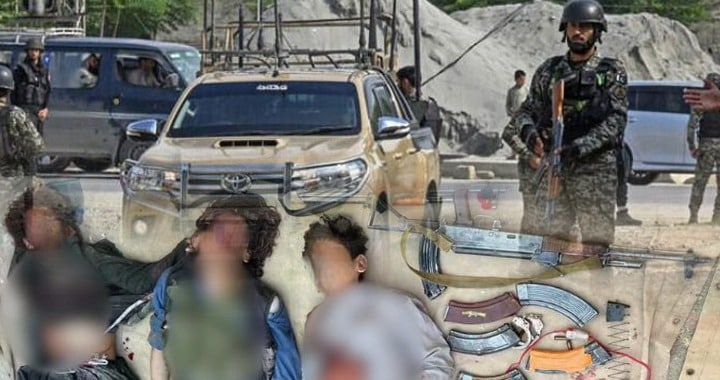
Khyber Pakhtunkhwa’s current security landscape is being defined not simply by the number of terrorist attacks, but by the increasingly broad geography in which terrorists are attempting to operate. From Bannu, Lakki Marwat, Tank and Dera Ismail Khan to Lower Dir and the districts adjoining the former tribal areas, terrorist networks are repeatedly testing security arrangements, probing vulnerabilities and attempting to create fear.
Yet the emerging pattern also reveals something equally important: wherever terrorists have attempted to expand their operational space, police and security forces have responded with intelligence-based operations, rapid intervention and increasingly sophisticated surveillance and counterterrorism measures.
The attempted assault on the Lal Qila check post in Lower Dir was significant precisely because the area had remained comparatively stable for extended periods. The attack demonstrated that terrorists are prepared to test new locations when pressure in their traditional operating areas increases.
But an attempted expansion does not amount to territorial control.
Terrorist organizations do not necessarily need to capture and hold territory to create disruption. They can seek to achieve their objectives by attacking police posts, threatening local figures, disrupting transportation, planting explosives or spreading fear among communities.
That is why the security response must extend beyond individual attacks.
The broader contest is over whether terrorist networks can establish freedom of movement, build local support and create a permanent climate of insecurity. Preventing that outcome requires continuous pressure rather than episodic responses.
From Reaction to Prevention
The most effective counterterrorism success is often the attack that never happens.
A recent incident near the University of Science and Technology in Bannu illustrates this principle. Suspicious explosive material was detected in the area, the location was immediately secured and the Bomb Disposal Unit rendered the threat harmless.
No major attack occurred, no public casualties were reported and the suspected explosive material never reached an intended target.
That is not an absence of counterterrorism success. It is counterterrorism working as it should.
The same principle is visible in intelligence-based operations across Bannu. Police and security forces have repeatedly acted on information about terrorist presence before networks could complete their preparations. In one recent operation, five terrorists affiliated with Fitna al-Khawarij were eliminated, including a highly wanted terrorist.
Such operations demonstrate the growing importance of intelligence fusion. Information obtained through local networks, surveillance, investigations and other intelligence channels becomes valuable only when it can be converted into rapid operational action.
This is increasingly important because terrorist tactics are changing.
Direct assaults remain a threat, but terrorists are also experimenting with suicide vehicles, improvised explosives, surveillance drones and other low-cost technologies. Small drones can provide reconnaissance over police positions and potentially expose movement patterns that were previously difficult to observe.
The response must therefore evolve at the same pace.
Technology Meets Local Intelligence
Modern equipment can dramatically improve the effectiveness of frontline personnel, but technology cannot replace local knowledge.
A police officer equipped with a modern surveillance system still needs information about the terrain. A drone can observe movement, but local intelligence can help explain whether that movement is ordinary or suspicious. A checkpoint can be fortified, but intelligence can reveal whether terrorists are preparing to approach it from another direction.
Khyber Pakhtunkhwa’s communities therefore represent a critical layer of the counterterrorism architecture.
Residents know their villages, roads, markets and surrounding terrain. They can identify unfamiliar individuals, unusual activity and changes in patterns of movement. When this knowledge is communicated safely to law-enforcement institutions, it can help prevent terrorists from establishing themselves in new areas.
But cooperation requires confidence.
Tribal elders, religious scholars, community representatives and ordinary citizens who cooperate with the state can become targets of terrorist intimidation precisely because terrorists understand the value of their influence.
Protecting such citizens is therefore not merely a matter of personal security. It is an investment in intelligence and community resilience.
At the same time, civilians should never be expected to replace professional security institutions.
Public courage deserves recognition, but when ordinary citizens are forced to physically confront terrorists, it reflects the severity of the security environment rather than a sustainable security model. The armed responsibility for counterterrorism rests with the state.
Citizens can help by reporting suspicious activity, rejecting terrorist intimidation, supporting lawful institutions and maintaining social cohesion. They should not be compelled to become an alternative armed force.
Security Must Restore Normal Life
Khyber Pakhtunkhwa has already endured the consequences of prolonged terrorism. Communities have experienced displacement, disrupted education, damaged infrastructure, economic losses and the loss of family members.
The ultimate measure of counterterrorism success must therefore extend beyond operational statistics.
A secure district is one where children can attend school, markets can operate, roads remain open and businesses can function without fear.
This makes security and development inseparable.
Security creates the environment in which development can take place. Development, in turn, strengthens communities and reduces the social vulnerabilities that terrorists seek to exploit.
The objective is not to create a province permanently organized around checkpoints and emergency deployments. It is to create a security environment in which extraordinary measures can gradually give way to normal policing and civilian life.
That requires sustained operations against terrorist networks, but also stronger institutions capable of maintaining the peace once immediate threats have been disrupted.
No District Should Become a Terrorist Safe Haven
The geographic spread of terrorist attempts also makes inter-district coordination essential.
Police, counterterrorism investigators, intelligence institutions and security forces possess different capabilities. Their effectiveness increases when information moves quickly between them.
A terrorist network identified in Bannu should not be able to exploit an administrative boundary and disappear into another district. A facilitator detected in Tank should not be able to establish a new network in Lakki Marwat. A terrorist group attempting to probe Lower Dir should encounter intelligence systems already aware of its movements and methods.
Terrorists do not recognize district boundaries.
Counterterrorism intelligence cannot afford to either.
This is also why the National Action Plan’s core lesson remains relevant. Terrorism cannot be defeated by one institution operating independently. Police, security forces, intelligence institutions, provincial administrations and federal authorities must function as parts of one counterterrorism architecture.
Political leadership has a role in that architecture as well.
Terrorism should not become a partisan battlefield. Political disagreement and lawful political mobilization are legitimate, but terrorist organizations should never be allowed to exploit political divisions to weaken the state’s response.
A police officer attacked in Bannu is not a victim belonging to one political party. A civilian threatened in Lower Dir does not represent another. Terrorism is an attack on the state and society as a whole.
The Battlefield Is Getting Harder for Terrorists
The current situation in Khyber Pakhtunkhwa should therefore not be read simply as a story of terrorists expanding their reach.
It is also a story of terrorist networks being forced to adapt as security forces deny them the freedom of action they seek.
The use of drones, suicide vehicles and improvised tactics reflects an attempt to find new openings. Intelligence-based operations, rapid police responses, surveillance systems and community cooperation are closing those openings.
The objective must now be to keep that pressure continuous.
Terrorists should find every district increasingly hostile to their movement, recruitment, financing and operations. Communities should become increasingly resistant to intimidation. Police and security forces should become increasingly capable of detecting threats before they materialize. That is the direction in which Khyber Pakhtunkhwa’s counterterrorism strategy must move. Not from one operation to another, but toward a system in which terrorist networks are denied the time, space, resources and confidence required to rebuild.
The province has already demonstrated that terrorists can be disrupted, their networks penetrated and their attacks prevented.
The next step is to make that pressure permanent. The objective is not merely to keep terrorists out of one district. It is to leave them with nowhere in Khyber Pakhtunkhwa where they can operate with confidence.



