
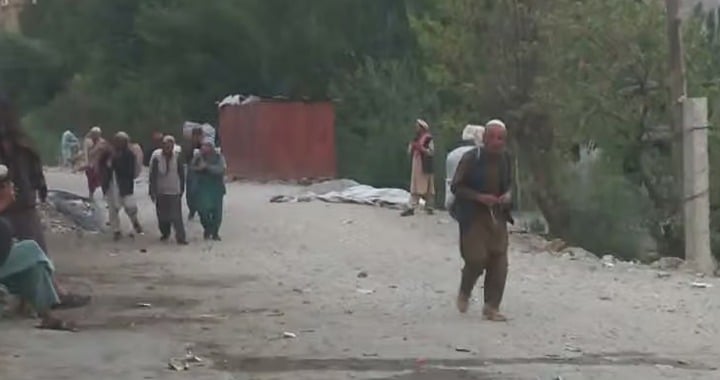
Taliban forces have launched widespread arrests, house-to-house searches and what local residents describe as intimidation and mistreatment in Badakhshan’s Nasi district, shortly after Juma Khan Fateh and a number of his men surrendered to the Taliban.
Local sources said the crackdown began after the surrender and has left residents fearful of collective reprisals. The developments have also raised fresh questions about the credibility of Taliban assurances of amnesty and forgiveness for those who surrender or abandon armed resistance.
Residents said Taliban forces have been conducting searches of homes under the stated pretext of locating and disarming fighters associated with Fateh. During these operations, residents have reportedly been beaten, detained and subjected to harsh treatment.
The situation has left Nasi under a heavy security presence. The local market remains closed, while roads connecting several villages with the district centre have reportedly remained blocked. Taliban forces have established checkpoints at various locations and detained a large number of people.
Residents further said health centres, hotels, mosques and schools in the district have been taken over for military purposes, adding to the sense that normal civilian life has yet to return.
Amnesty Promises Under Scrutiny
The latest developments have placed the Taliban’s repeated promises of general amnesty under renewed scrutiny.
The Taliban have frequently presented surrender and reconciliation as avenues through which former opponents can return to ordinary life without facing reprisals. Yet reports emerging from Nasi suggest that the reality on the ground may be markedly different, with residents and former fighters living under fear of arrest and retaliation.
The concern is particularly acute among hundreds of people associated with Fateh who remain in mountainous areas of the district. Sources said many of them learned of the surrender indirectly and are now uncertain about what awaits them or what course of action they should take.
A relative of one of Fateh’s former fighters, who is currently staying in the Shakh Dara area, said the situation had generated deep fear among those who had fought alongside Fateh during the recent clashes.
According to local accounts, the concern stems partly from the possibility of reprisals by Taliban forces following the fighting in Nasi.
The reported clashes had already exposed tensions between the Taliban and armed groups challenging their authority in Badakhshan. Local sources said Taliban intelligence personnel deployed to the area from Kabul suffered heavy casualties during the initial fighting, raising fears among Fateh’s former forces that surrender could be followed by punitive action.
The issue is therefore no longer simply about disarmament.
It is about whether surrender is genuinely being treated as a pathway toward reconciliation or merely as a means of identifying, isolating and subsequently detaining opponents.
If individuals surrender believing that they will receive protection under an amnesty, only to face arrest or mistreatment, the consequences extend well beyond Nasi. Such conduct can undermine confidence in future surrender arrangements and make armed groups less willing to lay down their weapons.
Gold Miners Caught in the Crossfire
The humanitarian consequences of the fighting have also extended to hundreds of workers employed in Nasi’s gold mines.
The week-long clashes reportedly left many miners stranded in the district, unable to travel toward villages and lower-lying areas where food and other necessities were available. Local accounts described severe shortages, with some workers reportedly enduring hunger during the fighting.
Following Fateh’s surrender, some miners were able to leave the mining areas and enter nearby villages. However, concerns remain that they could be detained or mistreated on suspicion of having links with Fateh’s forces.
The situation illustrates how prolonged military pressure can quickly transform a political or security confrontation into a civilian crisis. Workers with no direct role in the fighting can become trapped between armed forces, deprived of access to food, transport and essential services, and subsequently exposed to suspicion when they attempt to return home.
Disarmament or Reprisal?
In Faizabad, preparations are reportedly under way for a Taliban delegation tasked with disarming Fateh’s remaining forces.
The delegation is expected to include senior Taliban figures along with influential local representatives from Nasi. Its stated purpose is to oversee the disarmament process, although reports indicate that the committee had not formally begun its work at the time of reporting.
A meeting was reportedly held in Faizabad with influential Badakhshan figures, during which concerns were raised over the treatment of Nasi residents. Those attending reportedly called for an end to mistreatment and harassment by Taliban forces.
The demand is significant because the success of any disarmament process depends heavily on trust.
A genuine disarmament arrangement requires more than the collection of weapons. It requires credible guarantees that those who surrender will not subsequently be subjected to arbitrary detention, collective punishment or revenge.
Without such guarantees, the Taliban face a familiar dilemma: coercion may produce short-term submission, but it can deepen the grievances that fuel future resistance.
Badakhshan’s latest developments therefore offer a revealing test of the Taliban’s approach to dissent.
Five years after returning to power in Kabul, the Taliban continue to portray their rule as one of stability and security. Yet stability imposed through fear is fundamentally different from peace built through reconciliation and public confidence.
The situation in Nasi demonstrates the distinction.
If surrender is followed by raids, arrests and intimidation, then an announcement of general amnesty risks becoming little more than a tactical instrument. Conversely, if the Taliban genuinely want to persuade armed opponents to disarm, they must demonstrate that their assurances have meaning after the weapons are handed over.
For the residents of Nasi, that distinction is not theoretical.
Their homes, livelihoods, schools, health facilities and places of worship are caught in the consequences of the confrontation. For the miners stranded by the fighting, the issue is food and physical safety. For former fighters hiding in the mountains, it is whether surrender means safety or exposure to retaliation.
And for Badakhshan as a whole, the question is whether the end of a week of fighting will bring genuine reconciliation or merely replace open combat with arrests, intimidation and repression.
The Taliban may have secured the surrender of a number of their opponents.
But what happens after surrender will determine whether that achievement becomes a step toward lasting stability or another chapter in Badakhshan’s cycle of resistance and repression.



