
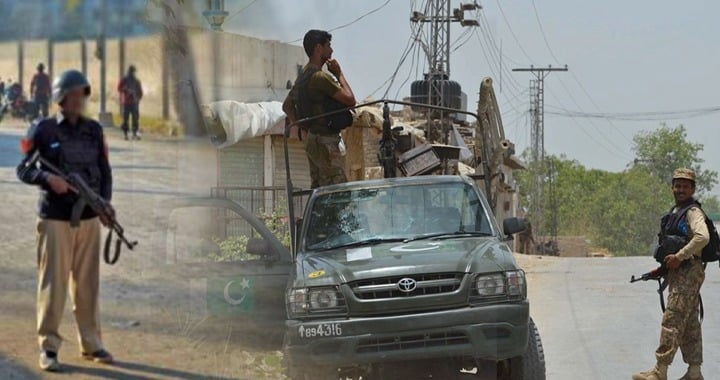
The most worrying feature of the current security environment in Khyber Pakhtunkhwa is not simply the frequency of terrorist attacks. It is their geographic spread.
Bannu, Lakki Marwat, Tank and Dera Ismail Khan have remained under sustained pressure, while terrorist activity has also increasingly tested areas such as Lower Dir and the districts adjoining the former tribal areas. The attempted attack on the Lal Qila check post in Lower Dir was particularly significant because it demonstrated that terrorists are willing to probe areas that had enjoyed comparatively greater stability.
The strategic implication is clear: terrorism is attempting to expand its psychological and operational footprint.
A terrorist network does not necessarily need to capture territory to claim success. It can achieve considerable impact by forcing communities to alter their routines, keeping police stations under constant pressure, disrupting transport, intimidating local figures and creating the perception that no area is completely secure.
That makes the recent attacks across Khyber Pakhtunkhwa more than a collection of unrelated incidents.
They should be viewed as pressure points within a broader counterterrorism contest.
The challenge for the provincial security architecture is complicated by the fact that the nature of attacks varies considerably from district to district. In one area, terrorists may attempt a direct assault on a check post. Elsewhere, they may plant explosives, target a police vehicle, use a suicide attacker or employ drones for surveillance.
The response therefore cannot be based on one standard template.
Police stations in vulnerable districts require different defensive arrangements from those used in urban centres. Border districts need stronger surveillance and intelligence networks. Roads connecting remote communities require greater monitoring. Public institutions require rapid explosive-response capabilities. And areas where terrorist networks have local roots require sustained intelligence operations rather than temporary security deployments.
The successful disposal of suspicious explosive material near a university in Bannu provides a useful example of preventive security. The threat did not have to become a successful attack for the counterterrorism system to be considered effective. Information reached the police, the area was secured, the Bomb Disposal Unit was deployed and the suspected material was rendered harmless.
This is what modern counterterrorism should increasingly look like: detecting threats while they are still threats, rather than measuring success after casualties occur.
The same principle applies to intelligence-based operations.
In Bannu, coordinated police and security operations have repeatedly disrupted terrorist networks before they could consolidate their positions. In one recent operation, five terrorists affiliated with Fitna al-Khawarij were eliminated, including a highly wanted terrorist. Earlier operations also demonstrated the value of using aerial surveillance and advanced technology to identify terrorist movement and hideouts.
Yet tactical successes should not create complacency.
Every terrorist eliminated represents one less immediate threat, but terrorist organizations can replace operatives through recruitment, financing and cross-border facilitation. The strategic objective must therefore be to dismantle the ecosystem that produces attackers.
That requires a much broader understanding of security.
A police officer needs weapons and protective equipment, but the officer also needs reliable intelligence. A check post needs fortifications, but it also needs surveillance. A district needs more personnel, but it also needs a system capable of identifying terrorist facilitators before they become attackers.
The community itself is another layer of that security architecture.
Khyber Pakhtunkhwa’s tribal and rural communities possess an enormous amount of local knowledge. Residents know unfamiliar faces, unusual movement and suspicious activity long before a distant institution might detect them. Properly protected and integrated into a lawful intelligence framework, that knowledge can become one of the strongest barriers against terrorist infiltration.
But public cooperation cannot be demanded without public confidence.
When tribal elders, religious scholars, police personnel or ordinary citizens openly cooperate with the state, terrorists may attempt to punish them. The state therefore has a responsibility to protect those who help prevent terrorism. Otherwise, fear can silence precisely the people whose information is most valuable.
This is where the idea of community-led resistance needs to be handled carefully.
Public courage deserves recognition, but civilians should not be forced into becoming an alternative security force. When children appear carrying weapons or ordinary residents feel compelled to physically confront terrorists, it is evidence of extraordinary pressure on society, not a model for sustainable security.
The responsibility for armed counterterrorism belongs to the state.
Citizens can provide information, reject terrorist intimidation, support lawful institutions and help preserve social cohesion. They should not have to fill gaps in professional security capacity.
This distinction is particularly important because Khyber Pakhtunkhwa has already experienced the consequences of prolonged conflict. Displacement, interrupted education, economic losses and damaged infrastructure leave scars long after an operation ends.
The province therefore needs a counterterrorism strategy that protects both lives and normality.
Schools must remain open. Markets must function. Roads must remain usable. Police families must receive institutional support. Businesses must be able to operate without paying an invisible security tax through fear and disruption.
This is why counterterrorism and development cannot be treated as separate subjects.
Security creates the space for development, while development strengthens the social resilience required to resist terrorism.
At the provincial level, another issue deserves attention: coordination.
Police, counterterrorism investigators, intelligence institutions and security forces possess different capabilities. Their effectiveness increases when information moves rapidly between them. A terrorist who is identified in one district should not be able to exploit an administrative boundary and disappear into another.
The threat does not respect district lines, so intelligence cannot either.
The same principle applies to political leadership. Terrorism should not become a partisan contest. A police officer attacked in Bannu does not belong to one political party, just as a civilian victim in Lower Dir does not belong to another.
Political disagreement is legitimate. Political mobilization is legitimate within the law. But counterterrorism requires a minimum national consensus: terrorists cannot be allowed to exploit political divisions to weaken the state’s response.
The National Action Plan demonstrated the value of such coordination in the past. Its central lesson remains relevant: terrorism cannot be defeated by one institution acting alone.
Khyber Pakhtunkhwa is now confronting a more technologically capable and geographically flexible terrorist threat. The answer must therefore be equally flexible.
The province does not need a permanent state of siege.
It needs better intelligence, better policing, better technology, protected communities, stronger institutions and a political environment in which counterterrorism remains above partisan competition.
The objective should not simply be to push terrorists from one district into another.
It should be to make every district increasingly hostile to terrorism, while making the state increasingly capable of detecting and dismantling terrorist networks before they can strike.
That is the real test facing Khyber Pakhtunkhwa.



