
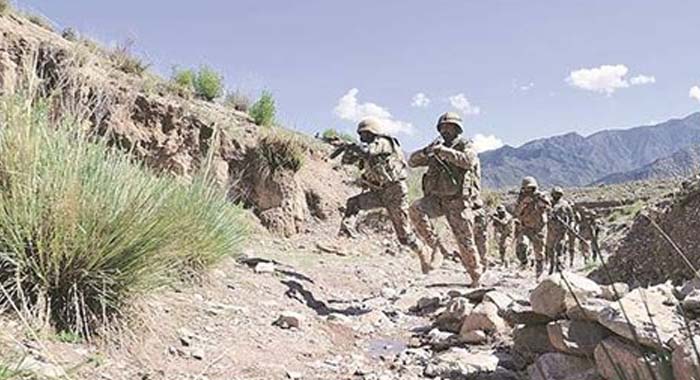
Security forces have conducted a successful intelligence-based operation in the Laje area of Kharan District, Balochistan, under Operation Radd-ul-Fitna 3, resulting in the elimination of seven elements associated with Fitna al-Khawarij, while several others were reportedly injured.
According to security sources, the operation was launched following credible intelligence regarding the presence of Fitna al-Khawarij elements in the area. Acting swiftly on the intelligence, security forces engaged the hostile elements and successfully neutralized seven of them.
During the operation, the hideouts used by the elements were completely dismantled, while a substantial quantity of modern weapons, ammunition and military equipment was recovered.
Security forces also recovered two vehicles and a motorcycle from the site, further indicating the operational and logistical nature of the network operating in the area.
According to security sources, the eliminated elements were allegedly involved in planning and facilitating a range of violent activities in Kharan and Laje, including extortion, robbery, kidnapping for ransom, targeted killings and suicide attacks.
The operation has therefore dealt a significant blow to an armed network that was allegedly seeking to establish and maintain operational capabilities in the region.
The action forms part of the ongoing Operation Radd-ul-Fitna 3, under which security forces are conducting rapid and intelligence-driven operations against armed groups operating in Balochistan.
The campaign is aimed at identifying terrorist hideouts, disrupting command and operational networks, dismantling logistical infrastructure and preventing hostile elements from planning attacks against civilians, security personnel and critical installations.
The latest operation in Kharan demonstrates the importance of timely intelligence in locating concealed networks and enabling security forces to take targeted action before planned attacks can be carried out.
The Kharan operation follows a series of intelligence-based actions reported in different parts of Balochistan.
Earlier this week, security forces conducted an operation in the Sarkani and Chadgi areas of Panjgur, reportedly killing five Fitna al-Khawarij elements, including a key commander identified as Wazir, son of Jamal.
Similarly, on August 9, operations were reportedly conducted in Mastung, Bolan, Washuk, Awaran, Sibi, Khuzdar, Harnai and Nushki, during which 15 elements were killed and their communications and operational networks were reportedly disrupted.
On August 6, security forces reportedly eliminated another 12 Fitna al-Hindustan elements during operations in Washuk and Mastung.
The successive operations indicate an intensified intelligence-led campaign aimed at preventing armed groups from establishing safe havens and maintaining networks across Balochistan.
The operations are taking place against the backdrop of a broader deterioration in Pakistan’s security environment.
According to data cited from ACLED, the number of reported terrorist incidents in Pakistan increased substantially between 2022 and 2025, rising from 658 incidents in 2022 to 2,425 in 2025. The data also indicates a more than sevenfold increase in attacks attributed to the Tehrik-e-Taliban Pakistan (TTP) during the same period.
While Khyber Pakhtunkhwa has remained among the areas most severely affected by terrorism, Balochistan has also faced repeated attacks targeting civilians, security personnel and strategic installations.
The security situation has been particularly challenging in remote districts, where armed groups have attempted to exploit difficult terrain, establish hideouts and develop networks for financing, recruitment and logistics.
The latest operation underscores the continued efforts of Pakistan’s security forces and law-enforcement agencies to dismantle armed networks before they can translate their plans into attacks.
Security forces are maintaining pressure on hostile elements through intelligence gathering, targeted operations, area clearance and disruption of logistical networks. The focus remains on identifying remaining members and facilitators associated with the networks operating in the affected areas.
The authorities have also emphasized that the objective of the ongoing operations is not merely to eliminate individual elements, but to disrupt the wider operational infrastructure supporting terrorism in Balochistan.
The security situation has gained additional urgency following a series of deadly attacks in the province. Recent incidents have included attacks on civilians and security personnel, prompting intensified joint operations involving the Pakistan Army, Frontier Corps and Balochistan Police.
The successful action in Kharan reflects the continued resolve of Pakistan’s security forces to prevent armed groups from using Balochistan as a base for violent activities.
With the latest intelligence-based operation, a suspected operational network has suffered significant losses, while its hideouts, weapons and mobility assets have been seized or destroyed.
Security forces remain committed to protecting civilians, securing communities and dismantling terrorist infrastructure across the province. Operations under Radd-ul-Fitna 3 will continue, with security agencies maintaining an intelligence-driven approach to identify and neutralize remaining threats.
The ultimate objective remains the restoration of lasting peace, security and stability across Balochistan, while ensuring that hostile elements are denied the space and resources required to carry out further violence.



