
Taliban spokesman Zabihullah Mujahid’s description of Pakistan as being controlled by a “small military group in Islamabad” is not merely a political accusation. It is a revealing attempt to construct an alternative reality around a confrontation whose origins are increasingly difficult to disguise.
The first correction is elementary. Pakistan’s elected political government is based in Islamabad. The Pakistan Army’s General Headquarters is in Rawalpindi. More importantly, Pakistan’s confrontation with terrorist networks operating from Afghan territory is not the private agenda of a “small military group”. It is a matter of national security involving the country’s armed forces, law-enforcement agencies, border communities and, above all, the protection of Pakistan’s sovereignty and territorial integrity.
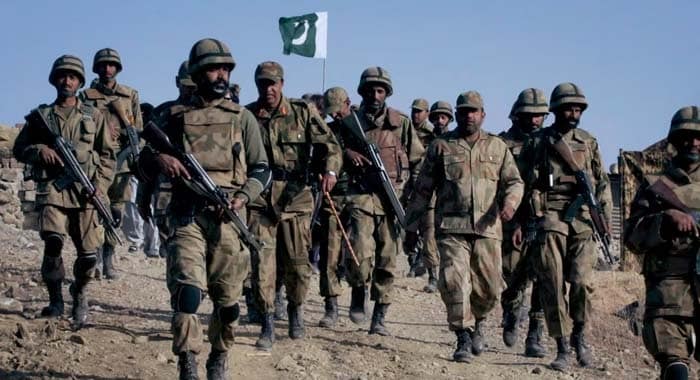
Pakistan’s soldiers are the people confronting the violence on the ground. They are the ones being attacked, ambushed and killed by terrorist groups. To portray the armed forces themselves as the source of the confrontation therefore turns cause and effect upside down.
And that inversion is central to the Taliban narrative.
The Real Reason Pakistan’s Armed Forces Are in the Crosshairs
The Taliban may prefer to describe Pakistan’s military as an obstacle to their interests, but there is a much simpler explanation for why Pakistani security forces have become their principal target: those forces are standing between terrorist networks and the Pakistani state.
That is particularly relevant to Tehrik-e Taliban Pakistan, or Fitna al-Khwarij. A United Nations monitoring report stated that TTP was accorded greater liberty and support by the Afghan de facto authorities and that TTP attacks against Pakistan consequently increased, amplifying regional tensions. The same report said TTP attacks from Afghan soil had contributed to cross-border military confrontation.
That is not Islamabad inventing an Afghan problem for political convenience. It is an international finding.
The UN has gone further. Its monitoring team has said that claims by the Taliban that no terrorist groups operate from Afghan territory are not credible, while specifically identifying TTP activity from Afghanistan as a major short-term threat to the stability of the Taliban authorities themselves.
So when Mujahid claims that Pakistan is being pushed into confrontation by a small group in Islamabad, the obvious question is: who is actually being attacked?
Pakistan’s security personnel.
Pakistani police.
Pakistani civilians.
Pakistani state institutions.
And who is repeatedly identified in international reporting as operating from Afghanistan?
TTP.
The Taliban cannot erase that chain of cause and effect by changing its vocabulary.
Pakistan Did Not Wake Up One Morning and Choose War
The second major problem with Mujahid’s statement is the historical amnesia behind the claim that the Taliban administration does not want conflict with Pakistan.
Pakistan spent years dealing with Afghanistan through dialogue, diplomatic engagement, border coordination and repeated appeals for action against terrorist networks operating from Afghan territory. Islamabad has continued to publicly describe dialogue and diplomacy as its preferred approach, while insisting that Afghan territory cannot be allowed to serve as a base for attacks against Pakistan. Pakistan’s Foreign Ministry reiterated that position as recently as June 2026.
And there is something even more difficult for the Taliban narrative to escape: Pakistan repeatedly sat down for talks.
Qatar and Türkiye mediated Afghanistan-Pakistan talks in Doha and Istanbul in 2025, where the two sides agreed to a ceasefire and a monitoring and verification mechanism.
The effort did not produce a durable resolution.
That failure matters because Pakistan did not reject dialogue as a principle. It repeatedly returned to the negotiating table while demanding something extraordinarily basic: that Afghan territory not be used for terrorism against Pakistan.
The problem was not that Pakistan had no interest in talks.
The problem was that talks could not substitute for action against the threat generating the talks in the first place.
And when diplomacy repeatedly fails to stop attacks, a state cannot be expected to surrender the right of self-defense.
Pakistan’s position has therefore been more accurately described as retaliatory rather than expansionist. Its stated objective has been to prevent cross-border terrorism and protect its territory, not to occupy Afghanistan or redesign its political system.
That distinction is crucial.
The Taliban’s Complaint About ‘Confrontation’ Misses the Origin of the Crisis
Mujahid says the Taliban do not want Afghanistan locked in confrontation with Pakistan.
Fine.
But Afghanistan does not need Pakistan’s military to “lock” it into confrontation. The Taliban themselves control the territory from which the principal security challenge emanates.
The contradiction is almost impossible to miss.
The Taliban say they want peace with Pakistan while denying, minimizing or deflecting the presence and activities of groups attacking Pakistan from Afghan soil. They say they oppose the use of Afghan territory against other countries, yet the UN monitoring mechanism continues to report TTP activity from Afghanistan and an increase in attacks against Pakistan.
Peace is not simply a declaration.
It is a security outcome.
If attacks continue, denial does not become policy. It becomes rhetoric.
And rhetoric does not stop bullets.
Who Actually Asked for Talks?
The Taliban’s latest narrative also overlooks another inconvenient feature of the recent diplomatic history: mediation efforts repeatedly arose because the parties were trying to prevent confrontation from worsening.
The Doha and Istanbul processes, brokered by Qatar and Türkiye, were concrete diplomatic efforts rather than imaginary talking points.
Pakistan also continued to welcome third-party efforts aimed at persuading Kabul to ensure that Afghan soil would not be used against Pakistan. Islamabad publicly said such messages had been conveyed through multiple channels, including friendly Arab and other partner governments.
That record makes the Taliban’s claim that Pakistan simply wants confrontation difficult to sustain.
There is an important distinction between wanting war and being prepared to use force when diplomacy fails.
Pakistan has demonstrated the latter.
That is not the same thing as seeking the former.
The Taliban’s Contradiction Is Bigger Than Pakistan
There is also a wider problem here. The Taliban increasingly present themselves as victims of foreign pressure while simultaneously denying the security realities their neighbors and international institutions are documenting.
That strategy may work domestically, where access to independent information is severely constrained. It becomes much harder to sustain internationally.
The UN has repeatedly raised concerns about terrorism emanating from Afghanistan and its spillover effects. A 2026 monitoring report specifically linked Taliban tolerance and support for TTP with increased attacks against Pakistan and warned of wider regional implications.
That is why the Taliban’s claim that Pakistan is manufacturing the confrontation deserves skepticism.
Pakistan did not invent TTP.
Pakistan did not create the networks operating from across the border.
Pakistan did not decide to shelter or tolerate terrorist infrastructure in Afghanistan.
And Pakistan certainly did not ask its soldiers to become the targets of an expanding cross-border terrorist campaign.
They are fighting because someone has to.
‘A Nod for the Wise, a Rod for the Otherwise’
For years, Pakistan’s approach reflected the first half of that old maxim: explain, engage, persuade.
Dialogue was attempted.
Messages were conveyed.
Third-party mediation was accepted.
Ceasefires were explored.
Monitoring mechanisms were proposed.
The international community was briefed.
And evidence was repeatedly placed before international forums.
But diplomacy has a limit. It cannot become an endless ritual in which one side talks while the other side watches the threat grow.
When peaceful pressure fails and attacks continue, the state eventually faces a choice between action and strategic surrender.
Pakistan chose action.
That should not be confused with aggression.
It is the basic responsibility of a sovereign state to defend its people and territory.
The Final Question for Kabul
The Taliban may continue calling Pakistan’s military “a small group in Islamabad”. They may continue accusing foreign actors. They may continue denying the realities documented by international monitors.
But none of those slogans answers the central question:
Why are terrorist attacks against Pakistan increasing while the attackers continue to find space across the border?
Until Kabul answers that question honestly, its claim that it wants no conflict with Pakistan will remain incomplete at best.
Pakistan has made its position remarkably clear: diplomacy remains preferable, dialogue remains possible, and peaceful resolution remains the better path.
But peace cannot mean Pakistan absorbs terrorism while the Taliban deny its source.
Nor can negotiations become an excuse for indefinite inaction.
The choice before Kabul is therefore not complicated.
If the Taliban genuinely want an end to confrontation with Pakistan, they must stop treating the source of the confrontation as a political inconvenience and start confronting it as a security responsibility.
Until then, Pakistan will continue doing what every sovereign state has the right, and indeed the duty, to do: defend its people, protect its borders and respond when its sovereignty is attacked.



