
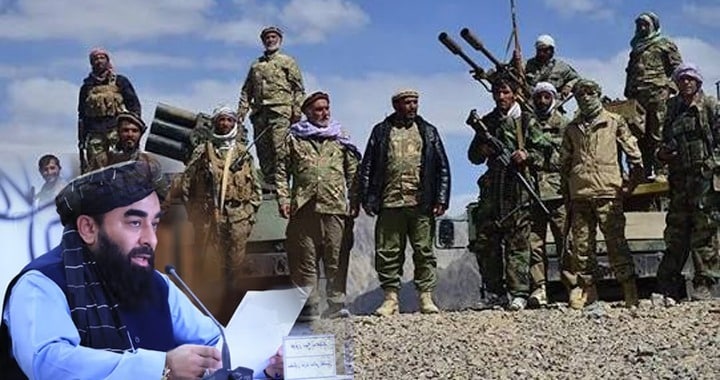
Taliban spokesman Zabihullah Mujahid’s latest argument against political engagement with Afghanistan’s opposition reveals far more about the Taliban’s own political insecurity than it does about the groups they seek to dismiss. Mujahid says the opposition is divided, pursues different goals and has already been “tested”, while warning that its return to power would take Afghanistan back to the conditions of the past. He therefore presents exclusion not as a political choice, but almost as a necessity for Afghanistan’s survival.
That argument deserves to be turned on its head.
The most striking problem with Mujahid’s formulation is his reference to “past conditions” as though the Afghanistan that existed before the Taliban takeover was some uniquely disastrous period from which Afghans must be protected at all costs. Whatever the failures, corruption, political disputes, insecurity and institutional weaknesses of previous Afghan governments, those governments at least contained political contestation, competing institutions, public debate and some degree of participation by different political and ethnic constituencies.
The Taliban’s answer to those imperfections has not been to build a more representative political system. It has been to eliminate meaningful political competition altogether.
That distinction matters.
Afghanistan under the Taliban has developed into an intensely centralized and exclusionary political order in which meaningful opposition has virtually no institutional space. International reporting and United Nations assessments have repeatedly described the Taliban governing structure as highly exclusionary, with persistent concerns over political participation, representation and restrictions on fundamental rights.
The most devastating example is the systematic restriction of women and girls. Girls have been denied access to secondary education and women have faced sweeping restrictions on education, employment and public life. The issue is not merely one group being unhappy with a government. It is an entire segment of Afghan society being pushed away from public life by decree.
That is hardly an improvement on the “past conditions” Mujahid invokes.
The Taliban’s Definition of Stability Is the Absence of Dissent
The deeper contradiction in Mujahid’s statement is that the Taliban appear to define stability primarily as the absence of opposition. Their logic is remarkably simple: if rival political forces are prevented from competing, there is no political conflict; if dissenting voices are suppressed, there is no visible dissent; if power is concentrated in one structure, then political fragmentation supposedly disappears.
But this is not political stability. It is political closure.
A functioning political system does not prove its strength by eliminating every competing idea. It proves its strength by surviving disagreement, absorbing criticism, accommodating different constituencies and allowing peaceful political alternatives to emerge.
That is precisely what the Taliban’s model struggles to provide.
And then comes Mujahid’s second argument: the opposition groups are divided and pursue different objectives.
Of course they are.
Afghanistan is not politically homogeneous. It is a country of different ethnic communities, political traditions, ideological currents, regional interests and personalities. Expecting every opposition group to share an identical programme would be absurd.
But Mujahid’s argument misses the crucial point.
The opposition does not need to agree on everything to agree on one fundamental objective: the end of Taliban monopoly over political power.
One faction may want a federal arrangement, another a constitutional republic, another a more decentralized political order, another stronger representation for particular communities. They can disagree profoundly about the Afghanistan they want to build after the Taliban.
Their convergence begins with what they do not want.
They do not want one armed movement to permanently decide who governs, who participates, who speaks, who studies, who works and who is excluded.
That common objective is precisely why the Taliban’s attempt to reduce the opposition to a collection of disconnected factions is politically convenient but strategically shortsighted.
The Taliban themselves emerged from armed struggle, factional organization and competing ideological currents. Yet when they were fighting their way back to power, they did not consider their internal differences a reason to abandon the struggle. They managed to operate under a broader strategic umbrella because they shared a common objective.
The same political logic can work against them.
Different opposition groups can remain different while still converging around one historic demand: ending Taliban exclusivity.
Mujahid’s refusal to contemplate a political settlement therefore says something important. It suggests that the Taliban are not merely unconvinced by the opposition’s political programmes. They are unwilling to accept the principle that political power should be contested at all.
That is the real issue.
A government confident in its legitimacy should not be terrified by the prospect of other Afghans returning, organizing politically or asking for a seat at the table.
A government confident in its record should welcome comparison.
A government confident in its popularity should not need to pre-emptively declare its opponents unfit to participate.
The Taliban’s position instead appears to rest on a circular proposition: they are entitled to rule because allowing anyone else to participate would supposedly damage Afghanistan, and Afghanistan must therefore be protected from political competition by keeping the Taliban in exclusive control.
That is not an argument for national unity.
It is an argument for permanent monopoly.
And perhaps that is why Mujahid’s own words are more revealing than he intended. By warning that the opposition could return to power and change Afghanistan’s political direction, he implicitly acknowledges that the question of who governs Afghanistan remains unsettled.
The Taliban may have captured the state, but capturing the state is not the same thing as winning the Afghan people’s enduring political consent.
Afghanistan does not need to choose between the Taliban and a romanticized version of its past. It needs a political future in which no armed faction can permanently monopolize power, no ethnic or social group is treated as disposable, women and girls are not denied their basic rights, and opposing ideas are not treated as threats simply because they are opposing ideas.
That is exactly the possibility the Taliban’s exclusionary politics is trying to prevent.
And that is why the opposition’s differences may matter far less than the one thing that brings many of its strands together: Afghanistan cannot remain indefinitely under a system that has confused control with governance, force with legitimacy and silence with stability.



