
The Government of Pakistan has categorically rejected and condemned, in the strongest possible terms, the recent remarks made by Indian Defence Minister Rajnath Singh regarding the internationally recognized dispute of Jammu and Kashmir. Pakistan has described the statements as highly provocative, irresponsible, and contrary to established international legal and diplomatic principles, warning that such rhetoric poses a serious threat to regional peace, stability, and security.
Responding to comments made by the Indian Defence Minister suggesting that any future dialogue with Pakistan would be confined solely to “Pakistan-administered Kashmir” and asserting that the Indian armed forces had been granted a “free hand” to respond decisively to perceived threats, Pakistan’s Foreign Office emphasized that such statements reflect an alarming pattern of aggressive posturing and coercive diplomacy by the Indian leadership.
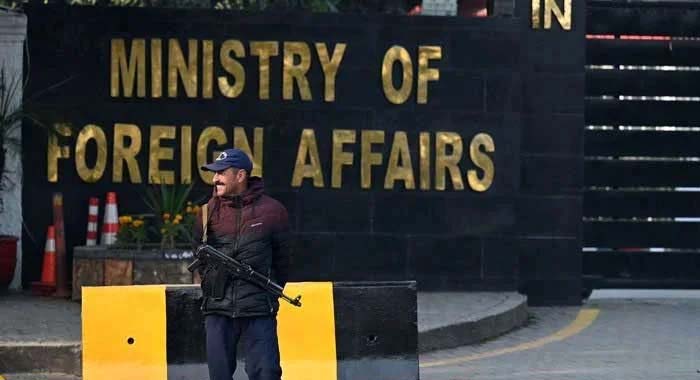
In an official statement, the Foreign Office noted that the Indian Defence Minister’s remarks deliberately distort the internationally recognized status of the Jammu and Kashmir dispute, which remains on the agenda of the United Nations Security Council. The statement underscored that the dispute has yet to be resolved in accordance with relevant UN Security Council resolutions and the principle of the right to self-determination of the Kashmiri people.
The Foreign Office further observed that the Indian leadership’s continued reliance on inflammatory rhetoric appears to be an attempt to divert international attention from its prolonged occupation of Indian Illegally Occupied Jammu and Kashmir (IIOJK), its alleged involvement in destabilizing activities across the region, and the growing political and social challenges confronting India domestically.
Pakistan reiterated that attempts to intimidate through military threats or coercive language will neither alter the legal and political realities surrounding the Jammu and Kashmir dispute nor weaken Pakistan’s unwavering commitment to safeguarding its sovereignty, territorial integrity, and national security.
The statement emphasized that Pakistan remains fully prepared to respond to any act of aggression and highlighted the unity, resilience, and determination demonstrated by the Pakistani nation and its armed forces during Operation Bunyan-ul-Marsoos, describing it as a clear testament to Pakistan’s capability and resolve to defend its national interests against any external adventurism.
Calling upon the international community, particularly the United Nations, Pakistan urged global stakeholders to take serious note of India’s continued disregard for international law and its obligations under the United Nations Charter and relevant Security Council resolutions. The Foreign Office stressed that India must be held accountable for its failure to implement the UN-mandated commitments guaranteeing the right of self-determination to the people of Jammu and Kashmir.
Pakistan further reaffirmed that any durable peace in South Asia can only be achieved through sincere dialogue, respect for international law, and the peaceful resolution of outstanding disputes, particularly the Jammu and Kashmir issue.
Echoing the Government’s position, Defence Minister Khawaja Muhammad Asif strongly condemned the Indian Defence Minister’s remarks, stating that India cannot alter internationally recognized legal realities through political rhetoric or coercive posturing.
In a statement shared on social media, the Defence Minister reaffirmed that Jammu and Kashmir remains an internationally recognized disputed territory, the final disposition of which must be determined in accordance with relevant United Nations Security Council resolutions and the freely expressed will of the Kashmiri people.
The Defence Minister categorically rejected India’s repeated allegations against Pakistan, asserting that such claims lack credibility in view of India’s own documented record of destabilizing activities in the region. He stated that India’s continued attempts to malign Pakistan are designed to distract attention from its internal political challenges and its policies in Indian Illegally Occupied Jammu and Kashmir.
He further warned that irresponsible statements from senior Indian leadership risk lowering the threshold for interstate conflict in South Asia, thereby undermining regional peace and security. Such rhetoric, he noted, is incompatible with the responsibilities expected of a nuclear-armed state and serves only to heighten tensions in an already fragile security environment.
Reaffirming Pakistan’s principled position, the Defence Minister stated that Pakistan remains firmly committed to peace, constructive engagement, and meaningful dialogue based on mutual respect and sovereign equality. However, he stressed that Pakistan’s commitment to peace must not be misconstrued as weakness, emphasizing that the country possesses both the capability and determination to defend its sovereignty and territorial integrity against any aggression.
The Government of Pakistan reiterated that lasting peace and stability in South Asia require adherence to international law, responsible statecraft, and meaningful diplomatic engagement rather than inflammatory rhetoric and unilateral assertions. Pakistan reaffirmed its commitment to a peaceful resolution of all outstanding disputes through dialogue, while making it unequivocally clear that any threat to its sovereignty, territorial integrity, or national security will be met with full resolve.



