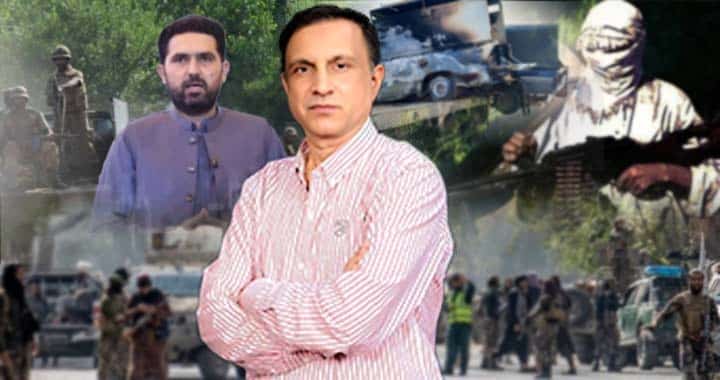
For years, the debate surrounding Pakistan’s security has revolved around military operations, cross-border terrorism and regional geopolitics with Kabul at its center. These are undoubtedly important dimensions of the challenge, but recent developments on both sides of the Durand Line point towards a broader reality. The weakening grip of the Afghan Taliban over different parts of Afghanistan and the deteriorating security situation in Khyber Pakhtunkhwa are not two separate stories. They are interconnected developments that must be viewed through the same strategic lens.
The recent reports of expanding resistance activities in Afghanistan deserve close attention. Whether in Badakhshan or elsewhere, it is becoming increasingly evident that the interim Taliban administration is struggling to establish undisputed authority across the country. This is no longer merely an assessment coming from outside observers. The signs are visible on the ground through recurring reports of armed resistance, growing public resentment, increasing restrictions on political figures, and an expanding campaign against dissent.
No government can remain stable indefinitely when it relies primarily on coercion while failing to deliver governance. Military control can suppress unrest for a period of time, but it cannot replace functioning institutions, economic opportunities or public confidence. Afghanistan today appears to be confronting precisely this dilemma.
Resistance Is Growing from Within
The emerging resistance movements should not be viewed as isolated incidents confined to one province or one ethnic group. Different organizations may operate under different names and with different objectives, but collectively they reflect a widening dissatisfaction with the prevailing political order inside Afghanistan.
Equally important is the fact that many individuals associated with previous Afghan governments, including former officials and members of the former security establishment, continue to possess organizational experience, local influence and networks that can evolve into organized opposition.
At the same time, the Taliban administration appears increasingly concerned about political dissent. Restrictions on prominent political personalities, limitations on travel and tighter surveillance indicate an administration that is becoming more defensive rather than more confident.
History offers a consistent lesson. Governments that spend most of their energy containing internal opposition eventually find themselves unable to concentrate on governance. Afghanistan increasingly appears to be entering such a phase.
Economic realities only deepen this challenge.
The country’s fragile economy continues to struggle under international isolation. Employment opportunities remain limited. Millions of Afghans continue to face severe humanitarian hardships. Families continue to experience poverty that should concern not only Afghanistan but the wider region.
Such conditions inevitably create fertile ground for political unrest. Economic frustration often becomes the fuel upon which political resistance grows.
Pakistan Must Stay Focused on Its Own Principles
Despite these developments, Pakistan’s policy should remain guided by restraint rather than opportunity.
There will undoubtedly be voices suggesting that Pakistan should involve itself more directly in Afghanistan’s internal affairs, particularly if resistance movements gather further momentum. Such suggestions should be resisted.
Pakistan has consistently maintained that Afghanistan’s internal political future must be determined by Afghans themselves. That principle remains sound.
Interference may produce temporary tactical advantages but often creates strategic liabilities that endure for decades. Pakistan understands this lesson better than most countries in the region.
That does not mean remaining indifferent to developments across the border.
When instability inside Afghanistan directly affects Pakistan through cross-border terrorism, infiltration or the presence of internationally recognized terrorist organizations, Islamabad has every right to strengthen border security, improve intelligence coordination and protect its citizens.
There is a clear distinction between safeguarding national security and interfering in another country’s internal political affairs.
That distinction must remain intact.
The Security Challenges Are Connected
Unfortunately, instability inside Afghanistan does not remain confined within Afghanistan.
The United Nations and multiple international monitoring mechanisms have repeatedly highlighted the continued presence of numerous terrorist organizations operating from Afghan territory. Among these, the banned Tehreek-e-Taliban Pakistan remains one of the most serious threats confronting Pakistan.
Every major terrorist incident inside Pakistan reminds policymakers that developments across the border cannot simply be ignored.
The recent attack in Tank is one painful example.
The sacrifices made by Pakistan’s security personnel once again demonstrate the determination of those defending the country. Yet these sacrifices also highlight another uncomfortable reality.
Military courage alone cannot permanently solve problems created by weak governance.
The armed forces perform a defined mission. They conduct intelligence-based operations, dismantle terrorist hideouts, neutralize dangerous networks and restore immediate security.
But after every successful operation comes an equally important phase.
That phase belongs to civilian governance.
It is here that Pakistan continues to face serious institutional weaknesses.
Military Operations Cannot Replace Governance
One misconception repeatedly appears whenever terrorism resurfaces.
Many assume that every security setback automatically reflects military failure.
The facts suggest otherwise.
In district after district across Khyber Pakhtunkhwa, security forces have conducted complex operations, often under extremely difficult conditions. They have cleared areas, dismantled terrorist infrastructure and restored immediate order.
However, once these operations conclude, responsibility gradually shifts towards civilian institutions.
Police forces.
District administrations.
Provincial departments.
Counterterrorism institutions.
Local governance.
Development authorities.
Unfortunately, this transition has often proved far less successful than the operations themselves.
The challenge is not simply eliminating terrorists.
The challenge is preventing their return.
That requires sustained policing, functioning intelligence networks, responsive district administrations, reliable infrastructure, effective public services and local confidence in government institutions.
Where governance weakens, terrorists search for opportunities to regroup.
Where administration disappears, extremist networks attempt to rebuild influence.
This pattern has repeated itself too many times across different districts of Khyber Pakhtunkhwa.
The KP Government Cannot Afford Strategic Confusion
Recent developments have raised another concern that deserves serious discussion.
Security policy requires clarity.
Public communication requires consistency.
Political leadership requires confidence.
Unfortunately, the provincial government’s messaging on terrorism has frequently appeared uncertain, contradictory and reactive.
When operations are underway, citizens deserve accurate information.
When security challenges emerge, governments should communicate facts rather than confusion.
The public understands that operational details cannot always be disclosed immediately.
However, refusing to acknowledge obvious realities only creates unnecessary speculation.
People living in Bannu, Tank, Lakki Marwat, Karak, Dera Ismail Khan, Mohmand, Bajaur, Swat and Waziristan already know the security challenges they face.
Attempting to avoid discussing those realities does not improve security.
Transparent communication builds public confidence.
Conflicting statements weaken it.
More importantly, governments should not appear absent during moments of crisis.
Leadership during difficult times is measured not only through statements but through visible engagement, institutional coordination and timely decision-making.
The public expects provincial leadership to remain fully informed about developments within its own jurisdiction, particularly when security personnel are making the ultimate sacrifice.
That expectation is neither unreasonable nor political.
It is simply good governance.
Security Success Cannot Substitute for Governance
The same pattern is visible across Khyber Pakhtunkhwa. Whenever terrorists establish a foothold, the security forces launch intelligence-based operations, clear the area, dismantle hideouts and eliminate those involved. Yet after every successful operation, another question emerges. Who is responsible for ensuring that the terrorists do not return?
That responsibility does not belong to the military alone. It belongs to the provincial administration, the police, the civil bureaucracy and the elected government. Counterterrorism has always required two parallel tracks. One is kinetic action against armed groups. The other is governance that prevents those groups from rebuilding their networks.
Recent developments from Swat illustrate this challenge. Reports indicate that small groups of terrorists have attempted to infiltrate mountainous areas again despite previous operations that had restored peace. Such incidents raise important questions about post-operation management. If cleared areas are not continuously monitored by local institutions, small infiltrating groups can exploit difficult terrain, intimidate local populations and gradually rebuild logistical support.
The same concern applies to districts stretching from Tank, Bannu and Lakki Marwat to Dera Ismail Khan and parts of Waziristan. These are not isolated incidents. They form part of a broader security environment that demands sustained coordination between military and civilian institutions.
Military operations are designed to remove immediate threats. Governance is supposed to ensure that those threats do not return.
Unfortunately, the provincial government’s public messaging has often appeared inconsistent. At different times, conflicting statements have emerged regarding security operations, their scope and even whether such operations were taking place. Such contradictions create unnecessary confusion precisely when clarity is needed most.
Public confidence depends on timely information. Citizens living in conflict-affected districts deserve regular security briefings based on facts rather than political rhetoric. Transparent communication strengthens resilience and reduces the space for rumors and disinformation.
The people of Khyber Pakhtunkhwa have repeatedly demonstrated resilience during difficult years. What they now expect is leadership that matches their sacrifices.
Security also requires administrative preparedness. Check posts must be hardened against vehicle-borne attacks. Police stations require continuous upgrades. Intelligence coordination must improve further. Local policing capacities, particularly CTD capabilities, require sustained investment, training and technological support. Modern surveillance equipment, anti-drone systems and rapid response mechanisms are useful only when personnel are adequately trained to employ them effectively.
Pakistan’s armed forces have repeatedly demonstrated their operational capabilities. The challenge increasingly lies in ensuring that civilian institutions are equally capable of holding territory after operations conclude.
Balochistan’s Security Challenge Is Increasingly Multi-Dimensional
Balochistan presents an even more complex picture. Multiple terrorist organizations continue attempting to destabilize the province through attacks against civilians, infrastructure and state institutions. Various groups operate with different ideological motivations, yet their operational objectives frequently overlap.
Recent attacks, including the attempted assassination of a district and sessions judge in Mastung, illustrate how diverse terrorist actors continue seeking high-profile targets. Claims of responsibility by different organizations also demonstrate that Pakistan no longer confronts isolated threats but rather an evolving ecosystem of violent extremism.
Security investigations in previous cases have pointed towards facilitation networks, logistical support structures and information sharing between different actors. Countering such interconnected threats requires intelligence-led policing, financial investigations, cyber capabilities and stronger institutional coordination.
Equally important is strengthening civilian governance across conflict-prone districts. Good governance remains one of the strongest long-term counterterrorism tools. Efficient policing, functioning schools, accessible healthcare, economic opportunities and responsive local administration reduce the space within which extremist organizations attempt to recruit or intimidate vulnerable populations.
No military can permanently replace effective civilian administration.
Pakistan therefore faces two interconnected challenges. The first is defending its borders against cross-border terrorism and preventing externally supported militant networks from operating with impunity. The second is ensuring that domestic governance becomes resilient enough to deny terrorists opportunities created by administrative weakness.
Developments inside Afghanistan will continue influencing Pakistan’s western border. Internal instability, growing resistance activity and economic deterioration across Afghanistan create conditions that militant organizations may seek to exploit further. Islamabad’s stated policy of non-interference in Afghanistan’s internal affairs remains strategically important. At the same time, Pakistan cannot ignore security threats that originate beyond its borders and directly affect its citizens.
The relationship between Afghanistan’s internal stability and Pakistan’s internal security has become inseparable. A fragmented Afghanistan creates opportunities for transnational terrorist organizations. An underprepared provincial administration inside Pakistan increases those opportunities further.
That is precisely why security cannot be viewed solely through a military lens. Counterterrorism is also about governance, institutional competence and public confidence.
Pakistan’s security forces continue demonstrating resolve on the battlefield. The next stage of success depends upon equally determined civilian governance. Only when both pillars operate together can lasting peace become sustainable.
The war against terrorism, ultimately, is not won only through operations. It is won when security gains are consolidated through competent governance, responsive institutions and a state that remains fully present long after the gunfire has stopped.