There comes a point in every nation’s security journey when incremental adjustments are no longer enough. Pakistan is approaching, if it has not already reached, that moment. The threats confronting the country today are no longer confined to a single border, a single terrorist organization or even a single domain of warfare. They are interconnected, technologically adaptive and strategically coordinated. Understanding this reality is the first step toward formulating an effective national response.
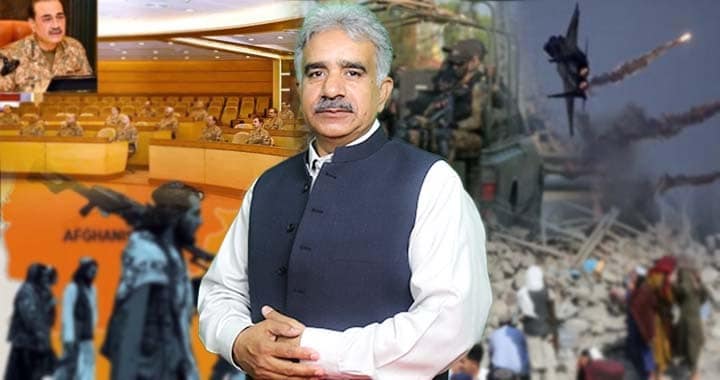
The recent Corps Commanders’ Conference should therefore not be viewed merely as another routine military meeting. It represented a strategic assessment of Pakistan’s evolving security environment and, more importantly, a clear articulation of the state’s resolve to safeguard its sovereignty against threats originating both within and beyond its borders.
One aspect of the conference deserves particular attention. Pakistan conveyed an unambiguous message that no distinction will be made between those who directly carry out terrorist attacks and those who provide them sanctuary, financing, training or logistical support. Terrorism does not survive in isolation. It survives because networks exist that nurture it, facilitate it and protect it. Unless these ecosystems are dismantled, terrorist violence will continue to regenerate regardless of how many individual terrorists are eliminated.
For several years, Pakistan exercised considerable restraint despite repeated provocations emanating from across the western border. Terrorist groups continued to exploit sanctuaries, reorganize their structures and launch attacks against Pakistani civilians and security personnel. Alongside these attacks came increasingly hostile rhetoric from elements within Afghanistan’s interim administration, accompanied by repeated denials regarding the presence of terrorist groups operating from Afghan territory.
The issue has now moved beyond diplomatic exchanges. It has become a matter of Pakistan’s national security.
Every sovereign state possesses not only the right but also the responsibility to protect its citizens. If terrorist organizations continue to exploit foreign territory to plan and execute attacks inside Pakistan, expecting Islamabad to remain indefinitely passive would neither be realistic nor consistent with international practice. Counterterrorism cannot succeed if artificial geographical boundaries become permanent shields for those orchestrating violence.
This is precisely why intelligence-based operations have become central to Pakistan’s evolving security doctrine. The objective is no longer simply to respond after an attack has taken place. The objective is to identify, disrupt and neutralize terrorist infrastructure before innocent lives are lost. The growing emphasis on prevention over reaction reflects lessons learned through decades of sacrifice.
Pakistan has paid an extraordinary price in this war. Thousands of civilians, soldiers, police officers, intelligence personnel and members of law enforcement agencies have laid down their lives. Entire communities have endured displacement, economic disruption and psychological trauma. No country that has borne such a burden can afford complacency when confronted with renewed threats.
The western border, however, is only one dimension of a much broader strategic picture.
The eastern front continues to present challenges of a different nature, where conventional military deterrence intersects with economic security and international law. Among these challenges, water security is rapidly emerging as an issue that deserves far greater national attention than it currently receives.
Attempts to manipulate river flows or undermine Pakistan’s legitimate water rights cannot be viewed merely as technical or environmental disputes. Water is becoming an instrument of strategic coercion across many parts of the world. Countries increasingly recognize that controlling water resources can produce political, economic and humanitarian consequences without firing a single shot.
Pakistan’s rights under the Indus Waters Treaty are internationally recognized. Any effort to erode those rights, alter agreed mechanisms or weaponize water introduces a serious security dimension that extends well beyond irrigation and agriculture. Food security, energy production, industrial growth and national stability all depend upon predictable access to water resources.
The Corps Commanders’ Conference therefore sent an important message, not only regarding conventional defence but also regarding the protection of Pakistan’s strategic interests. National security today encompasses much more than territorial defence. It includes safeguarding critical infrastructure, ensuring uninterrupted economic activity, protecting cyberspace, securing supply chains and preserving access to essential natural resources.
The western frontier presents another emerging challenge that often receives insufficient attention.
Several hydropower projects are being developed along river systems that eventually flow into Pakistan. While every country has the sovereign right to pursue legitimate development, regional water management cannot become another arena for geopolitical competition. External actors seeking influence through infrastructure projects must recognize that any initiative affecting downstream states inevitably carries strategic implications.
Pakistan cannot afford to examine these developments in isolation. The security environment stretching from the eastern border to the western frontier increasingly resembles an interconnected strategic theatre where diplomatic, economic, technological and military considerations reinforce one another.
Yet perhaps the most significant transformation is not occurring on either border.
It is occurring within terrorism itself.
For years, terrorist organizations relied primarily upon physical mobility, cross-border infiltration and localized recruitment. Those methods have not disappeared, but they have evolved dramatically. Modern terrorist networks adapt quickly when confronted with sustained pressure. They relocate. They fragment into smaller operational cells. They cooperate with ideologically different organizations whenever tactical interests converge.
This evolution explains why terrorist violence in Pakistan can no longer be analyzed through the lens of individual organizations alone.
Whether one examines Fitna al-Khwarij, the Balochistan Liberation Army, Daesh affiliates or transnational extremist networks, an unmistakable pattern emerges. Operational cooperation, intelligence sharing, logistical facilitation and overlapping areas of influence have become increasingly significant features of the contemporary terrorist landscape.
Pressure in one theatre often results in movement toward another.
When infiltration routes become difficult in one region, alternative corridors are explored elsewhere. When border management becomes more effective in one province, operational focus shifts toward another. Terrorist organizations survive by remaining flexible. States must therefore become even more adaptable than the adversaries they confront.
This changing battlefield demands an equally dynamic national strategy.
For too long, discussions about terrorism have focused almost exclusively on kinetic operations. Military action remains indispensable, but it represents only one component of a much larger national effort. Sustainable success requires intelligence dominance, institutional coordination, technological modernization, financial disruption of terrorist networks and strategic communication capable of defeating extremist propaganda before it gains traction.
If terrorism has evolved, governance must evolve with it.
Far too often, public debate treats security as the exclusive responsibility of the armed forces and law enforcement agencies. That is an incomplete understanding of national security. Soldiers can eliminate terrorists. Intelligence agencies can dismantle networks. Police can arrest facilitators. Yet no military institution can substitute for effective governance, responsive administration and public trust.
This reality becomes particularly visible after every terrorist attack.
The immediate response should always focus on rescuing victims, treating the injured and bringing perpetrators to justice. But once the emergency phase ends, another responsibility begins, standing beside the families whose lives have been shattered.
The recent terrorist attack on civilians in the outskirts of Quetta demonstrated an important aspect of this responsibility. The immediate visit to the injured, public assurances that the perpetrators would be pursued, financial assistance for affected families and commitments regarding the education of children sent a message that victims had not been left alone.
Support for victims should never become a political competition between provinces. Every Pakistani citizen deserves the same compassion, regardless of whether terrorism strikes Quetta, Bannu, North Waziristan, Bajaur, Lakki Marwat, Dera Ismail Khan or Karachi.
Those who lose loved ones to terrorism should never feel abandoned once television cameras leave the scene.
Equally important is resisting the temptation to turn every terrorist incident into an opportunity for political point-scoring. Terrorists seek precisely that outcome. They want attacks to deepen divisions, weaken confidence in institutions and transform national tragedies into partisan disputes.
Pakistan cannot afford to grant them that victory.
There is another misconception that deserves correction.
Every act of terrorism in Balochistan is often presented through the narrow prism of ethnicity. Reality is considerably more complex.
Balochistan is home not only to Baloch communities but also to Pashtuns, Hazaras and many other Pakistanis who have lived, worked and built their futures there for generations. Terrorists do not distinguish between these communities when pursuing violence. Teachers, laborers, engineers, traders, transport workers and ordinary citizens have all suffered.
Killing innocent Pakistanis is not nationalism.
Targeting passengers because of their identity is not political resistance.
Murdering laborers working on development projects is not a struggle for rights.
Extorting businesses, intimidating contractors and attacking schools, hospitals or public infrastructure cannot be legitimized by wrapping violence in political slogans.
Every society has grievances. Every federation has governance challenges. Pakistan is no exception.
Development gaps, administrative shortcomings and unequal access to public services deserve serious attention and genuine policy responses. But those legitimate discussions must never be confused with campaigns of terrorism that deliberately target civilians and seek to weaken the state through fear.
Good governance and effective counterterrorism are complementary, not competing, objectives.
Where governance improves, terrorist narratives lose credibility.
Where institutions deliver justice and opportunity, recruitment becomes more difficult.
Where citizens trust the state, propaganda finds fewer willing audiences.
This brings us to another issue that deserves greater national reflection.
Pakistan has spent decades improving its ability to conduct kinetic operations against terrorist organizations. Operations such as Rah-e-Rast, Rah-e-Nijat, Zarb-e-Azb and Radd-ul-Fasaad significantly degraded terrorist infrastructure and restored the writ of the state across large areas.
Those achievements should never be underestimated.
But terrorist organizations also learned from those defeats.
Instead of mass formations, they adopted smaller cells.
Instead of permanent camps, they shifted to dispersed networks.
Instead of relying solely on physical meetings, they embraced encrypted communications and social media.
Instead of traditional propaganda methods, they built digital ecosystems capable of reaching thousands of people within minutes.
Recruitment itself has changed dramatically.
Not long ago, extremist organizations depended heavily on personal contact through local networks, gatherings and physical interaction.
Today, a smartphone can perform much of that function.
Propaganda videos, encrypted messaging platforms, online fundraising, virtual indoctrination and coordinated information campaigns have fundamentally altered the operational environment.
The information domain has become a battlefield in its own right.
Every fabricated claim circulated after a terrorist attack, every manipulated video, every coordinated misinformation campaign and every attempt to spread anti-state narratives forms part of the same conflict.
Winning battles on the ground while losing the information space is not sustainable.
Pakistan therefore requires an integrated media strategy capable of exposing disinformation quickly, communicating verified facts effectively and preventing hostile narratives from dominating public discourse.
Technology must also become a force multiplier for national security.
Artificial intelligence, advanced surveillance systems, data integration, drone detection, counter-drone capabilities, biometric verification, satellite imagery and predictive intelligence are no longer luxuries reserved for advanced militaries. They are becoming operational necessities.
Terrorist organizations have already demonstrated their willingness to exploit commercially available technologies, including quadcopters, encrypted communications and social media platforms.
The state must remain several steps ahead.
This is not simply about purchasing new equipment.
It is about integrating intelligence, technology, policing, border management and strategic communication into a single national framework capable of adapting as quickly as the threat itself.
Pakistan’s enemies understand that they cannot prevail through conventional warfare alone.
They seek instead to exploit economic vulnerabilities, information warfare, cross-border terrorism, water security, proxy groups and political polarization simultaneously.
The national response must therefore be equally comprehensive.
The future of Pakistan’s counterterrorism effort will not be determined solely by the number of successful operations conducted each year.
It will be determined by how effectively the country combines military professionalism, political maturity, technological innovation, institutional coordination and public resilience into one coherent national strategy.
The Corps Commanders’ Conference reflected an important recognition that the character of the threat has changed.
Our response must change with it.
Pakistan has defeated formidable terrorist challenges before, not because one institution acted alone, but because the nation ultimately chose unity over division and resilience over fear.
The next phase of this struggle will demand the same resolve, strengthened by better governance, smarter technology, stronger institutions and an unwavering commitment to protecting every Pakistani citizen.
Tomorrow’s war has already begun.
The question is not whether the enemy has changed.
The question is whether we are prepared to stay ahead of that change.