
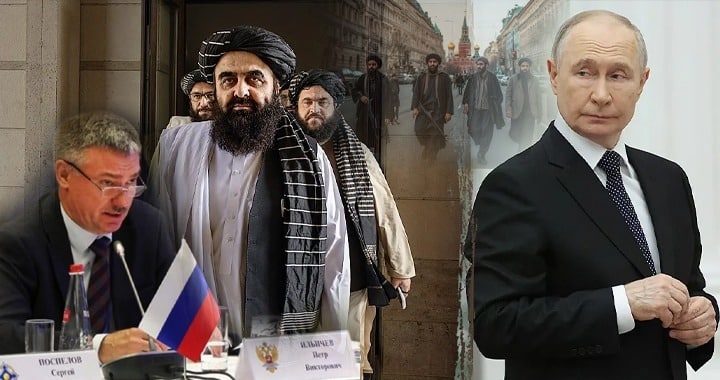
Russia’s latest warning about the security situation in Afghanistan has revived an increasingly difficult question: if Moscow officially recognizes the Taliban administration as the legitimate government of Afghanistan, why do Russian officials continue to describe the country as home to dozens of terrorist groups and tens of thousands of fighters?
The question is not merely rhetorical. It goes to the heart of one of the most visible contradictions in regional diplomacy.
Only recently, a senior Russian Foreign Ministry official warned that approximately 20 terrorist organizations, comprising between 20,000 and 23,000 fighters, remain present in Afghanistan. The assessment was not issued by a rival government, a Western intelligence service, or a regional adversary. It came from Russia itself.
Yet almost simultaneously, Moscow has continued expanding engagement with the Taliban administration, culminating in military-technical cooperation agreements and unprecedented diplomatic recognition.
Recognition Was Supposed to Produce Results
Recognition is generally justified on pragmatic grounds.
States recognize governments because they believe engagement can deliver outcomes that isolation cannot. In Afghanistan’s case, one of the primary arguments advanced by supporters of engagement has been that working with the Taliban would improve security, enhance counterterrorism cooperation, and encourage responsible governance.
If that was the objective, Russia’s own security assessments invite scrutiny.
If Afghanistan still hosts roughly 20 terrorist groups with more than 20,000 fighters, according to Russian officials, then the obvious question becomes: what measurable security gains have resulted from formal recognition?
The contradiction becomes even sharper because Moscow is not merely maintaining diplomatic contacts. Russia has gone further than any major power by formally recognizing the Taliban administration while simultaneously warning regional states about terrorist threats emanating from Afghan territory.
Two Russian Narratives
Recent statements coming from Moscow appear to present two different pictures of Afghanistan.
One narrative emphasizes stability.
Russian President Vladimir Putin on his visit to India, in December 2025, suggested that despite existing challenges, Afghanistan remains firmly under Taliban control. Such statements imply that the Taliban exercise sufficient authority across the country and maintain a functioning governing structure.
The second narrative focuses on persistent security threats.
Russian diplomats, security officials, think tanks, and regional security forums continue to warn about terrorist organizations operating inside Afghanistan, the dangers of cross-border attacks, radicalization efforts, criminal financing networks, and the presence of thousands of armed fighters.
Taken together, these positions create an unavoidable policy dilemma.
If the Taliban truly exercise effective control over Afghanistan, why do so many terrorist groups remain active?
Conversely, if terrorist organizations continue operating freely and in large numbers, can Afghanistan genuinely be described as securely governed?
The Question Many Regional States Have Been Asking
For countries directly affected by terrorism, particularly Pakistan and Central Asian states, this contradiction is hardly new.
For years, regional governments have argued that the central issue is not whether the Taliban control Afghanistan, but what happens under that control.
The debate has never revolved solely around governance. It has revolved around the continued presence of terrorist organizations that regional states believe threaten their security.
Numerous United Nations reports have documented the presence of terrorist groups inside Afghanistan. Various regional intelligence assessments have reached similar conclusions.
The latest Russian assessment effectively places Moscow within the same broad camp of concern.
That makes the contradiction harder to ignore because Russia is no longer commenting from the outside. It is now a state that has formally recognized the Taliban while continuing to acknowledge the persistence of terrorist networks inside the country.
Engagement Versus Accountability
Supporters of engagement argue that maintaining channels with the Taliban is necessary for regional stability.
There is logic to this argument. Afghanistan cannot simply be ignored, and neighboring countries require mechanisms for dialogue on border security, trade, migration, and counterterrorism.
However, engagement and accountability are not mutually exclusive.
Recognition carries political weight. It signals legitimacy and can be interpreted as an endorsement of a government’s ability to fulfill its responsibilities.
The challenge for Moscow is that its own officials continue highlighting conditions that suggest major counterterrorism shortcomings remain unresolved.
This raises a fundamental question: should recognition be accompanied by clearer benchmarks and expectations regarding terrorist groups operating from Afghan territory?
The Signal Sent to the Region
The issue extends beyond Afghanistan itself.
Regional governments closely watch how major powers respond to security threats.
When a country formally recognizes a government while simultaneously warning that dozens of terrorist organizations continue operating under that government’s watch, mixed signals inevitably emerge.
For neighboring states confronting terrorism, the concern is straightforward.
If the existence of thousands of fighters and dozens of terrorist groups does not affect diplomatic recognition, what incentive exists for meaningful corrective action?
A Question Moscow Cannot Avoid
Russia’s engagement with Afghanistan reflects strategic calculations, regional realities, and geopolitical interests. Few dispute that Moscow has legitimate reasons to maintain relations with Kabul.
What remains difficult to reconcile is the growing gap between Russia’s diplomatic posture and its own security assessments.
One branch of the Russian state warns about terrorist groups, cross-border threats, radicalization networks, criminal financing, and regional instability.
Another branch deepens cooperation with the very administration responsible for preventing those threats.
Until that contradiction is addressed, a simple question will continue to shadow Moscow’s Afghanistan policy:
If Afghanistan still hosts 20 terrorist groups and up to 23,000 fighters according to Russia’s own assessment, what exactly has formal recognition changed?



