
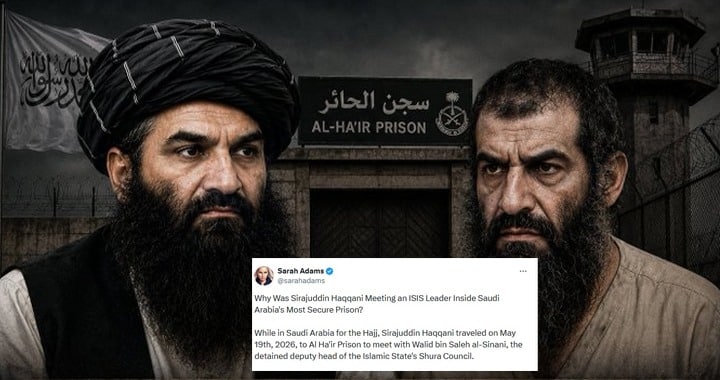
On May 19, 2026, Sirajuddin Haqqani, head of the Haqqani Network, Afghanistan’s Minister of Interior under the Taliban regime, and one of the FBI’s most wanted terrorists with a $10 million bounty on his head walked into Al Ha’ir Prison, one of Saudi Arabia’s most fortified maximum-security detention complexes, and sat down with Walid bin Saleh al-Sinani, the detained deputy head of the Islamic State’s Shura Council. A top-ten ISIS leader. In a Saudi prison. With a Taliban minister. On a visit that should, under any credible security protocol, have been impossible.
That meeting reported and analysed by former CIA analyst Sarah Adams, on her X platform, has generated urgent and unanswered questions about who authorised the encounter, what was discussed, whether the conversation was recorded, and what the intelligence services of the United States, the United Kingdom, Europe, and Australia know about the outcome. The implications, if Adams’s assessment is accurate, extend directly to the national security of Western nations and to the safety of civilians on three continents.
To fully appreciate the gravity of this incident, it is necessary to understand precisely who the two individuals involved are and what their presence in the same room inside a maximum-security prison represents for global counter-terrorism.
Sirajuddin Haqqani is not a peripheral figure in the global jihadist movement. He is, by any objective assessment, one of the most operationally significant and dangerous terrorist leaders alive today. He simultaneously holds two identities that, in any rational international order, should be irreconcilable: he is the serving Minister of Interior of Afghanistan under the Taliban regime a position that grants him diplomatic travel documents, protocol courtesies, and access to foreign capitals and he is a designated terrorist, the head of the Haqqani Network, and was one of the FBI’s Most Wanted Terrorists, with a $10 million reward posted by the United States government for information leading to his capture.
The Haqqani Network, which Sirajuddin leads, has been designated a Foreign Terrorist Organisation by the United States Department of State. Under his operational command, the network has been linked to some of the most devastating attacks of the past two decades. These include the 2008 suicide bombing of the Indian Embassy in Kabul one of the deadliest terrorist attacks in Afghan history multiple coordinated suicide bombings targeting US and NATO military installations across Afghanistan, and the kidnapping of American, Canadian, and other Western citizens held for ransom or political leverage. His fingerprints are on attacks that killed American soldiers. His network has held Western hostages for years. He remains, as of the date of this press release, a free man serving in government, travelling internationally, and apparently receiving authorised access to maximum-security prison facilities in allied nations.
The contradiction this represents a $10 million FBI fugitive holding a Cabinet portfolio and travelling to Saudi Arabia for Hajj is not a bureaucratic anomaly. It is a symptom of the broader failure of the international community to hold the Taliban regime to any meaningful counter-terrorism standard as a condition of diplomatic and economic engagement.
On the other side of the table sat Walid bin Saleh al-Sinani a figure whose name is less publicly known but whose position within the Islamic State hierarchy places him among the most consequential detained terrorist leaders in the world today. Al-Sinani serves as the deputy head of the ISIS Shura Council the supreme governing and deliberative body of the Islamic State organisation, responsible for strategic decision-making, ideological direction, and the authorisation of major operational activity. This is not a mid-level ISIS operative. This is not a foot soldier or a regional commander. This is a Top-10 member of the global ISIS leadership structure, detained by Saudi authorities in what should be and in a properly functioning counter-terrorism environment, would be one of the most closely guarded and intelligence-rich custody arrangements in the world.
Al-Sinani’s detention in Al Ha’ir Prison represents a significant counter-terrorism achievement for the Kingdom of Saudi Arabia. His value as an intelligence asset his knowledge of ISIS networks, financing channels, sleeper cells, operational planning, and global deployment of operatives is incalculable. Every conversation he has, every visitor he receives, every piece of information that enters or exits that cell, is of direct and immediate relevance to the counter-terrorism operations of the United States, the United Kingdom, the European Union, Australia, and every other nation targeted by Islamic State operations. Which makes what happened on May 19, 2026, not merely surprising but deeply, urgently alarming.
The meeting of these two individuals one a free-moving Taliban government minister travelling on Hajj, the other a maximum-security prisoner whose detention is a matter of international counter-terrorism significance is, by any rational security calculus, an event of extraordinary gravity. It is precisely the kind of meeting that intelligence agencies spend years trying to detect, prevent, infiltrate, or at minimum document in forensic detail. That it apparently occurred, that it was apparently authorised, and that it has received only a fraction of the scrutiny it demands from Western governments and media, is itself a story of institutional failure that must be told and confronted.
Al Ha’ir Prison, located south of Riyadh, is not an ordinary detention facility. It is one of Saudi Arabia’s premier maximum-security complexes, purpose-built to house individuals whose detention is considered a matter of national and regional security. The facility holds terrorism convicts, high-value security detainees, and individuals designated as threats to the stability of the Kingdom and the broader region.
Access to Al Ha’ir particularly access to high-value terrorism detainees is not granted casually, informally, or without the explicit authorisation of Saudi security authorities at the highest levels. The protocols governing contact with detainees of al-Sinani’s profile would, under any reasonable security framework, require formal approval, documented justification, and almost certainly some form of monitoring or recording of the interaction.
This is precisely why Adams’s central question carries such weight: in virtually no conceivable scenario did this meeting occur without the knowledge, awareness, and authorisation of Saudi officials. Somebody approved it. Somebody facilitated the logistics. Somebody knew before, during, or after that the head of the Haqqani Network had been granted access to a senior ISIS Shura Council member inside one of the Kingdom’s most sensitive detention facilities.
If Saudi authorities were aware of the meeting and the operational realities of Al Ha’ir Prison make awareness virtually certain then a question of immediate and urgent intelligence significance follows: was the conversation monitored, recorded, or documented?
This is not an abstract procedural question. According to Adams’s analysis, Sirajuddin Haqqani was reportedly expected to provide al-Sinani with an update on terrorists deployed to Europe, Australia, and the United States terrorists whose operational mandates include killing American, European, and Australian civilians. If that assessment is accurate, the meeting was not a social courtesy between two jihadist figures who happened to find themselves in proximity. It was a strategic briefing. It was a command communication. It was, in effect, a terrorist operational update conducted inside a Saudi state detention facility.
The intelligence implications of this scenario are staggering. Any recordings, transcripts, notes, or intelligence reports generated from or about this meeting would represent some of the most operationally significant counter-terrorism intelligence available to any Western service. The questions that must be answered and answered urgently include: Was the meeting between Haqqani and al-Sinani recorded by Saudi authorities? If recordings or transcripts exist, have they been shared with US, UK, European, or Australian intelligence services? What specific information was exchanged regarding terrorist operatives deployed to Western countries? Were any operational instructions conveyed from Haqqani to al-Sinani, or vice versa? Who else was present during the meeting on both sides? What was the stated purpose of the visit, and what justification was provided to Saudi authorities? Has the CIA, NSA, MI6, or any allied service been formally briefed on the content of this meeting?
These are not rhetorical questions. They are operational intelligence imperatives. Any intelligence service in the United States, Europe, or Australia that is tasked with preventing terrorist attacks on its soil — and is aware of this meeting has an obligation to pursue answers with maximum urgency.
For years, Western governments and their official narratives have sought to compartmentalise the global jihadist threat portraying the Taliban, the Haqqani Network, ISIS, Al-Qaida, and their affiliates as distinct, siloed, and often competing organisations with limited meaningful interaction at the senior leadership level. This framing has served a number of policy purposes: it has justified engagement with the Taliban as a distinct entity from Al-Qaida and ISIS; it has allowed governments to claim progress against one group while acknowledging the persistence of another; and it has provided political cover for the deeply uncomfortable reality of Taliban diplomatic rehabilitation on the world stage.
The May 19 meeting in Al Ha’ir Prison did not simply complicate this narrative. It demolished it. The head of the Haqqani Network simultaneously the Taliban’s Minister of Interior and one of the world’s most wanted terrorists met privately with a top-ten ISIS leader inside a Saudi maximum-security prison. This is not the behaviour of isolated, competing organisations. This is the behaviour of a connected, communicating, and potentially coordinating global jihadist movement whose internal divisions are, at the leadership level, far more fluid than official narratives have acknowledged. Adams is unambiguous on this point. For years, incidents like this have continued to reveal interactions occurring behind closed doors between some of the most senior figures in the global jihadist movement. Each such revelation should prompt a fundamental reassessment of the analytical frameworks being used to understand and counter the threat. So far, that reassessment has not occurred at the scale or speed that the evidence demands.



