
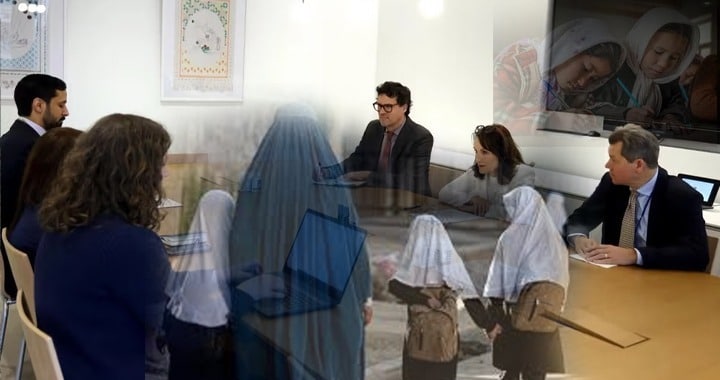
The United Arab Emirates has reiterated its support for the rights of Afghan women and girls, emphasizing the importance of ensuring their access to education, employment, and equal participation in society ahead of key United Nations discussions on Afghanistan.
According to an official statement, Ghassaq Shaheen, Deputy Permanent Representative of the UAE to the United Nations, met with Georgette Gagnon, the acting head of the United Nations Assistance Mission in Afghanistan (UNAMA), on Thursday to discuss recent developments in Afghanistan and the role of the UN mission in supporting peace and stability.
The UAE mission said the two sides exchanged views on the situation in Afghanistan, with particular attention to humanitarian and human rights concerns, including the status of women and girls under Taliban rule.
Abu Dhabi stressed that Afghan women and girls must have access to education, employment opportunities, and meaningful participation in public and social life, a position the UAE has consistently advocated in international forums since the Taliban returned to power in 2021.
The diplomatic engagement comes at a significant moment for Afghanistan at the United Nations. The UN Security Council is expected to review the future mandate of UNAMA later this month, with discussions anticipated in mid-June. The UN mission is also scheduled to present a new report on Afghanistan in the coming days, outlining political, security, humanitarian, and human rights developments across the country.
The UAE has repeatedly voiced concern over restrictions imposed on Afghan women and girls, particularly the continued ban on secondary and higher education for female students. Afghanistan remains the only country in the world where girls and women are barred from education beyond the sixth grade.
In previous sessions of the UN Human Rights Council, Emirati representatives called for the protection of Afghan women’s rights and urged the international community to remain engaged on the issue.
The UAE has also maintained contacts with Afghan women activists in recent years. During meetings held last year, Afghan women campaigners appealed for stronger international support to safeguard basic rights and educational opportunities for women and girls facing restrictions under Taliban policies.
The latest statement adds to growing international pressure on the Taliban administration over its treatment of women and girls. Human rights organizations, UN officials, and several governments have repeatedly argued that lasting stability and development in Afghanistan cannot be achieved while half of the country’s population remains excluded from education, employment, and public life.
The renewed Emirati position also follows a series of recent international reports highlighting broader concerns inside Afghanistan, including restrictions on women’s freedoms, allegations of arbitrary detention, prison abuses, corporal punishments, and reported cases of sexual violence attributed to Taliban officials. Rights advocates argue that the continued denial of educational opportunities to girls remains one of the most visible symbols of the country’s ongoing human rights crisis.
The statement also comes shortly after 74 Afghan girls completed undergraduate and graduate degrees at U.S. universities through an international scholarship initiative, underscoring what rights advocates describe as a growing divide between educational opportunities available to Afghan women abroad and the restrictions they continue to face under Taliban rule at home.



