
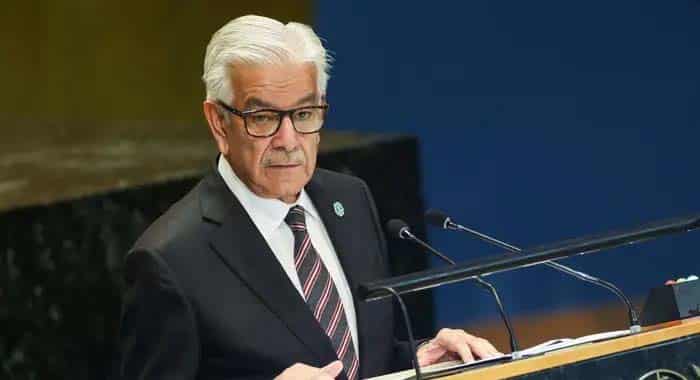
Pakistan’s Defence Minister Khawaja Asif has reiterated Islamabad’s longstanding concerns regarding the continued presence and activities of the banned Tehreek-e-Taliban Pakistan (TTP), stating that recent reports of Taliban leader Hibatullah Akhundzada urging the group to halt attacks inside Pakistan have not translated into any meaningful change on the ground.
The remarks come amid renewed scrutiny of Afghanistan-Pakistan relations following reports that the Taliban leadership had informally conveyed to Islamabad that Akhundzada had warned the TTP against conducting attacks across the border. Pakistani officials, however, remain unconvinced, arguing that verbal assurances alone are insufficient without verifiable and sustained action.
According to Khawaja Asif, Pakistan’s assessment of the security situation indicates that support structures and operational realities linked to the TTP remain largely unchanged. He suggested that contradictory messages emerging from different Taliban officials have contributed to a growing trust deficit, making it difficult for Islamabad to rely on statements that are not accompanied by measurable outcomes.
The Defence Minister emphasized that Pakistan’s concerns stem not from the absence of assurances, but from what officials describe as a lack of practical implementation. He argued that any meaningful improvement in bilateral security relations would require tangible measures aimed at curbing the activities of militant groups allegedly operating from Afghan territory.
The latest debate was triggered by a report published by The Express Tribune, which stated that the Taliban administration had unofficially informed Pakistani authorities that Supreme Leader Hibatullah Akhundzada had instructed the TTP to cease attacks inside Pakistan. According to the report, the communication was presented as part of broader Taliban efforts to demonstrate responsiveness to Islamabad’s security concerns.
However, Pakistani officials reportedly viewed the message as insufficient, maintaining that symbolic warnings and informal assurances do not address the core issue confronting bilateral relations. Officials familiar with the matter argue that Pakistan continues to seek concrete evidence of action against militant networks that it believes threaten regional stability and Pakistani national security.
The issue has remained a central source of tension between Islamabad and Kabul since the Taliban’s return to power in Afghanistan in August 2021. Pakistani authorities have repeatedly expressed concern over what they describe as the continued presence of TTP elements and associated facilitation networks across the border. The Taliban administration, meanwhile, has consistently rejected accusations that Afghan territory is being used to launch attacks against neighboring countries.
Despite periodic diplomatic engagements and multiple rounds of dialogue, the security dispute has persisted. Over recent months, tensions have periodically escalated into border incidents and military confrontations, resulting in casualties on both sides and disruptions to cross-border movement and trade.
Regional stakeholders have also sought to prevent a further deterioration in relations. Countries including Saudi Arabia, Türkiye, Qatar, and China have reportedly supported diplomatic efforts aimed at reducing tensions and encouraging constructive engagement between Pakistan and the Afghan Taliban administration. While these initiatives have helped maintain communication channels, they have yet to produce a breakthrough on the core security concerns dividing the two sides.
Officials familiar with Pakistan’s position say Islamabad continues to seek stronger guarantees regarding counterterrorism commitments. Among the measures reportedly under discussion are formal assurances concerning action against the TTP and steps to prevent Afghan territory from being used by groups targeting Pakistan.
The Taliban administration, however, maintains its position that no foreign militant organizations are being allowed to operate from Afghan soil and has repeatedly stated that Afghanistan’s territory will not be used against any other country.
Analysts note that the ongoing disagreement reflects a broader challenge facing regional diplomacy: the gap between political assurances and security realities. While both sides continue to express a desire for stable relations, the absence of mutual trust and differing perceptions of the threat environment continue to complicate efforts toward a lasting understanding.
For Pakistan, officials argue that progress will ultimately be measured not by statements or warnings, but by verifiable actions capable of reducing cross-border militancy and addressing long-standing security concerns. Until such developments occur, observers believe mistrust is likely to remain a defining feature of relations between Islamabad and Kabul.



