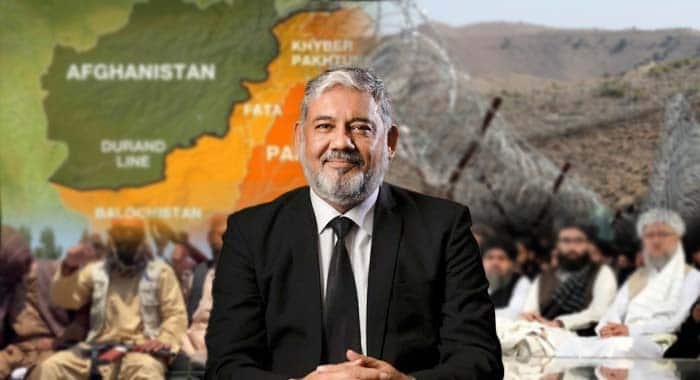
(Moazzam Butt)
The debate surrounding the Pak-Afghan border often referred to in historical and political discourse as the Durand Line continues to resurface in regional and international conversations, despite the fact that, from a practical and administrative standpoint, it has functioned as an established international boundary for decades. Much of the disagreement is not rooted in current legal ambiguity but in competing historical narratives, political identity, and evolving regional geopolitics.
To understand why segments of Afghan political opinion continue to dispute the legitimacy of this border, one must examine its historical evolution, the legal instruments that shaped it, and the political developments that followed the creation of Pakistan in 1947.
The origins of the Pak-Afghan border trace back to the colonial period, when British India and the then Emirate of Afghanistan negotiated frontier arrangements to define spheres of influence. These agreements were not sudden or isolated decisions but part of a broader pattern of 19th-century geopolitical stabilization involving regional powers including the British Empire, Tsarist Russia, and Persian authorities.
The Afghan state under various rulers, including Amir Dost Mohammad Khan, engaged in multiple diplomatic interactions with regional powers, including the British, to define territorial limits and reduce frontier instability. These engagements were driven by strategic necessity rather than ideological alignment, as Afghanistan sought to maintain sovereignty amid pressure from expanding empires.
By the late 19th century, agreements between British Indian authorities and Afghan leadership formalized a demarcation line intended to regulate administrative control and border management. This boundary, though later contested in political discourse, became the practical frontier for governance, taxation, and security operations.
A significant shift occurred with the partition of British India in 1947, resulting in the creation of Pakistan as a sovereign state. At that time, existing international agreements and inherited administrative boundaries were transferred to the successor state framework, a standard practice under international law concerning state succession.
The legal principle of uti possidetis juris—widely recognized in international jurisprudence holds that newly formed states inherit pre-existing administrative boundaries of their predecessor territories. In this context, Pakistan inherited the border arrangements that had already been established between British India and Afghanistan.
However, the political environment of partition was complex. In the North-West Frontier regions, influential leaders such as Khan Abdul Ghaffar Khan (commonly known as Bacha Khan) advocated for distinct political considerations for Pashtun populations. The Bannu Resolution of 1947 reflected demands for political options distinct from accession to Pakistan or India, adding a layer of political complexity to the transition period.
While these political movements are significant in historical terms, they did not alter the legal continuity of the boundary inherited by Pakistan.
A recurring argument in Afghan political discourse is the refusal by certain governments or political factions to fully recognize the border as an international frontier. This position is often rooted less in legal principle and more in political identity, historical interpretation, and domestic political considerations.
From a legal perspective, however, the existence of the border is supported by decades of state practice, administrative enforcement, and international precedent. Borders are not solely defined by unilateral acceptance but by sustained recognition through governance, control, and inter-state relations over time.
Pakistan’s position has consistently been that the border is an internationally established frontier inherited through legal succession and reinforced through continuous administrative management.
In recent years, Pakistan has undertaken extensive efforts to formalize and secure the border through fencing, establishment of crossing points, and enhanced customs and immigration controls. These measures represent a shift from historically porous frontier management to a regulated international boundary system.
The construction of fencing along large stretches of the border, along with the establishment of designated transit gates, reflects an operational reality: both states engage in regulated cross-border movement for trade, travel, and humanitarian purposes under defined protocols.
This modernization process has significantly reduced informal crossings and has been aimed at improving security, curbing unauthorized movement, and facilitating lawful trade.
Border regions globally often face challenges related to smuggling, informal trade, and illicit trafficking. The Pak-Afghan border is no exception. Issues such as narcotics trafficking, arms smuggling, and human smuggling have been documented by multiple regional security assessments over time.
It is important, however, to distinguish between structural challenges inherent in difficult terrain and allegations of politically motivated narratives. While both Pakistan and Afghanistan have at various times accused elements across the border of facilitating or tolerating illegal networks, such issues are more accurately understood as transnational criminal problems rather than purely political disputes.
Modern border enforcement mechanisms, including surveillance infrastructure and coordinated checkpoints, are designed to address these challenges in a systematic manner.
Occasionally, suggestions emerge that the border dispute could be raised in international forums such as the United Nations. From a legal standpoint, such an initiative faces significant structural limitations.
The United Nations does not typically adjudicate bilateral border agreements that are historically established and operationally enforced unless there is mutual consent or a specific mandate under international law. In this case, the boundary in question is not a newly disputed line but one that has functioned for decades as a de facto and de jure international frontier under principles of state succession and customary practice.
Therefore, attempts to internationalize the issue lack strong legal grounding in the absence of a mutually agreed framework for reconsideration.
The Pak-Afghan border issue cannot be viewed in isolation from broader regional dynamics. South and Central Asia remain interconnected through trade corridors, security concerns, and historical cultural linkages.
At various times, regional and global powers have influenced narratives surrounding the border, either directly or indirectly, as part of broader strategic interests. These influences often intersect with local political debates, sometimes amplifying historical grievances or competing national narratives.
However, the long-term trajectory of the region increasingly points toward economic integration, transit trade development, and infrastructural cooperation rather than territorial redefinition.
One of the most significant developments in recent years has been the growing emphasis on regulated trade and transit agreements between Pakistan and Afghanistan. Economic interdependence has become a stabilizing factor, encouraging both sides to maintain functional working relations despite political disagreements.
Cross-border trade routes, transit agreements, and regional connectivity projects involving neighboring countries are reshaping the strategic importance of the border. In this context, stability and predictability become more valuable than historical contestation.
Economic logic increasingly favors cooperation over confrontation, particularly in regions where populations on both sides depend on cross-border commerce for livelihoods.
Within Afghanistan, as within Pakistan, border narratives often serve domestic political functions. Questions of sovereignty, identity, and historical interpretation are frequently mobilized in political discourse for internal legitimacy.
Similarly, in Pakistan, the emphasis has increasingly been on securing the border, regulating movement, and ensuring that national security concerns are addressed within a structured legal framework.
It is in this intersection of history and politics that much of the disagreement persists, even when the practical realities on the ground suggest a settled administrative boundary.
The Pak-Afghan border question is not merely a legal debate; it is a layered issue shaped by colonial history, post-colonial state formation, political identity, and contemporary security dynamics. While differing narratives continue to exist, the functional reality of the border as an established international frontier remains firmly in place.
Legal principles of state succession, decades of administrative control, and modern border management infrastructure all reinforce its status. At the same time, the persistence of political debate reflects deeper historical sensitivities that cannot be resolved through legal arguments alone.
Moving forward, the region’s stability is likely to depend less on revisiting historical boundary questions and more on strengthening cooperation in trade, security, and regional connectivity. The challenge for policymakers on both sides is not to reopen settled legal questions, but to manage shared realities in a way that promotes peace, development, and long-term regional integration.