
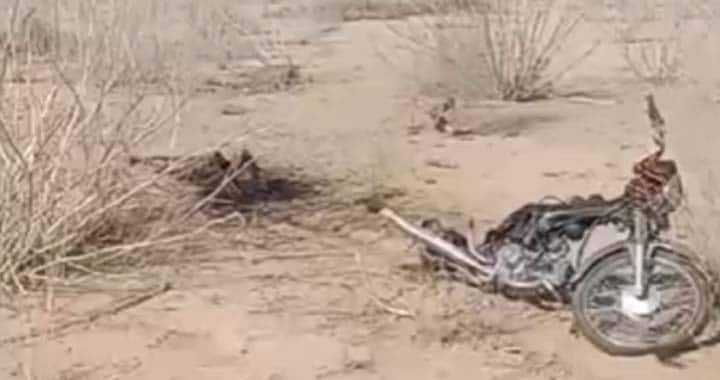
A young man was martyred after a landmine planted by the proscribed Balochistan Liberation Army (BLA) detonated in the Dera Bugti district of Balochistan, officials and local sources said.
According to details, the victim was passing through the area when the explosive device buried underground went off with a powerful blast, killing him on the spot. Security sources said the device had been planted earlier in the region, where such incidents have repeatedly endangered civilian movement.
Authorities and local elders strongly condemned the attack, describing it as a cowardly act aimed at destabilizing peace and deliberately targeting non-combatants. Defence analysts said such groups are increasingly relying on improvised explosive devices and landmines as they avoid direct confrontation with security forces.
The incident is part of a broader and deeply concerning pattern in which civilians continue to bear the brunt of terrorist violence across multiple regions. In Balochistan and Khyber Pakhtunkhwa, non-combatants, including women and children, have repeatedly been killed or injured in similar attacks over recent months.
In a separate development reported earlier, a young girl was injured in firing attributed to the BLA, highlighting the increasing toll on civilians caught in the conflict. Officials and security observers linked such incidents to sustained counterterrorism pressure on militant networks, arguing that armed groups are increasingly shifting towards soft targets to maintain operational visibility and spread fear among local populations.
This trend is not limited to internal attacks. In border regions, civilians have also been affected by cross-border shelling incidents originating from across the Afghanistan frontier. Security sources have previously attributed some of these attacks to elements linked to the Afghan Taliban and affiliated terrorist networks, including the TTP and other groups operating with varying degrees of facilitation and safe havens across the border.
In one such reported incident in the Chitral border sector, firing from across the border reportedly endangered civilian areas near populated settlements, raising concerns about the vulnerability of border communities to external fire. Authorities have maintained that Pakistan’s response operations are directed at militant targets, while reiterating efforts to minimize civilian harm.
A series of earlier incidents across Khyber Pakhtunkhwa, including mortar attacks, improvised explosive device (IED) blasts, and cross-border shelling in areas such as Chitral, North and South Waziristan, Bannu, Bajaur, and Khyber, have also resulted in civilian casualties, including women and children. In several cases, entire families have been killed or injured in residential areas struck by indirect fire.
Security analysts note that the cumulative pattern reflects a shift in tactics, where civilians are increasingly exposed not only to internal militant activity but also to spillover violence from across the border. They argue that the convergence of multiple actors, including groups such as the TTP and BLA, alongside cross-border militant facilitation networks, has intensified the threat environment for non-combatants.
An additional dimension highlighted in earlier reporting is the growing use of indirect fire and explosive devices in populated and semi-populated areas, particularly in regions with difficult terrain. Such methods, experts say, often result in unintended civilian casualties due to low precision and unstable operational conditions, further blurring the line between intended and actual targets.
Security forces continue counterterrorism operations across Balochistan and Khyber Pakhtunkhwa, targeting militant infrastructure, movement routes, and support networks. Officials maintain that these operations aim to disrupt organized violence and protect civilian populations, although the persistence of such incidents underscores the ongoing volatility in affected regions.
In the broader context, observers point to a sustained and expanding cycle of violence in which civilians remain the primary victims, whether through landmines in Balochistan, IEDs in tribal districts, or cross-border shelling along the frontier. The recurring nature of these incidents continues to raise serious concerns over civilian safety and long-term regional stability.



