
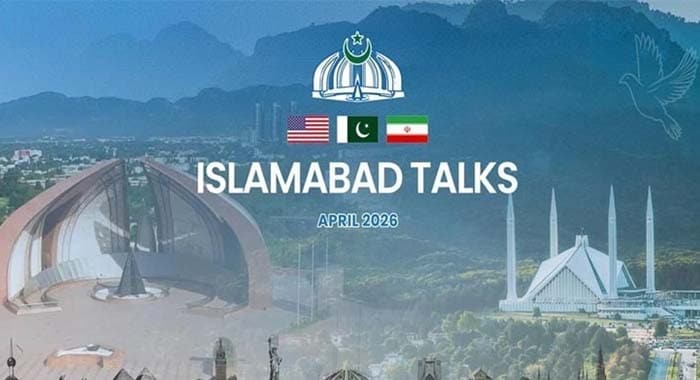
Pakistan has once again come into the global diplomatic spotlight as U.S. President Donald Trump announced that the next round of negotiations between the United States and Iran will be held in Islamabad, marking a significant development in ongoing efforts to address escalating regional tensions.
In a statement posted on his social media platform Truth Social, Trump confirmed that American representatives are already present in Pakistan for discussions, with additional high-level figures expected to participate in the upcoming negotiation rounds. He indicated that key U.S. figures, including Steve Witkoff and Jared Kushner, would be part of the talks, and suggested that both sides are approaching a potential agreement framework.
Trump described the ongoing diplomatic process as being at a critical stage, stating that a “fair and acceptable offer” has been extended to Iran. He added that a resolution could be reached through either diplomatic or coercive means, warning that if negotiations fail, the United States would take actions of a scale not seen in decades.
The former president further escalated rhetoric by warning of potential strikes on Iranian infrastructure in the event of a breakdown in talks, including energy facilities and transport networks. He accused Tehran of violating ceasefire understandings and contributing to instability in the region, including alleged attacks on foreign vessels.
He also claimed that disruptions in the Strait of Hormuz are having significant economic consequences for Iran, while asserting that U.S. strategic positioning remains unaffected.
According to diplomatic sources, the U.S. delegation is expected to arrive in Pakistan in phases, while an Iranian negotiating team is also likely to reach Islamabad for parallel engagements. This follows earlier indications that indirect communication channels between Washington and Tehran have been facilitated through Pakistan’s mediation efforts.
Iranian state-affiliated media have acknowledged that recent exchanges between the parties were facilitated through diplomatic messaging channels involving Pakistan, underscoring Islamabad’s growing role as a facilitator of regional dialogue.
Iran’s Foreign Ministry spokesperson has criticized external maritime restrictions and military pressure, describing them as violations of recent ceasefire understandings and warning against measures that could further escalate tensions.
Meanwhile, additional reports suggest that Washington and Tehran have made progress in outlining a preliminary framework for discussions, with Islamabad playing a central coordinating role in facilitating contact between the two sides.
It is also noted that previous rounds of indirect U.S.–Iran engagement, held recently in Islamabad after years of diplomatic stagnation, laid the groundwork for the current negotiation track.
Analysts view the choice of Islamabad as a venue for these sensitive discussions as a reflection of Pakistan’s increasing diplomatic engagement in facilitating communication between adversarial states at a time of heightened regional volatility.



