
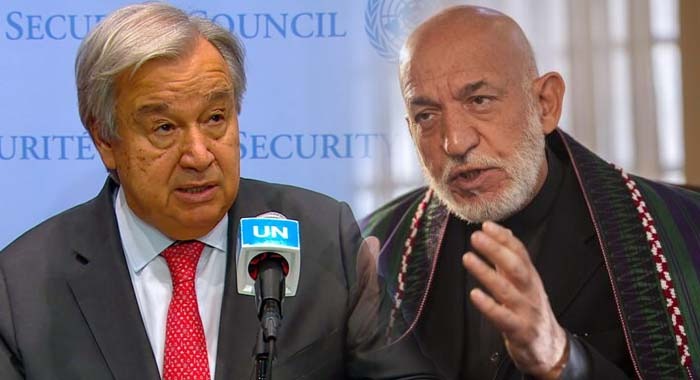
Former Afghan president Hamid Karzai has called on António Guterres to condemn Pakistan’s strikes inside Afghanistan, terming them a violation of sovereignty and international law.
In a statement shared on April 7, Karzai said his communication to the UN chief outlined what he described as Pakistan’s decades-long approach of leveraging armed groups to influence the region. He urged the United Nations to take diplomatic steps to prevent further strikes and reduce tensions between the two сосед countries.
However, Karzai’s position raises critical questions that remain unanswered. Has he, at any point, publicly held the Afghan Taliban accountable for their role in enabling cross-border terrorism, particularly against Pakistan? Has he ever called on the Taliban to prevent the use of Afghan soil for launching attacks in neighboring countries, or to curb the activities of the banned Tehreek-e-Taliban Pakistan (TTP) and other terrorist networks operating from within Afghanistan?
These questions gain further significance in light of recent attacks in Bajaur, Kurram, Bannu, Lakki Marwat, and North Waziristan, where Pakistani authorities maintain that terrorist elements operating from Afghan territory carried out assaults on civilians and security forces. Islamabad has consistently stated that its actions across the border are retaliatory in nature, targeting militants responsible for these attacks, rather than acts of unprovoked aggression.
The broader issue, therefore, is not limited to sovereignty alone but extends to the responsibility of preventing one’s territory from being used against others. Karzai’s criticism of Pakistan invites scrutiny of his own stance during and after his presidency—whether he has ever pressed the Taliban to abandon policies that risk exporting instability beyond Afghanistan’s borders.
Meanwhile, the United Nations has largely confined its response to expressions of concern. Guterres has urged both sides to exercise restraint amid escalating tensions, but questions persist over whether the UN has any concrete mechanism or initiative beyond repeated calls for de-escalation.
As cross-border attacks continue and retaliatory strikes follow, the region faces a cycle of action and response that underscores deeper structural issues—safe havens, militant networks, and the absence of enforceable commitments. Without addressing these root causes, diplomatic appeals alone are unlikely to alter realities on the ground.



