
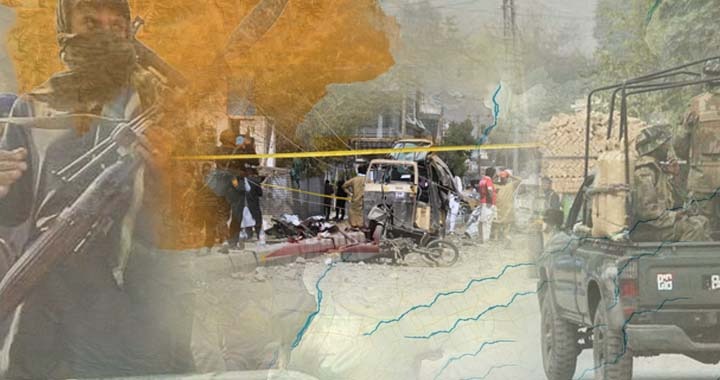
Terrorist attacks in North Waziristan and Bannu have intensified in recent days, with civilians increasingly coming under direct fire, underscoring a sharp rise in violence across the region. In Mir Ali tehsil, militants have repeatedly targeted unarmed populations, reflecting a sustained and deliberate campaign to spread fear. In Hasu Khel, mortar shells fired during clashes struck Khushhaliy and surrounding areas, partially damaging homes and injuring livestock, as security forces continue operations to contain the threat.
The surge in attacks is marked by a pattern of indiscriminate violence. On March 5, three civilians, including a woman, were injured in mortar fire from an unidentified location. On March 31, an eleven-year-old boy was wounded in terrorist activity, followed by another incident on April 1 in which a young girl was injured in firing attributed to the Balochistan Liberation Army. The violence escalated further on April 2, when a blast near Bannu’s Domel police station killed a family of five and injured 13 others, highlighting the growing lethality of these attacks.
Alongside mortar strikes, abductions and targeted killings have emerged as a parallel tactic. On March 16, terrorists carried out two separate killings in Bannu district. Malik Nabiullah, a prominent political and social figure from the Lakki Marwat Machan Khel community, was abducted and later executed, while his companions were released. In a separate incident, Shah Zeb Khan, a young resident of the Barkazai community, was abducted from his village and later found dead near Baka Khel Tochi Bridge. These incidents point to a deliberate strategy of eliminating influential and vulnerable individuals to deepen fear within local communities.
Cross-border elements have further compounded the threat. Afghan Taliban have been involved in mortar attacks on civilian areas along the Pakistan-Afghanistan border, including an incident in Leti (Tari Pasha), Bajaur, where four brothers were killed after shells struck a residential area. Such attacks indicate an expanding dimension of the threat, placing additional pressure on border security and exposing civilian populations to violence from across the frontier.
The convergence of mortar attacks, abductions, and targeted killings illustrates a broader escalation in terrorist activity, with civilians bearing the brunt of the violence. Security forces have responded by intensifying operations, increasing patrols, and cordoning off affected areas, but the frequency and spread of these incidents highlight the complexity of the challenge.
This sustained spike in attacks reflects a coordinated effort by terrorist elements and their facilitators to destabilize the region, disrupt daily life, and undermine public confidence. The continued targeting of civilians, including women and children, reinforces the urgent need for sustained counter-terrorism measures and heightened vigilance to protect vulnerable communities across North Waziristan and Bannu.



