
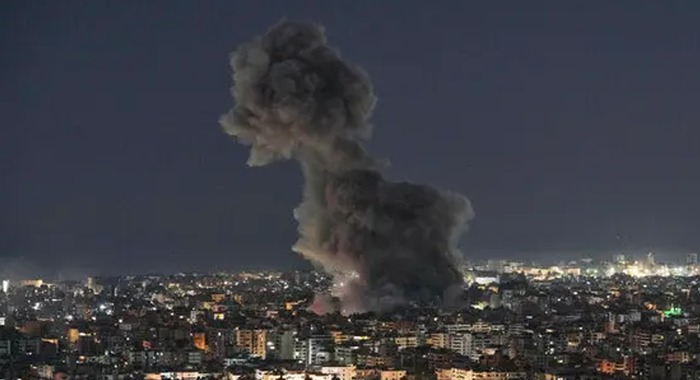
The conflict between the United States, Israel, and Iran has intensified significantly, with expanding military operations, rising casualties, and growing fears of a wider regional war. Recent developments indicate a sharp escalation in both the scale and scope of hostilities, raising serious concerns about global security, energy stability, and humanitarian impact.
In Iran, US and Israeli forces have widened their strikes to include critical infrastructure in and around the capital, Tehran. Targets have reportedly included a century-old medical research facility, steel plants, and a major bridge near the city. US officials have justified the bridge strike by claiming it was used for transporting materials linked to Iran’s military drone program, while Iranian authorities maintain it was civilian infrastructure—an assertion that, if verified, could raise serious questions under international law.
The human toll continues to mount. Iranian officials report that since the start of the campaign, more than 2,000 people have been killed and over 26,000 injured. Additionally, over 600 schools and educational institutions have reportedly been damaged or destroyed, compounding the humanitarian crisis and disrupting civilian life on a massive scale.
Iran has responded with strong rhetoric and continued military posture, vowing to sustain the conflict until its adversaries face what it describes as “humiliation” and “surrender.” Iranian officials have also warned against any potential ground invasion, stating that the country is prepared to defend itself against all forms of aggression.
Beyond Iran’s borders, the conflict is increasingly spilling into the broader region. In the Gulf, several countries have reported security incidents linked to the escalation. In the United Arab Emirates, falling debris from aerial activity resulted in the death of a foreign worker, while Bahrain experienced multiple warning sirens and disruptions due to airborne threats. Saudi Arabia reported intercepting an incoming drone, and Kuwait responded to a fire incident at its airport amid heightened alert levels.
The strategic Strait of Hormuz, through which roughly one-fifth of the world’s oil supply passes, has emerged as a critical flashpoint. Iran’s blockade of the waterway has disrupted global shipping and driven oil prices above $100 per barrel. In response, the United Kingdom has initiated discussions with dozens of countries to secure and reopen the route, while regional bodies have called for potential international intervention to ensure maritime security.
In the United States, the situation has been accompanied by notable developments within the military leadership. Defense Secretary Pete Hegseth has abruptly dismissed several senior military officials, including the Army’s top general, prompting speculation about a wartime restructuring of command aligned with evolving strategic priorities. Meanwhile, US leadership has intensified its rhetoric, warning of further strikes targeting Iran’s infrastructure if diplomatic terms are not met.
The conflict has also drawn reactions from various international stakeholders. Pakistan has reiterated its intent to encourage dialogue between Washington and Tehran, though officials acknowledge significant obstacles to peace efforts. At the same time, public opinion within the Iranian diaspora appears divided, with a majority expressing opposition to the ongoing war.
In Israel, daily life has been significantly disrupted by repeated air raid sirens, particularly in densely populated areas such as Tel Aviv. Civilian infrastructure, including schools and airports, has been affected as the country prepares for a prolonged conflict. On Israel’s northern front, hostilities with Hezbollah have intensified, with the group claiming multiple attacks targeting Israeli forces and equipment within a short time frame.
The conflict’s ripple effects are also evident in neighboring regions, including Iraq, Syria, and Lebanon. Armed groups in Iraq have claimed responsibility for attacks on US military installations, while Israeli operations in southern Syria have expanded. In Lebanon, escalating violence between Israel and Hezbollah has raised concerns about mass displacement, with international organizations warning of severe humanitarian consequences if the conflict continues.
As the situation evolves, the risk of a broader regional war remains high. The combination of intensified military action, strained diplomatic channels, and growing humanitarian challenges underscores the urgency of de-escalation efforts. The international community faces increasing pressure to prevent further escalation and to address the far-reaching implications of a conflict that is rapidly extending beyond its initial boundaries.



