
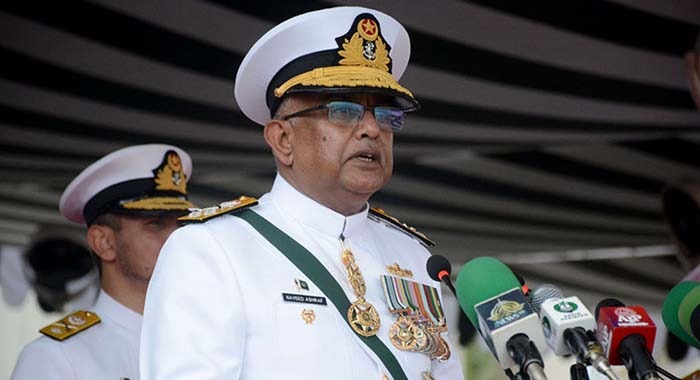
Admiral Naveed Ashraf, Chief of the Pakistan Navy, highlighted the growing complexity and intensity of maritime threats in the Indo-Pacific region, stressing that no single country possesses sufficient resources to address these challenges independently. In an exclusive interview with Sri Lankan media, Admiral Ashraf outlined Pakistan Navy’s vision for a secure, open, and cooperative maritime environment that safeguards trade, energy routes, and regional stability.
Admiral Ashraf emphasized that a truly free and open Indo-Pacific should not evolve into a bloc-driven or militarized arrangement that marginalizes certain states or disrupts regional balance. He stressed that Pakistan is committed to ensuring the security of sea lines of communication, particularly vital energy corridors such as the Strait of Hormuz, as any disruption could directly affect national and regional economic stability.
In light of recent geopolitical tensions, including the US-Israel-Iran disputes, the Pakistan Navy has launched Operation Protector of the Seas to ensure safe maritime passage for commercial vessels and uninterrupted energy imports. The Navy is closely coordinating with the Pakistan National Shipping Corporation to conduct escort operations, safeguarding the movement of commercial ships and ensuring uninterrupted supply chains.
Admiral Ashraf highlighted that safeguarding maritime routes is not only a matter of national interest but also aligns with global norms, protecting export markets, facilitating imports, and strengthening emerging trade corridors.
Pakistan has significantly enhanced its underwater and surface warfare capabilities to maintain regional maritime balance. The Navy has expanded its submarine fleet, including Hangor-class diesel-electric submarines, equipped with advanced weapons, sensors, and combat management systems. Additionally, Pakistan has inducted Type-054 A/P frigates from China and MILGEM-class corvettes from Turkey, representing the most advanced surface platforms in Pakistan’s naval history.
The Navy has also strengthened its aviation arm with JET LARMP systems, while expanding focus on cyber and space domains. These capabilities support multi-domain operations, enabling Pakistan to address emerging threats across surface, subsurface, air, and digital spheres.
Addressing regional strategic competition, Admiral Ashraf noted that rising tensions among global powers directly affect maritime security in the Indian Ocean. He emphasized Pakistan’s support for an inclusive and cooperative maritime order that upholds freedom of navigation, international maritime law, and multilateral collaboration. Pakistan advocates a non-block approach, where economic integration and security cooperation benefit all regional stakeholders rather than serving narrow state interests.
Admiral Ashraf underlined Sri Lanka’s strategic importance in safeguarding critical sea lanes. He praised the Sri Lankan Navy and Air Force for their prompt assistance during recent maritime incidents near Galle, including rescue operations for the IRIS Dena and IRIS Bushehr crews, demonstrating Sri Lanka’s neutral, responsible role in regional security.
Pakistan Navy continues close collaboration with the Sri Lankan Navy, including joint training, port visits, and shared maritime domain awareness exercises, fostering a resilient regional maritime security framework.
Highlighting Pakistan’s contribution to multinational initiatives, Admiral Ashraf noted the Navy’s active participation in CTF-150 and CTF-151, as well as recent anti-narcotics operations that intercepted a $1 billion shipment—the largest in Combined Maritime Forces history. Pakistan also conducts biennial “Together for Peace” exercises, the latest in February 2025, bringing together approximately 60 international delegates to promote dialogue and principles-based maritime order.
Admiral Ashraf concluded by affirming Pakistan’s unwavering commitment to peace, stability, and secure maritime trade routes across the Indo-Pacific, reinforcing its role as a responsible and proactive maritime stakeholder.



