
Hassam Uddin
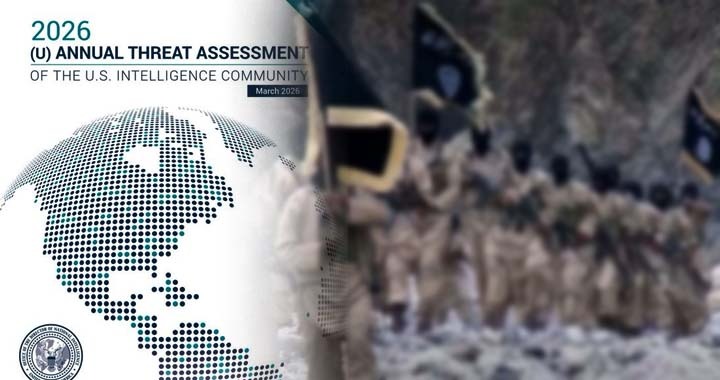
The latest U.S. Intelligence Community Annual Threat Assessment (ATA) has issued a stark warning that Al-Qa’ida and ISIS remain among the most significant threats to U.S. interests overseas, particularly across regions in Africa, the Middle East, and South Asia. Despite years of counterterrorism operations, both groups continue to exploit political instability and ungoverned spaces to rebuild their operational capabilities and sustain their global reach.
According to the assessment, Al-Qa’ida is estimated to have between 15,000 and 28,000 members worldwide, while ISIS maintains a force of approximately 12,000 to 18,000 fighters. Over the past five years, the growth of these organizations has been concentrated largely in conflict zones across Africa, where their most active and violent affiliates operate.
The report identifies Al-Qa’ida in the Arabian Peninsula (AQAP) in Yemen, ISIS-Khorasan (ISIS-K) in South Asia, and ISIS elements in Syria as the groups most likely to engage in external plotting against international targets. In particular, ISIS in Syria is expected to focus on rebuilding its ranks by reconnecting with detainees and affiliates, including hundreds of fighters and thousands of associated women and children who have escaped or been released from detention camps in northeast Syria.
The assessment also highlights uncertainty surrounding the impact of the ongoing U.S.–Israel–Iran conflict on the global terrorism landscape. While Iranian-aligned groups including Hamas and Lebanese Hizballah have been significantly degraded by Israeli-led military operations, supported by U.S. intelligence and defense capabilities, they continue to retain the capacity for asymmetric attacks against U.S. and allied interests.
Iran itself remains a concern for U.S. security officials. The report indicates that Tehran has previously demonstrated the capability to plan and execute lethal operations targeting Americans both domestically and abroad. Analysts warn that such activities could resume if Iran’s current leadership stabilizes and rebuilds its operational networks.
Meanwhile, non-state actors aligned with Iran including the Huthis in Yemen and Iraqi Shia militias are assessed to remain resilient. These groups continue to pose a threat to U.S. forces and regional stability. During recent military engagements, including Operation Epic Fury, Iraqi militias reportedly carried out attacks on U.S. bases, causing damage and underscoring their ongoing operational capability.
The report also points to rising sectarian tensions following the killing of Iranian Supreme Leader Ayatollah Ali Khamenei on February 28. The incident triggered protests and strong reactions among Shia communities in the Middle East and South Asia. Religious decrees issued by senior clerics in Iran calling for retaliation are expected to heighten the risk of individual or coordinated attacks against U.S. targets globally.
At the same time, influential religious figures have urged restraint. Grand Ayatollah Ali al-Sistani in Iraq publicly called for de-escalation and a peaceful resolution to the conflict, reflecting concerns about the broader implications of continued instability.
Overall, the ATA underscores that while terrorist organizations have been weakened in terms of centralized power, they remain adaptive and dangerous. Their ability to leverage regional conflicts, ideological narratives, and decentralized networks continues to pose a persistent and evolving threat to global security.



