
The Afghan Taliban regime’s systematic violations of basic human rights and support for terrorist organizations have revealed its brutal nature to the world, raising serious concerns for regional and global security. Experts warn that the regime’s authoritarian policies and extremist alignment have rendered Afghanistan increasingly isolated and unacceptable on the international stage.
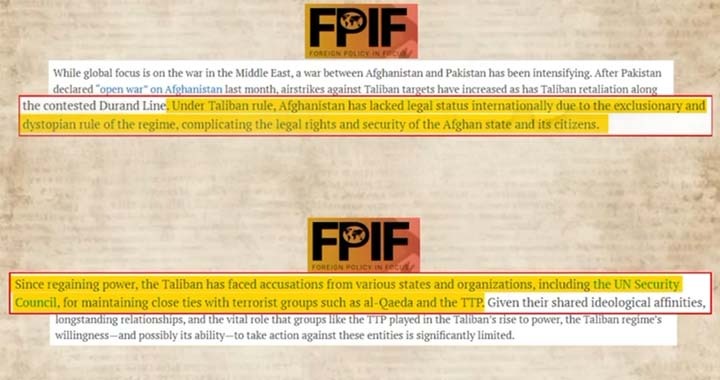
According to the U.S.-based think tank Foreign Policy In Focus, the Taliban’s rigid governance structure, coupled with international isolation, has severely undermined the legal status of the Afghan state and placed fundamental civil liberties at grave risk. The regime’s oppressive laws endanger the rights and futures of Afghan citizens, particularly women, children, and minority groups.
The think tank further notes that the Taliban continue to maintain links with terrorist groups such as Al-Qaeda and Fitan al-Khawarij, while refraining from any significant action against them. This association underscores that the regime’s claim to sovereignty is largely performative, as it lacks formal recognition from the global community. To date, no country has granted the Taliban full diplomatic recognition, leaving the regime without legitimate authority to represent Afghanistan internationally.
Experts emphasize that the Taliban’s extremist and anti-democratic policies have pushed Afghanistan into a state of global isolation and deepened the country’s economic and humanitarian crises. Beyond internal governance, the Taliban’s backing of terrorist networks including Al-Qaeda and Tehrik-i-Taliban Pakistan (TTP) poses a tangible security threat that extends far beyond Afghanistan’s borders, directly affecting the stability of the wider region.
In addition to undermining human rights, the Taliban’s approach has jeopardized Afghanistan’s international standing. Analysts warn that the absence of legal recognition, combined with extremist alliances, limits the country’s engagement in global diplomacy, trade, and security cooperation, perpetuating economic decline and humanitarian hardship.
The global community continues to monitor Afghanistan closely, with experts calling for coordinated international strategies to mitigate the threat posed by the Taliban regime’s policies, protect regional security, and promote human rights and stability in the country.



