(Mushtaq Yusufzai)
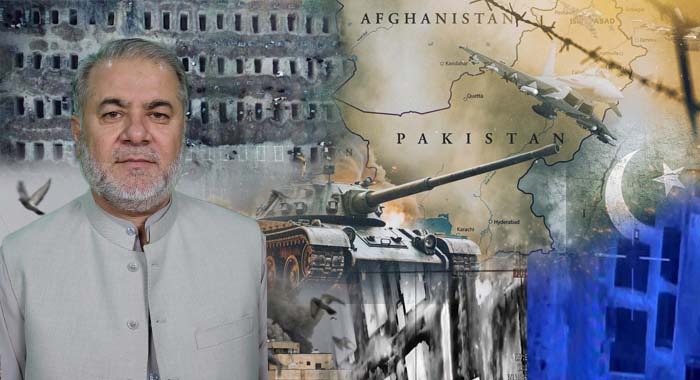
The escalating tensions between Pakistan and Afghanistan are no longer confined to sporadic border skirmishes. What began as cross-border incidents has now evolved into sustained head-to-head clashes, airstrikes and retaliatory operations. Yet despite the intensity of the exchanges, there is still no clear roadmap towards a ceasefire. Wars are often easier to start than to end. And if history teaches us anything about this region, it is that once conflict narratives harden, diplomacy becomes exponentially more difficult.
At present, there is little indication that a ceasefire is imminent. While discussions about de-escalation surface periodically through informal channels and regional interlocutors, the fundamental disagreements remain unresolved. Pakistan’s position, articulated repeatedly by its military leadership, is straightforward: stability will not return unless militant groups operating from Afghan soil are addressed decisively. These include Al-Qaeda, the Tehreek-e-Taliban Pakistan (TTP), the Balochistan Liberation Army (BLA) and Daesh affiliates. Islamabad’s demand is clear Kabul must either act against these groups, distance itself diplomatically, or cooperate with Pakistan in neutralising them.
From Pakistan’s perspective, the issue is not ideological but security-driven. Officials argue that since the Taliban returned to power in Kabul in August 2021, there has been a marked increase in militant violence inside Pakistan. Many in Pakistan had initially hoped that a Taliban government would usher in greater border stability. Instead, Islamabad believes that sanctuaries for anti-Pakistan groups have persisted, if not expanded. Until this core issue is resolved, talk of ceasefires may remain superficial.
The current round of hostilities has also highlighted a stark military asymmetry. The Afghan Taliban built their battlefield reputation on guerrilla warfare insurgency tactics that proved effective against both Soviet and US-led forces. However, fighting a neighbouring state with a conventional military and advanced air capabilities is a fundamentally different proposition. Air power changes the calculus of war. Guerrilla fighters armed with rifles and rocket-propelled grenades can challenge occupation forces in rugged terrain. But without modern air defence systems or comparable air force capacity, sustaining direct confrontation becomes increasingly costly.
Recent Pakistani air operations appear designed not merely as retaliation but as strategic signalling demonstrating capability, reach and technological superiority. In modern warfare, perception can be as important as territory. A single airstrike can send a broader geopolitical message. That message seems to have resonated. Public statements from Taliban spokespersons in recent days have adopted a noticeably different tone, emphasising dialogue over escalation. Whether that shift translates into concrete policy decisions remains to be seen. Regionally and globally, there is little appetite for another prolonged conflict. The Middle East is already in flux. Iran faces external pressures. Global powers are recalibrating priorities. No major actor appears eager to see the Pakistan–Afghanistan frontier ignite into a sustained war.
Historically, whenever tensions rise between Islamabad and Kabul, countries such as Saudi Arabia, Turkey, the UAE and Qatar have stepped in to facilitate dialogue. These nations maintain relationships with both sides and have often played quiet mediating roles. Yet mediation only works when both parties see compromise as preferable to confrontation. Afghanistan has reportedly reached out to multiple countries seeking diplomatic channels to reduce tensions. That in itself suggests concern about escalation. But the crux remains: will Kabul take meaningful action against anti-Pakistan militant networks?
No discussion of this conflict is complete without addressing the Tehreek-e-Taliban Pakistan (TTP). According to United Nations reporting, thousands of TTP fighters are believed to be present in Afghanistan. Pakistani officials argue that these fighters not only operate from Afghan territory but also benefit from networks of sympathy and logistical depth. From Islamabad’s viewpoint, the TTP issue is existential. Attacks inside Pakistan targeting security forces, civilians and infrastructure are seen as red lines. If Afghanistan cannot or will not restrain these actors, Pakistan is likely to continue unilateral measures. For Kabul, however, the TTP question is complicated by ideological affinities and internal political calculations. Many Taliban fighters who fought for decades now find themselves unemployed or without clear roles. Some have reportedly gravitated towards other militant networks, further blurring lines of responsibility.
This web of affiliations makes accountability difficult but not impossible. Modern conflicts are fought not only on battlefields but across social media feeds. Disinformation, propaganda and psychological operations now accompany every military exchange. Claims of downed aircraft, exaggerated casualty figures and viral videos shape public perception long before facts can be independently verified. In Afghanistan, where media freedoms have narrowed significantly, narratives often circulate without scrutiny. In Pakistan, social media amplifies every rumour, sometimes blurring the line between analysis and activism. The first casualty of war, as the saying goes, is truth.
There have been instances where fabricated stories including alleged downed aircraft or dramatic battlefield reversals gained traction online. Such narratives serve a purpose: boosting morale on one side while undermining confidence on the other. An informed public requires critical thinking. Emotional reactions may fuel conflict, but they rarely resolve it. Another dimension frequently raised in Pakistani discourse is India’s perceived strategic positioning. India has developed closer ties with Afghanistan in recent years, investing in infrastructure and maintaining diplomatic engagement. In times of Pakistan–Afghanistan tension, Indian media coverage often reflects narratives sympathetic to Kabul. However, open military involvement by India remains unlikely. Direct engagement would risk broader regional escalation. More plausibly, the battleground remains informational and diplomatic rather than kinetic.
Nevertheless, perceptions matter. In a volatile environment, even indirect alignments can influence strategic calculations. Afghanistan today faces immense domestic challenges. Economic contraction, unemployment, humanitarian crises and restricted civic space define daily life for many citizens. Governance remains heavily centralised and opaque. When domestic pressures mount, external confrontation can sometimes serve as a unifying narrative tool. However, such strategies carry significant risk, especially when confronting a state with conventional military superiority. Pakistan, too, grapples with economic strain and political contestation. Yet its security doctrine remains shaped by decades of preparedness along its eastern border. Defence planning has historically prioritised conventional readiness. In this context, cross-border confrontation with Afghanistan introduces a new strategic theatre one that Islamabad appears determined to control swiftly and decisively.
Every war eventually ends at the negotiating table. The question is not whether dialogue will occur, but when and under what conditions.
For meaningful de-escalation, three elements appear essential:
-
Concrete action against cross-border militant networks.
-
Transparent verification mechanisms to rebuild trust.
-
Regional diplomatic engagement to sustain dialogue.
Absent these steps, cycles of retaliation may persist. It is worth remembering that Pakistan has hosted millions of Afghan refugees for decades, absorbing economic and social costs that rarely feature in geopolitical debates. Public sentiment in Pakistan reflects both fatigue and frustration. At the same time, ordinary Afghans bear the brunt of instability, poverty and limited opportunity. Escalation benefits neither population. Pakistan appears confident in its military edge. Afghanistan relies on resilience, terrain familiarity and ideological cohesion. Yet wars between neighbours rarely produce clean victories. The current trajectory suggests controlled escalation rather than all-out war. Airstrikes and retaliatory raids serve as calibrated signals demonstrations of capability without full mobilisation. But calibrations can misfire. A miscalculated strike, civilian casualties or symbolic target could shift public opinion and political pressure on both sides. The Pakistan–Afghanistan conflict stands at a crossroads. Continued confrontation risks entrenching hostility for years. Constructive engagement, though difficult, offers a path to stability. Neither side benefits from prolonged war. Yet neither appears ready to compromise on core security demands.
History shows that even the fiercest adversaries eventually negotiate. The challenge is preventing further bloodshed before that moment arrives. For now, the guns have not fallen silent. The skies are not clear. And the ceasefire remains an aspiration rather than an agreement. The coming weeks will determine whether this conflict deepens into a protracted struggle or becomes another chapter in a region long accustomed to cycles of war and uneasy peace.