
The assassination of Ayatollah Ali Khamenei in joint US-Israeli strikes has triggered one of the most consequential ruptures in Iran’s political system since 1979, sending immediate shockwaves across a region already under strategic tension.
Khamenei, who had ruled since 1989 after succeeding Ayatollah Ruhollah Khomeini, exercised ultimate authority over Iran’s military, judiciary, intelligence and foreign policy structures. His removal eliminates the central figure balancing the clerical establishment, political institutions and the powerful Islamic Revolutionary Guard Corps.
The strikes, publicly linked to statements by US President Donald Trump and Israeli Prime Minister Benjamin Netanyahu, represent an unprecedented decapitation of a sitting supreme leader. Iran has vowed retaliation, while regional air defence systems have been activated amid fears of further escalation.
For Pakistan, the event is not distant geopolitical drama but a strategic pressure signal.
Pakistan continues to operate under existing security pressure along its western frontier, where militant threats and cross-border security challenges remain active. At the same time, Islamabad manages strategic defensive posture on its eastern border, leaving limited strategic bandwidth for additional regional shock absorption.
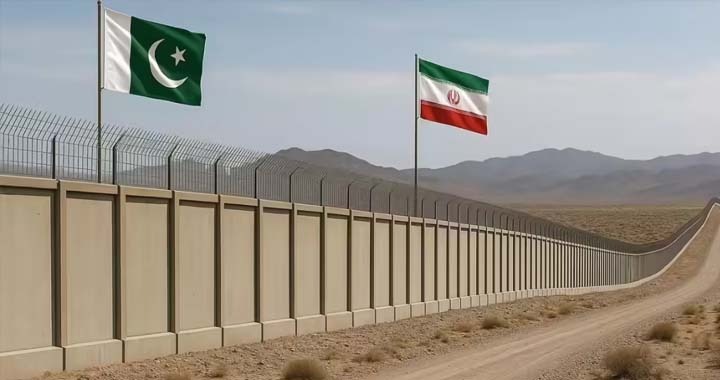
The immediate concern is potential instability within Iran’s border provinces. A shift in cohesion among clerical elites, political factions or security institutions could increase vulnerability in peripheral regions, including areas bordering Pakistan’s Balochistan province.
Balochistan has long been sensitive to cross-border security dynamics. Any turbulence in Iran’s Sistan and Balochistan region could affect border stabilization efforts, counterterror operations and intelligence coordination.
Beyond internal uncertainty lies the question of retaliation strategy. Iran’s military doctrine historically blends direct signaling with asymmetric projection. If the Islamic Revolutionary Guard Corps seeks expanded operational influence during leadership transition, regional proxy activity across Iraq, Syria, or maritime theatres cannot be ruled out.
Pakistan maintains diplomatic channels with Tehran while preserving strategic relations with Gulf states hosting US military assets. Any escalation spreading into Gulf security corridors could place Islamabad in a delicate balancing position between competing regional alignments.
Economic vulnerability also remains significant. Disruption around Gulf maritime shipping routes, particularly near the Strait of Hormuz, could trigger fuel price volatility. Pakistan’s heavy reliance on imported energy makes it highly sensitive to such shocks during a period of fiscal constraint.
The broader danger lies in strategic miscalculation. Fragmented command signals inside Iran, combined with external military pressure, increase the probability of unpredictable regional reactions.
In an arc stretching from Tehran to Kabul and toward the Arabian Sea, regional fault lines are shifting. The assassination of Iran’s supreme leader has altered West Asian political geometry while injecting additional uncertainty into Pakistan’s immediate security horizon.



