
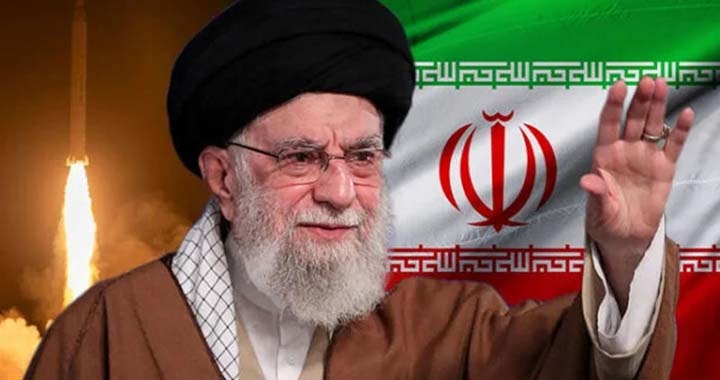
Iranian state media have confirmed that Supreme Leader Ayatollah Ali Khamenei was killed at his office during joint US-Israeli strikes, marking a historic rupture in the Islamic Republic’s political and military hierarchy and triggering immediate regional shockwaves.
A 40-day national mourning period has been declared.
The confirmation followed earlier claims by US and Israeli officials, including US President Donald Trump, who said on his Truth Social platform that the 86-year-old leader had been killed in coordinated strikes launched early Saturday. Israeli Prime Minister Benjamin Netanyahu had also indicated there were “growing signs” that Khamenei was dead, while Reuters cited a senior Israeli official claiming his body had been located.
Iran’s Tasnim and Mehr news agencies had initially reported that Khamenei remained “steadfast and firm in commanding the field,” before Sunday’s confirmation.
Khamenei had served as Iran’s supreme leader since 1989, succeeding Ayatollah Ruhollah Khomeini, the architect of the 1979 Islamic Revolution. As supreme leader, he exercised ultimate authority over the executive, judiciary, armed forces and the powerful Islamic Revolutionary Guard Corps, positioning him at the center of Iran’s regional military strategy.
Regional Fault Lines Widen
His assassination dramatically intensifies an already expanding conflict. Saturday’s strikes reportedly hit 24 Iranian provinces, killing at least 201 people, according to Iranian media citing the Red Crescent. Among the most controversial targets were two schools, including the Shajareh Tayyebeh girls’ elementary school in Minab, where Iranian media reported over 100 fatalities.
Iran’s response has been swift. The Revolutionary Guard announced successive waves of retaliatory strikes against US and Israeli positions. Air defence systems were activated across Gulf states hosting US assets, including Kuwait, Qatar, the United Arab Emirates, and Bahrain, underscoring how quickly the conflict has spilled beyond Iran’s borders.
For the Gulf monarchies, the risk calculus has sharpened overnight. US bases across the Arabian Peninsula now sit within direct range of Iranian missiles and proxy networks. Any sustained exchange threatens energy corridors, maritime routes through the Strait of Hormuz, and broader economic stability in West Asia.
Within Iran, succession planning mechanisms are expected to activate. Analysts indicate that a provisional leadership council may assume control pending formal clerical procedures. The power balance between the clerical establishment and the IRGC will be decisive in determining whether Tehran opts for calibrated retaliation or broader escalation.
Washington’s strategic gamble
For the United States, the operation signals a maximalist posture. Trump described the killing as an opportunity for the Iranian people to “take back their Country,” urging the IRGC and police to merge with “Iranian Patriots.” He further indicated that “heavy and pinpoint bombing” would continue as long as necessary.
At the United Nations, Secretary-General Antonio Guterres warned that military action risked igniting uncontrollable events in “the most volatile region of the world,” calling for immediate de-escalation.
Iran’s UN ambassador condemned the strikes as premeditated aggression, while US Ambassador Mike Waltz defended the action as lawful and necessary to prevent Iran from obtaining a nuclear weapon. China’s envoy Fu Cong expressed deep concern over escalating tensions, and Russia’s Vassily Nebenzia demanded an immediate halt to US and Israeli operations.
The repercussions extend beyond the immediate battlefield. A confirmed decapitation strike against Iran’s top leader sets a precedent with implications for global norms around targeted assassinations of heads of state. It also raises the probability of asymmetric retaliation across theatres where Iran maintains influence, including Iraq, Syria, Lebanon and the Red Sea corridor.
Markets are bracing for volatility. Energy prices are expected to react sharply to any disruption in Gulf shipping lanes. Diplomatic channels appear strained as competing narratives of legality and aggression collide at the Security Council.
With Iran entering a formal mourning period and retaliation already underway, the region stands at a precarious juncture. Whether this moment triggers regime fragmentation, consolidated hardline control, or a prolonged regional war will shape not only West Asia’s trajectory but Washington’s strategic footprint across the Middle East and beyond.



